Micro-moulding demands more than simply making everything smaller. Precise thermal control, short residence times and stable melt delivery are becoming critical as medical and technical components shrink while their functionality increases.
Advanced hot runner technology enables precise, stable and material-efficient production of increasingly small medical components.
The trend toward miniaturisation continues to reshape the plastics industry. Across medical, diagnostics, electronics, drug delivery and high-precision consumer applications, manufacturers are increasingly challenged to produce smaller components with greater functionality, tighter tolerances and more demanding material requirements.
What was once a simple moulded component is now frequently part of a sophisticated subassembly designed to integrate multiple functions into a smaller footprint. At the same time, pressure to reduce material consumption, improve sustainability and lower manufacturing costs has never been greater.
Gallery
For mould makers and processors, these market forces are creating a fundamental question: does it still make sense to mould small components with cold runner systems?
For decades, cold runners have been widely accepted as the preferred solution for many micro and small-part applications. However, advances in hot runner technology are changing that perception. Advanced high-performance manifold designs that support significantly smaller melt channels are enabling applications previously considered impractical for hot runner systems.
The challenges created by miniaturisation
The push toward miniaturisation presents several technical challenges for both mould makers and processors.
OEMs are continually seeking opportunities to reduce device size while adding functionality. Components must often incorporate intricate geometries, thin wall sections and increasingly complex resin formulations. Lightweighting initiatives further reduce shot weights, often resulting in moulded part weights measured in tenths or even hundredths of a gram.
At the same time, many of the engineering and medical-grade polymers used in these applications have relatively narrow processing windows. Maintaining material integrity throughout the moulding process becomes increasingly critical as part size decreases.
Historically, these factors have led many designers to favour cold runner systems. Yet the disadvantages of cold runners become increasingly difficult to justify in modern manufacturing environments.
Why cold runners are losing acceptance
The changing economics of manufacturing are causing many companies to reconsider traditional cold runner approaches.
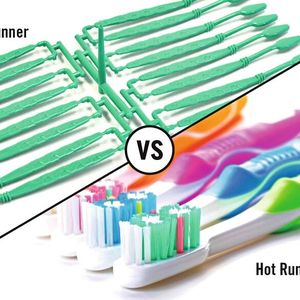
In many small-part applications, the runner can weigh significantly more than the finished component itself. This creates an ongoing material cost penalty and generates waste that is difficult or impossible to regrind when processing medical-grade materials.
Sustainability initiatives have become a key driver. Medical manufacturers are under increasing pressure to reduce waste streams throughout production. As manufacturers pursue aggressive sustainability targets and tighter margins, these inefficiencies are attracting greater scrutiny.
Material costs also continue to rise for many specialty engineering resins. When expensive polymers are being converted into runner scrap rather than saleable components, the financial impact can be significant.
Perhaps most importantly, cold runners inherently impose a cycle-time penalty. Every production cycle requires the cold runner to cool sufficiently for ejection. The additional cooling requirements reduce machine productivity and increase manufacturing costs. The result is longer cycle times, reduced productivity and higher cost per part.
As a result, many processors are searching for alternatives that eliminate waste while maintaining the process stability required for high precision applications.
Date: 08.12.2025
Naturally, we always handle your personal data responsibly. Any personal data we receive from you is processed in accordance with applicable data protection legislation. For detailed information please see our privacy policy.
Consent to the use of data for promotional purposes
I hereby consent to Vogel Communications Group GmbH & Co. KG, Max-Planck-Str. 7-9, 97082 Würzburg including any affiliated companies according to §§ 15 et seq. AktG (hereafter: Vogel Communications Group) using my e-mail address to send editorial newsletters. A list of all affiliated companies can be found here
Newsletter content may include all products and services of any companies mentioned above, including for example specialist journals and books, events and fairs as well as event-related products and services, print and digital media offers and services such as additional (editorial) newsletters, raffles, lead campaigns, market research both online and offline, specialist webportals and e-learning offers. In case my personal telephone number has also been collected, it may be used for offers of aforementioned products, for services of the companies mentioned above, and market research purposes.
Additionally, my consent also includes the processing of my email address and telephone number for data matching for marketing purposes with select advertising partners such as LinkedIn, Google, and Meta. For this, Vogel Communications Group may transmit said data in hashed form to the advertising partners who then use said data to determine whether I am also a member of the mentioned advertising partner portals. Vogel Communications Group uses this feature for the purposes of re-targeting (up-selling, cross-selling, and customer loyalty), generating so-called look-alike audiences for acquisition of new customers, and as basis for exclusion for on-going advertising campaigns. Further information can be found in section “data matching for marketing purposes”.
In case I access protected data on Internet portals of Vogel Communications Group including any affiliated companies according to §§ 15 et seq. AktG, I need to provide further data in order to register for the access to such content. In return for this free access to editorial content, my data may be used in accordance with this consent for the purposes stated here. This does not apply to data matching for marketing purposes.
Right of revocation
I understand that I can revoke my consent at will. My revocation does not change the lawfulness of data processing that was conducted based on my consent leading up to my revocation. One option to declare my revocation is to use the contact form found at https://contact.vogel.de. In case I no longer wish to receive certain newsletters, I have subscribed to, I can also click on the unsubscribe link included at the end of a newsletter. Further information regarding my right of revocation and the implementation of it as well as the consequences of my revocation can be found in the data protection declaration, section editorial newsletter.
Speaking of real-world scrap savings, an eight cavity cold-runner application that involved moulding a 0.15 g part produced about 4 g of scrap with each cycle. Transitioning to a hot runner system allowed them to double the mould capacity (16-cavity) and lowered cycle times by about 40 percent. Hot runner production eliminated cold runner scrap amounting to about 250,000 euros per year. The conversion to hot runner system for this specific application paid off within only four months.
The combination of increased output and reduced material consumption provides a powerful return-on-investment case for transitioning away from cold runner technology wherever possible. However, mould designers often face the reality that conventional hot runner systems have their limitations.
The limitation of conventional hot runner technology
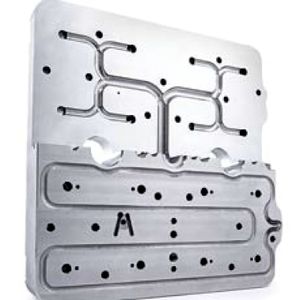
Despite the obvious advantages of hot runner systems, adoption in very small-part moulding has historically been limited. The primary challenge lies within the manifold itself. Conventional hot runner manifolds are typically manufactured using gun-drilling processes. While effective, this method imposes practical limits on how small the internal runner channels can be made. Larger flow channels result in greater melt volume within the manifold and increased residence time. For applications involving extremely low shot weights, this can create processing concerns, particularly when moulding heat-sensitive or highly engineered materials. As a result, many moulders continued to view cold runners as the safer option for micro and small-part production.
Smaller channels open new possibilities
Mold-Masters’ iFlow manifold technology has the capabilities to address these specific limitations. Unlike conventional gun-drilled manifolds, iFlow manifolds can be manufactured with melt channels as small as 2 mm in diameter. This capability allows hot runner systems to be applied in applications previously reserved for cold runners. The reduction in melt channel size delivers several important performance benefits.
Smaller channels reduce the volume of material residing within the manifold. Lower melt volume translates into reduced residence time, which can be especially beneficial when processing sensitive medical resins, engineering polymers or applications with exceptionally low shot weights. The smaller runner size capabilities of our iFlow manifolds are supported to the gate though our compact nozzle solutions are designed for small part weights. Custom solutions have been used on applications with part weights as low as 0.016 g and 9 mm pitches.
Mold-Masters’ standard and custom solutions help support the flexibility necessary in gating locations for micro parts.
Hot runner systems capable of incorporating smaller runner channels ensure residence time stays within acceptable tolerances. Depending on the material, the melt can start eroding within a short period of time. For certain grades of PBT, which can have thermal sensitivities, degradation starts after five minutes. To illustrate the differences on an application involving a part weight of 0.085 g, a conventional hot runner system would hold enough volume of material for up to 75 shots. At a 6 second cycle, residence time would be about 7.5 minutes. In a system with an iFlow manifold incorporating smaller runner channels, it would hold material for up to 24 shots with a residence time of only 2.5 minutes. This significantly improves residence times by up to 65 percent. Residence time is often critical to avoiding black spots or other defects of the part.
This capability fundamentally changes the economics of small-part production.
Improving quality through better melt management
Part quality remains the primary concern in medical and technical moulding. Reducing residence time helps preserve polymer properties and minimise the potential for material degradation. This is particularly important when processing high-value medical materials that require precise thermal control.
The smaller melt volume within an iFlow manifold also improves process responsiveness and contributes to more consistent melt delivery throughout production.
The melt flow in micro moulding is extremely sensitive to thermal variations. Precise thermal control and uniformity is essential for producing high-quality micro moulded parts. Mold-Masters’ technology supports a stable and controlled pathway for the melt from inlet to gate. iFlow manifolds and Master-Series nozzles feature Mold-Masters’ Brazed Heater technology, which ensures optimal heat conditions for small part production.
For moulders operating in highly regulated environments, consistency is often just as important as productivity. Stable melt conditions help reduce variability and support long-term process validation requirements.
Proven for micro-part applications
As miniaturisation trends continue, the industry increasingly requires technologies capable of supporting extremely small shot weights while maintaining process stability.
Mold-Masters has successfully implemented iFlow systems in applications with part weights below 0.1 grams and mould configurations containing up to 96 cavities. Supporting these demanding applications is the Mold-Masters’ Master-Series nozzle platform. Designed specifically for small-part moulding, these nozzles feature smaller internal channel diameters and are particularly well suited to inside-gated applications commonly found in medical components.
Together, the Master-Series nozzle and iFlow manifold combination provide mould makers with a practical solution for addressing the unique challenges of micro-moulding and high-cavitation small-part production.
Supporting the next generation of multi-material medical devices
Miniaturisation is not limited to single-material components. Many medical devices increasingly require multi-material or 2K constructions to achieve enhanced functionality, ergonomics or sealing performance.
To support this evolution, Mold-Masters also offers the E-Multi Mini. An all-electric, servo driven auxiliary injection unit which offers high-performance processing capabilities delivering excellent precision, repeatability, speed, and reliability.
The E-Multi product line sets the benchmark for auxiliary injection units in precision 2K moulding applications. Purpose-built for the most demanding low-shot-weight and micro-injection applications, the E-Multi Mini in compact 2K moulding environments.
The E-Multi Mini is capable of shot volumes as low as 0.1cc. It offers the additional advantages that it processes standard resin pellets rather than specialised micro pellets, which simplifies material logistics, lowers operating cost, and provides greater flexibility for manufacturers.
The E-Multi Mini has proven its ability to reliably process extremely small shot volumes using a wide range of technical resins, including materials that can be difficult to run on conventional injection moulding equipment, in various applications. This performance gives mould makers and processors greater freedom to develop increasingly sophisticated multi-material, micro-moulded, and medical components while maintaining process stability and part quality.
When combined with iFlow hot runner technology, the E-Multi Mini creates a complementary solution for manufacturers seeking to push the boundaries of miniaturisation, functionality and production efficiency.
Looking Forward
The medical moulding industry is entering an era where miniaturisation, sustainability and productivity are no longer separate objectives. Success increasingly depends on achieving all three simultaneously.
Cold runner systems have served the industry well for decades, but the growing demand for smaller parts, higher cavitation, reduced waste and improved process efficiency is accelerating the shift toward advanced hot runner solutions.
By enabling melt channels as small as 2 mm, supporting direct gating of extremely small components, and helping manufacturers reduce residence time, scrap and cycle time, Mold-Masters’ various technical solutions are helping to redefine what is possible in small-part moulding.
For European mould makers competing in an increasingly demanding global market, technologies that reduce cost per part while simultaneously improving quality and sustainability represent more than a process improvement. They provide a competitive advantage that can help shape the future of medical manufacturing.