Chip controlVibrating toolholders tackle tangled swarf in turning
Source:
Nydaloxe Precision
3 min Reading Time
Long, tangled swarf can disrupt automated turning and damage tools and components. Vibrocut Oscillate toolholders use adjustable mechanical oscillation to control chipbreaking at the cutting tip, offering a retrofit option designed to keep chips short without extending machining cycles.
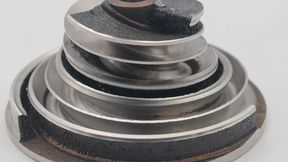
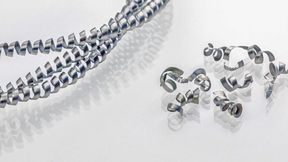
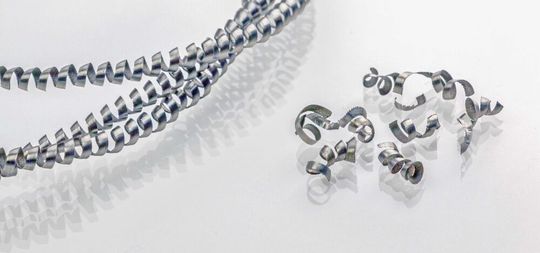
Chip form without and with Vibrocut Oscillate, left and right respectively.
(Source: Nydaloxe Precision)
Many metals and plastics tend to generate long, stringy ribbons or nests of material when turned, grooved and drilled on a lathe. It risks damaging the tool, as well as the component being produced, and reduces productivity due to the need for frequent machine stoppages to remove entangled swarf. Chipbreaker geometry moulded or ground into the face of cutting inserts helps to encourage swarf to break more frequently, but it is not enough if the workpiece material is particularly ductile.
High-pressure coolant directed to the point of cutting can help. Another way around the problem is to include canned cycles or macros into a program, but these consume extra time and reduce productivity. Some lathe manufacturers send oscillation signals to axis servo motors, but the vibration propagates through the entire mechanical drives of those axes, which takes a toll on the machine structure.
Gallery
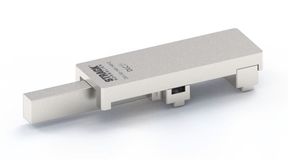
Now there is a different alternative to consider, following the invention by a German company, Vibrocut, of a range of vibrating toolholders that may be used in any driven station in the turret of a fixed-head lathe, including vertical turning centres. Vibrocut Oscillate is manufactured and distributed under license exclusively by a separate German firm, driven and static toolholder manufacturer Wendel Tools, which is represented in Britain and Ireland by Nydaloxe Precision.
For clarity, it should be noted that although the toolholder is located in a driven station in the turret, it cannot deploy a live mill, drill or other rotating cutting tool. The unit is purely used to generate reciprocating motion to assist chipbreaking when using stationary turning tools, grooving and parting blades and boring bars.
The system utilises a defined, one-dimensional tool oscillation to introduce predetermined breaking points into the swarf, ensuring robust, predictable and controllable chipbreaking, either with cut interruption (air cutting) or without. It produces short, manageable chips across all materials, including difficult-to-machine stainless steel, nickel-based alloys and plastics, regardless of cutting values, tool geometry, tool wear, or variable quality across material batches.
The technology does not extend the cutting cycle time for any given component. Oscillation is generated using a mechanical system inside the toolholder itself, whereby a mechanism converts rotation from the lathe turret's driven tool motor into axial reciprocating motion at the cutting tip, without subjecting any of the machine’s axis guideways and ballscrews to continuous oscillatory stress.
Users are able to fine-tune chip length by setting the oscillation frequency in the part program and manually adjusting the amplitude on the toolholder body. The Vibrocut Oscillate chipbreaking solution is seamlessly retrofittable across any make of lathe whose turret uses a standard toolholder interface. They include VDI 25 through to 70 and BMT 45 up to 75, with special toolholder versions available on request. The tool-side interface is Capto.
There are three product series to accommodate various production needs - compact, standard and heavy. Non-resonant, low-frequency oscillation is set between 1 to 100 Hz, stroke is adjustable up to 0.6 mm and maximum process force is 12 kN, depending on toolholder variant. Internal and external coolant supply is supported at pressures up to 20 bar.
The toolholders are available in two types to support diverse kinematic requirements: T-Line, which features oscillation at right angles to the tool drive axis; and L-Line, which provides in-line oscillation. Together, these configurations accommodate an extensive range of machining operations, including external longitudinal turning and grooving, face turning and grooving, boring and axial drilling.
Date: 08.12.2025
Naturally, we always handle your personal data responsibly. Any personal data we receive from you is processed in accordance with applicable data protection legislation. For detailed information please see our privacy policy.
Consent to the use of data for promotional purposes
I hereby consent to Vogel Communications Group GmbH & Co. KG, Max-Planck-Str. 7-9, 97082 Würzburg including any affiliated companies according to §§ 15 et seq. AktG (hereafter: Vogel Communications Group) using my e-mail address to send editorial newsletters. A list of all affiliated companies can be found here
Newsletter content may include all products and services of any companies mentioned above, including for example specialist journals and books, events and fairs as well as event-related products and services, print and digital media offers and services such as additional (editorial) newsletters, raffles, lead campaigns, market research both online and offline, specialist webportals and e-learning offers. In case my personal telephone number has also been collected, it may be used for offers of aforementioned products, for services of the companies mentioned above, and market research purposes.
Additionally, my consent also includes the processing of my email address and telephone number for data matching for marketing purposes with select advertising partners such as LinkedIn, Google, and Meta. For this, Vogel Communications Group may transmit said data in hashed form to the advertising partners who then use said data to determine whether I am also a member of the mentioned advertising partner portals. Vogel Communications Group uses this feature for the purposes of re-targeting (up-selling, cross-selling, and customer loyalty), generating so-called look-alike audiences for acquisition of new customers, and as basis for exclusion for on-going advertising campaigns. Further information can be found in section “data matching for marketing purposes”.
In case I access protected data on Internet portals of Vogel Communications Group including any affiliated companies according to §§ 15 et seq. AktG, I need to provide further data in order to register for the access to such content. In return for this free access to editorial content, my data may be used in accordance with this consent for the purposes stated here. This does not apply to data matching for marketing purposes.
Right of revocation
I understand that I can revoke my consent at will. My revocation does not change the lawfulness of data processing that was conducted based on my consent leading up to my revocation. One option to declare my revocation is to use the contact form found at https://contact.vogel.de. In case I no longer wish to receive certain newsletters, I have subscribed to, I can also click on the unsubscribe link included at the end of a newsletter. Further information regarding my right of revocation and the implementation of it as well as the consequences of my revocation can be found in the data protection declaration, section editorial newsletter.