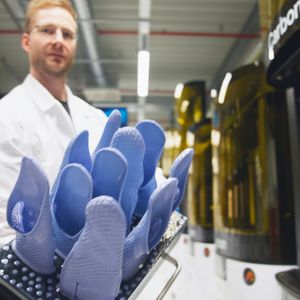
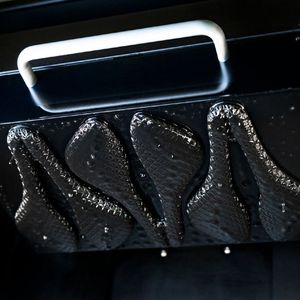
More than one million cycling saddles have been produced using Carbon’s additive manufacturing platform, with 11 brands and over 60 models now in production. Ahead of Formnext 2026, the company is highlighting how programmable lattice structures support customised cushioning and commercial-scale manufacturing.
Production partners such as Oechsler form part of Carbon's expanding global manufacturing ecosystem of over 40 partners worldwide, supporting the transition from product development to repeatable commercial manufacturing.
(Source: Carbon)
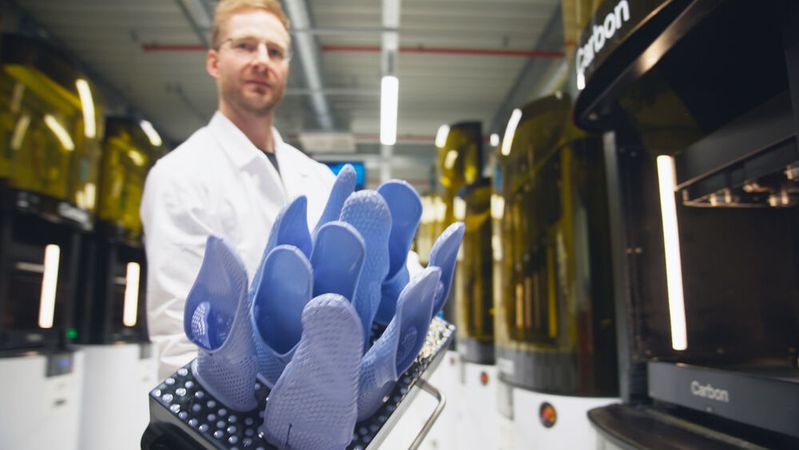
Carbon, a leading product development and manufacturing technology company, has announced that it has reached a major milestone, with more than one million cycling saddles now produced on its end-to-end additive manufacturing platform. The milestone reflects the growing role of Carbon Digital Light Synthesis™ (DLS™) in high-performance cycling, with leading brands worldwide using digitally programmed lattice structures to deliver precisely tuned cushioning, support and mechanical performance in end-use products. Carbon now partners with 11 saddle brands across the globe and has more than 60 saddle models in production.
The landmark comes ahead of Formnext 2026 (Frankfurt, November), where Carbon will put real-world production performance at the center of its show presence. At Hall 12.1, Booth F109, the company will showcase customer applications already in production with leading global brands across sectors that, as well as cycling, include custom footwear, protective equipment, mobility seating, medtech, industrial and automotive.
Gallery
“Reaching one million saddles is an important milestone, but it represents much more than a production number,” said Phil DeSimone, CEO of Carbon. “It shows what happens when digital manufacturing moves beyond prototyping and becomes a trusted way to make products at meaningful scale. Together with saddle brands and production partners, we have created an entirely new category of cycling products — moving from the first applications of lattice technology to products being ridden every day by consumers and by athletes competing at the very highest level of the sport.”
Carbon technology has become increasingly established within performance cycling, enabling brands to replace traditionally manufactured foam cushioning with programmable lattice structures whose mechanical response can be tuned across different areas of a saddle. This capability has now been proven at the highest levels of professional cycling — for example, at the 2026 Tour de France, where Tadej Pogačar once again raced on a custom fizik Argo Adaptive saddle, produced using Carbon Digital Light Synthesis™ technology and tailored through fizik’s One-to-One program to his individual pressure profile and riding position.
Selle Italia represents one of the latest brands to extend the possibilities of customizing digitally manufactured saddles with the launch of Unica, produced by Carbon partner Prototek. Unica uses pressure-mapping data captured from the individual cyclist to engineer a unique internal lattice structure around that rider’s pressure distribution, manufactured in Carbon’s EPU 46 material. Unica becomes the second fully customizable saddle made with the Carbon platform, demonstrating how digital production can make individualized performance products commercially viable — and unlock radically better products.
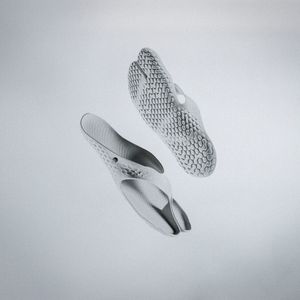
Beyond cycling, this shift is also evident across other categories, including through brand collaborations such as Vivobarefoot’s VivoBiome Tabi Gen 02, which uses a scan-to-print model powered by Carbon DLS to translate individual foot-scan data into personalized, made-to-order footwear. Together, these applications reflect how Carbon is helping brands move complex product concepts into repeatable commercial production, while making customization practical at production scale.
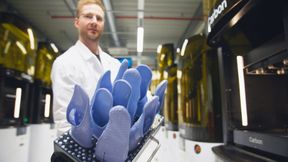
Supporting this growth is Carbon’s expanding global manufacturing ecosystem, which now includes over 40 production partners worldwide. The network enables brands to access qualified Carbon production capabilities closer to their markets, helping them transition from product development to scale commercial manufacturing and providing additional capacity as applications scale.
“The strongest proof of what Carbon can do is in the trust our customers put in Carbon technology, and the products our customers are putting into the world,” continued DeSimone. “Brands do not need more examples of what additive manufacturing might be capable of one day — they need evidence that it can deliver today. One million saddles is one very visible example of this. Similarly, if you look at our EPU Pro family of high-performance elastomers, more than 1,000 metric tons have now shipped since launch — and that is just one family of materials being used with the Carbon platform. The even bigger story, of course, is the breadth of products now being made with Carbon’s technology and the businesses building repeatable production around it. That is what we are excited to bring together at Formnext.”
Date: 08.12.2025
Naturally, we always handle your personal data responsibly. Any personal data we receive from you is processed in accordance with applicable data protection legislation. For detailed information please see our privacy policy.
Consent to the use of data for promotional purposes
I hereby consent to Vogel Communications Group GmbH & Co. KG, Max-Planck-Str. 7-9, 97082 Würzburg including any affiliated companies according to §§ 15 et seq. AktG (hereafter: Vogel Communications Group) using my e-mail address to send editorial newsletters. A list of all affiliated companies can be found here
Newsletter content may include all products and services of any companies mentioned above, including for example specialist journals and books, events and fairs as well as event-related products and services, print and digital media offers and services such as additional (editorial) newsletters, raffles, lead campaigns, market research both online and offline, specialist webportals and e-learning offers. In case my personal telephone number has also been collected, it may be used for offers of aforementioned products, for services of the companies mentioned above, and market research purposes.
Additionally, my consent also includes the processing of my email address and telephone number for data matching for marketing purposes with select advertising partners such as LinkedIn, Google, and Meta. For this, Vogel Communications Group may transmit said data in hashed form to the advertising partners who then use said data to determine whether I am also a member of the mentioned advertising partner portals. Vogel Communications Group uses this feature for the purposes of re-targeting (up-selling, cross-selling, and customer loyalty), generating so-called look-alike audiences for acquisition of new customers, and as basis for exclusion for on-going advertising campaigns. Further information can be found in section “data matching for marketing purposes”.
In case I access protected data on Internet portals of Vogel Communications Group including any affiliated companies according to §§ 15 et seq. AktG, I need to provide further data in order to register for the access to such content. In return for this free access to editorial content, my data may be used in accordance with this consent for the purposes stated here. This does not apply to data matching for marketing purposes.
Right of revocation
I understand that I can revoke my consent at will. My revocation does not change the lawfulness of data processing that was conducted based on my consent leading up to my revocation. One option to declare my revocation is to use the contact form found at https://contact.vogel.de. In case I no longer wish to receive certain newsletters, I have subscribed to, I can also click on the unsubscribe link included at the end of a newsletter. Further information regarding my right of revocation and the implementation of it as well as the consequences of my revocation can be found in the data protection declaration, section editorial newsletter.