Switching between fine-detail printing and high material throughput, a variable nozzle enables Herrmann Additive to produce large plastic components directly from pellets. Its VFGF process offers an alternative to tooling-based production, with applications ranging from lightweight automotive fixtures to a 205 kg pipe elbow.
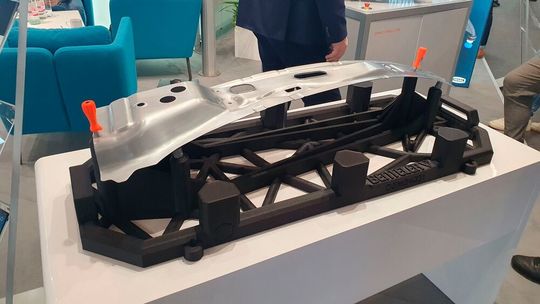
Large-format 3D printing application: an automotive inspection fixture that is precise and light enough to handle without a crane.
(Source: Herrmann Additive)
The team behind the Queen 1 is back with a new concept: Herrmann Additive produces large plastic components using 3D extrusion printing, acting as a development partner and full-service provider. From feasibility assessment to installation-ready components, the company offers cost-effective production. It has been operating successfully with this business model since 2025. Four Queen 1 systems are in operation at Herrmann Additive, with a fifth to follow by the end of 2026. More than 5,000 kg of material has been printed. The largest individual project in the company’s history has been completed, and an EN 45545-certified material is already proving its suitability in railway applications.
The key to producing XXL components is Herrmann Additive’s VFGF process (Variable Fused Granulate Fabrication). Rapid component availability, short lead times and substantial potential cost savings compared with tooling-based processes are among the characteristics of this manufacturing approach. Using plastic pellets rather than expensive polymer filament makes production cost-effective from single parts through to medium-sized production runs. Its distinctive feature is a variable nozzle (Variable Fusing), which can switch between turbo and detail modes as the component is built. This flexibility enables high build rates for large 3D components. Interested customers can have their application assessed through a free feasibility check.
The central element of the VFGF process is a variable nozzle for material deposition. The “V” stands for “Variable”, supplementing “FGF”, or Fused Granulate Fabrication, which refers to 3D extrusion printing with pellets.
What distinguishes a variable nozzle? It can print quickly at high material throughput in turbo mode, for example in infill areas inside the geometry, while ensuring high precision elsewhere on the component in detail mode. The variable nozzle on Herrmann Additive’s Queen 1 system uses a combination of 1.5 mm for detail mode and 3 mm for turbo mode, depositing material layer by layer, as 3D printers generally do. This enables cost-effective production of very large components without tooling, combining high resolution with short production times and low material costs. Maximum travel speed is 500 mm/s, while material output can vary between 150 and 2,000 g/h.
In detail mode, the variable nozzle produces fine features. These might include a surface requiring an accurate finish for high-gloss painting or features designed to accommodate fasteners. Component requirements may also include slopes or overhangs requiring support structures, as well as bridges or thin-walled bosses. This enables the production of complex or thin-walled components. Limited geometric freedom has previously been the main constraint in 3D printing with plastic pellets.
Turbo mode, by contrast, enables the short build times needed to make additive manufacturing of very large components economically competitive with conventional processes such as injection moulding, milling, hand lay-up or rotational moulding. Turbo mode is selected for infill areas or reinforcing ribs on the rear of components in non-visible areas.
During design, the printing instructions for the Queen 1 system specify which areas of the component require detail or turbo mode, with simulations used to validate these choices. This also gives designers scope to use bio-inspired structures and reduce material consumption through lightweight design.
Dennis Herrmann, Managing Director of Herrmann Additive, says: “We are back with a concept that works: today, our focus is on the finished component for our customers. Our experience from seven years of machine development goes into every component we deliver. Specifically, we see ourselves as a development partner for customers for whom tooling-based processes are not an option because of low production volumes.”
Date: 08.12.2025
Naturally, we always handle your personal data responsibly. Any personal data we receive from you is processed in accordance with applicable data protection legislation. For detailed information please see our privacy policy.
Consent to the use of data for promotional purposes
I hereby consent to Vogel Communications Group GmbH & Co. KG, Max-Planck-Str. 7-9, 97082 Würzburg including any affiliated companies according to §§ 15 et seq. AktG (hereafter: Vogel Communications Group) using my e-mail address to send editorial newsletters. A list of all affiliated companies can be found here
Newsletter content may include all products and services of any companies mentioned above, including for example specialist journals and books, events and fairs as well as event-related products and services, print and digital media offers and services such as additional (editorial) newsletters, raffles, lead campaigns, market research both online and offline, specialist webportals and e-learning offers. In case my personal telephone number has also been collected, it may be used for offers of aforementioned products, for services of the companies mentioned above, and market research purposes.
Additionally, my consent also includes the processing of my email address and telephone number for data matching for marketing purposes with select advertising partners such as LinkedIn, Google, and Meta. For this, Vogel Communications Group may transmit said data in hashed form to the advertising partners who then use said data to determine whether I am also a member of the mentioned advertising partner portals. Vogel Communications Group uses this feature for the purposes of re-targeting (up-selling, cross-selling, and customer loyalty), generating so-called look-alike audiences for acquisition of new customers, and as basis for exclusion for on-going advertising campaigns. Further information can be found in section “data matching for marketing purposes”.
In case I access protected data on Internet portals of Vogel Communications Group including any affiliated companies according to §§ 15 et seq. AktG, I need to provide further data in order to register for the access to such content. In return for this free access to editorial content, my data may be used in accordance with this consent for the purposes stated here. This does not apply to data matching for marketing purposes.
Right of revocation
I understand that I can revoke my consent at will. My revocation does not change the lawfulness of data processing that was conducted based on my consent leading up to my revocation. One option to declare my revocation is to use the contact form found at https://contact.vogel.de. In case I no longer wish to receive certain newsletters, I have subscribed to, I can also click on the unsubscribe link included at the end of a newsletter. Further information regarding my right of revocation and the implementation of it as well as the consequences of my revocation can be found in the data protection declaration, section editorial newsletter.
Application example: a complex, thin-walled functional prototype for caravan manufacturing
Polyamide GF25 was processed on the Queen 1 to produce a complex, thin-walled functional prototype for caravan manufacturing, using a layer height of 0.4 mm. The material was selected for its flame retardancy and properties close to those of the intended production material.
The component weighs 31 kg, including support structures. Printing the accurate component with its fine surface finish took 128 hours. Short lead times and the elimination of tooling costs were the decisive factors in the customer’s choice of VFGF.
Application example: a precise, lightweight assembly and inspection fixture for automotive production
Assembly and inspection fixtures are important applications for 3D printing because of their low production volumes. Herrmann Additive produced a 1.3 m-long inspection fixture for an automotive supplier using polyamide reinforced with 25 percent glass fibre (PA GF25). It was printed in less than 24 hours, with a positional tolerance tighter than ±0.2 mm over one metre of component length.
For the customer, however, weight was the decisive factor: the fixture weighs just 8 kg. In this case, lightweight design means that an operator can now carry it under one arm to where it is needed. Previously, a crane was required.
Application example: a large, functional pipe elbow for a hydroelectric power plant
The pipe elbow is a 205 kg component that must connect accurately to adjoining pipes, form leak-tight joints and withstand high operating pressures. PLA (polylactic acid) was selected as the material.
Layer heights across the component range from 0.4 to 1.2 mm. Due to its large volume, printing took 340 hours. The key criteria for the user were rapid availability, with delivery in four weeks instead of 16, significantly shorter development times and, above all, a 50 percent cost saving compared with a conventional manufacturing process.



:quality(80)/p7i.vogel.de/wcms/b0/7a/b07a7095a06502f296a68cc23c0333fd/0133339310v4.jpeg "The positive trends experienced in the machine tool industry are continuing into the second quarter: incoming orders increased by 12 percent compared to the previous year. (Source: VDW)")
:quality(80)/p7i.vogel.de/wcms/4b/e2/4be222cca85fc9ccbdf26c552cfc3c4c/0132990447v1.jpeg "A research project highlights potential of high-quality material loops for cars. (Source: BMW Group)")
:quality(80)/p7i.vogel.de/wcms/55/47/55478646728684cec46485443d736f85/0132634476v1.jpeg "Geopolitical tensions and weak demand weighed heavily on Italy's machine tool industry (Source: free licensed / KI-generiert)")
:quality(80)/p7i.vogel.de/wcms/2f/7a/2f7ac201c1abc14dc40a30d947684069/0132348722v1.jpeg "The Nova5e110T, a latest-generation all-electric injection moulding machine, produces a food-packaging application using liquid silicone rubber injection moulding. (Source: Negri Bossi)")
:quality(80)/p7i.vogel.de/wcms/ca/7f/ca7fe83775a6375546830e0c35d4d437/0133611107v2.jpeg "From 2027 onwards, Plastifocus will be jointly organized by Messe Düsseldorf India and PMMAI. (Source: Plastifocus)")
:quality(80)/p7i.vogel.de/wcms/8e/25/8e2561d12b8caeba7125507a0c957e6e/0133564611v1.jpeg "Nexgem brings together companies from the worlds of mechanical engineering, IT and software. (Source: VDW)")
:quality(80)/p7i.vogel.de/wcms/48/a5/48a599231b179ed4c8f2fc4f00fc80ac/0133459364v2.jpeg "Fakuma 2026 will mark its 30th edition in Friedrichshafen from 12 to 16 October, with around 1,600 exhibitors from 40 countries, innovation awards, expert discussions and career initiatives. (Source: Fakuma)")
:quality(80)/p7i.vogel.de/wcms/13/22/13224a29676f9fba818db663bcc63729/0133443239v1.jpeg "That’s a wrap for another AMB in Stuttgart. In around two years, metalworking innovations will once again take centre stage in Baden-Württemberg. Here, the organiser and industry representatives reflect on this year’s event ... (Source: Th. Wagner / Messe Stuttgart)")
:quality(80)/p7i.vogel.de/wcms/bf/4c/bf4c62c3279e5188bcd48126a83da56c/0133748224v2.jpeg "Bottle insert for blow moulding (Source: Ampco)")
:quality(80)/p7i.vogel.de/wcms/4e/0b/4e0bfa9522bc2c8b0bd07e1dd310eff9/0133682273v1.jpeg "By expanding in-house production, more products can be manufactured directly in Lüdenscheid. (Source: Hasco)")
:quality(80)/p7i.vogel.de/wcms/ab/e1/abe112310480fe1d8f690c0289c4dda2/0133694152v2.jpeg "Temperature-control flow diverters ensure uniform flow cross-sections. (Source: Nonnenmann)")
:quality(80)/p7i.vogel.de/wcms/18/cb/18cbc67d9db9584a02e1cb87adeb4955/0133336478v1.jpeg "The Meusburger compact slide 1:1 E 6100 was specially designed for use in stamping. (Source: Meusburger)")
:quality(80)/p7i.vogel.de/wcms/19/ea/19ead0e1b537e322629604b4e5c9a30b/0133747715v2.jpeg "Large-format 3D printing application: an automotive inspection fixture that is precise and light enough to handle without a crane. (Source: Herrmann Additive)")
:quality(80)/p7i.vogel.de/wcms/5d/3e/5d3ef4c4bdab296c816e624b38e624c6/0133609076v2.jpeg "BMFs PSL micro-precision 3D printing enables complex 3D microfluidic channels and intricate internal geometries for rapid design validation (Source: BMF)")
:quality(80)/p7i.vogel.de/wcms/32/44/32440bdff907b379245f456130355549/0133341463v1.jpeg "Stratasys F870 FDM system, a large-format additive manufacturing platform designed for industrial manufacturers, automotive OEMs, aerospace & defense production lines, looking to scale production on the factory floor. (Source: Stratasys)")
:quality(80)/p7i.vogel.de/wcms/f6/6e/f66e3f322d7e2a8fe7e80f808c67e607/0133319745v2.jpeg "Formnext brings together the global AM community and showcases the latest innovations in industrial 3D Printing and advanced production technologies. (Source: Mesago / Marc Jacquemin)")
:quality(80)/p7i.vogel.de/wcms/45/01/4501752ebc868bfb7b476a2a163f8ecc/0133744823v1.jpeg "(Source: Yamazaki Mazak )")
:quality(80)/p7i.vogel.de/wcms/2e/16/2e164579148a37acfe863dd3fbd9efb4/0133610821v2.jpeg "The FG-400 Neo, built for large-scale heavy-duty structural tube processing, will also be on display at Euroblech 2026. (Source: Mazak)")
:quality(80)/p7i.vogel.de/wcms/24/07/2407a4874f3c763937892a12e3e7d125/0133564963v2.jpeg "(Source: Walter)")
:quality(80)/p7i.vogel.de/wcms/03/8e/038ec919753fabff71f6e3473c772f74/0133130761v2.jpeg "The core reason behind the adoption of humanoid robots in the manufacturing or tool and mould making industry is the lack of labour in these markets. (Source: © Maksudul - stock.adobe.com)")
:quality(80)/p7i.vogel.de/wcms/4d/da/4dda0d3b2a4c0b1c1e21dc2deba9264e/0133445150v1.jpeg "Capture machine data in real time and display it clearly with Hummingbird. (Source: Open Mind)")
:quality(80)/p7i.vogel.de/wcms/e1/7d/e17db1eab6fedf3237a12e0ffb739cb9/0133378692v2.jpeg "Meet at the Machine is Siemens’ new initiative designed to bring together machine builders, software and automation technologies to accelerate innovation across the machine tool industry and help manufacturers achieve productivity faster. (Source: Siemens)")
:quality(80)/p7i.vogel.de/wcms/da/36/da36247b3e7af69fece5d3840ab65dd5/0133337118v1.jpeg "Eva understands questions asked in natural language, detects deviations in the process, and suggests concrete solutions — an assistant that goes well beyond a typical chatbot. (Source: Engel)")
:quality(80)/p7i.vogel.de/wcms/66/ce/66cee106850827fbcf9a46eb0682f3d0/0133197817v1.jpeg "Designed for maximum flexibility, the Solidcam Simulator is a fully self-contained simulation system that runs independently. (Source: Machine Works)")
:quality(80)/p7i.vogel.de/wcms/9f/d6/9fd6f5e480734eb5fea4560d6cfdf484/0132969018v1.jpeg "Meusburger blocks for eroding with starting hole and thread (Source: Meusburger)")
:quality(80)/p7i.vogel.de/wcms/5f/66/5f66d32bcf6e2e2fb01b3d98f1c33930/0131994480v1.jpeg "A Mitsubishi Electric MV2400S wire-cut EDM machine will be the first demonstration model to arrive at the Kenilworth showroom and technical centre of recently-appointed sales agent, Whitehouse Machine Tools. (Source: Whitehouse Machine Tools)")
:quality(80)/p7i.vogel.de/wcms/d5/1d/d51def0b31e213e756bbfb9479fa9c7e/0129925621v2.jpeg "Automatic electrode feeding: Together with Sodick and Erowa, the Robot Compact 80 (ERC80) was integrated — including connection to the Zeiss measuring machine and chip-based job management. (Source: Sodick)")
:quality(80)/p7i.vogel.de/wcms/f9/ca/f9ca9cace88200a5ec0946f193264963/0129209504v1.jpeg "Neil Taylor, who has worked in the toolroom at Pre-Met for 20 years. (Source: Pre-Met)")
:quality(80)/p7i.vogel.de/wcms/c8/5b/c85b37436b1df84a1bfe39b5c6d1e201/0133199632v1.jpeg "Enspec is a new professional-grade bridge coordinate measuring machine (CMM) designed to make high-precision inspection more accessible for manufacturers and subcontractors. (Source: Hexagon)")
:quality(80)/p7i.vogel.de/wcms/73/44/73448e9feaa91c6c35ad23c500d770c1/0133160891v1.jpeg "Smartshot i is an intelligent cold runner system for LSR injection moulding. (Source: Elmet)")
:quality(80)/p7i.vogel.de/wcms/d6/ba/d6ba94485018261fa2476c7233b3c1ee/0132634611v1.jpeg "The new AI Knowledge Assistant, delivers natural language responses drawn from the full product documentation library, enabling faster onboarding and reducing the learning curve for new users. (Source: Metrologic DCS )")
:quality(80)/p7i.vogel.de/wcms/b6/77/b677375070249449de37c041cc40ec87/0132635157v1.jpeg "Simulation of sweep scanning inspection of a turbine blade in LK Metrology’s Camio 2026 R1 programming, analysis and reporting software, which now provides comprehensive support for Renishaw’s Revo 5-axis scanning probe system. (Source: LK Metrology)")
:quality(80)/p7i.vogel.de/wcms/af/60/af6036fa7db7018cbe579fe969ee5ff9/0133608414v1.jpeg "Pictured is the zero-point interface version of the Easyfix automatic vice from DMG Mori, which clamps a succession of workpieces of different size in automated manufacturing processes, without the need for manual intervention. (Source: DMG Mori)")
:quality(80)/p7i.vogel.de/wcms/1f/52/1f5247c5477670cf53dc07472f04163c/0133600239v1.jpeg "A Stark.spheric three-point workholding arrangement for supporting an irregularly shaped part, or one that has distorted after stresses have been released after initial machining. Clamping is effected by the Stark.spheric pedestals pulling down on threaded studs previously attached to the underside of the component (or its fixture). (Source: Roemheld)")
:quality(80)/p7i.vogel.de/wcms/c7/0c/c70ce96cc0e31dd84ca136e5f580b010/0133561039v1.jpeg "Diagram show the interface between an EWS Varia base unit (right), which remains in the lathe turret, and a toolholder and cutter mounted in a quick-change adapter. This rapid tool exchange mechanism is used across the company’s entire range of VX, VXT and VXP lathe toolholders. (Source: EWS)")
:quality(80)/p7i.vogel.de/wcms/ca/d1/cad1c8eeb1436e5df9a72b11101b7df5/0133377800v1.jpeg "The STC0440-BT40 now gives manufacturers and integrators a high-power platform for material-removal tasks. (Source: Pushcorp)")
:quality(80)/p7i.vogel.de/wcms/0b/08/0b08341f8be2aa039063d7585d16e204/0133087099v1.jpeg "The Ruby Dark Mold Polishing Stone is designed for controlled material removal and consistent surface finishes in demanding mold polishing applications. (Source: Jacqueline Southby/ Boride)")
:quality(80)/p7i.vogel.de/wcms/44/e0/44e0d70e930c0ee85447518eda459259/0132763637v2.jpeg "The Focus was developed to meet changing requirements in parts cleaning. This cost-effective solvent cleaning system ensures a high level of cleanliness even with a relatively low cleaning volume. (Source: Karl Roll)")
:quality(80)/p7i.vogel.de/wcms/b8/6f/b86f649863182a925480692939ac91f8/0131684985v1.jpeg "Extreme high-speed Laser Material Deposition (EHLA) enables the additive deposition of functional surfaces with high precision and speed. This allows components to be efficiently coated, repaired, or manufactured with close-to-final-contour precision. (Source: Fraunhofer ILT)")
:quality(80)/p7i.vogel.de/wcms/d5/05/d5057e4ec3f7c3acbed8a4241d0683c6/0131673703v2.jpeg "Copper gauze for cleaning and polishing exposed round or conical surfaces. (Source: Guill)")
:quality(80)/p7i.vogel.de/wcms/5a/e5/5ae5dfc67c07f0ca8347161642c36df3/0130721540v1.jpeg "Müller Präzisionswerkzeuge supports its customers with customised, application-specific tools. (Source: Müller)")
:quality(80)/p7i.vogel.de/wcms/2a/08/2a08f8bd2df95ca843d52cbce64bf355/0131212753v1.jpeg "It has taken time, but the full force of the government’s steel policy is beginning to have a devastating impact on the downstream manufacturing sector according to the President of the Confederation of British Metalforming (CBM). (Source: CBM)")
:quality(80)/p7i.vogel.de/wcms/9e/bd/9ebd826ceed28c644a9205bdbf82beb4/0131007997v2.jpeg "The lead-free aluminium solutions that combine high performance with stable and reliable machining processes. (Source: Eural Gnutt)")
:quality(80)/p7i.vogel.de/wcms/d5/e6/d5e68c74fabff18ef737ee767b7b359f/0130415707v1.jpeg "Efficiency in machining and a reduced carbon footprint will be at the centre of Swiss Steel Group’s presentation at Wire 2026 in Düsseldorf. (Source: Swiss Steel Group)")
:quality(80)/p7i.vogel.de/wcms/81/f6/81f64931beca3c0adaee49112bba9181/0133742651v2.jpeg "Dr Martin Kováčik, Executive Vice President Thermoplast Sales and Service EMEA at Shibaura Machine LWB, and Tomaž Rihtaršič, Managing Director of Triproject Bled, have agreed on a partnership covering Croatia and Slovenia with immediate effect. (Source: Shibaura Machine LWB)")
:quality(80)/p7i.vogel.de/wcms/eb/2e/eb2ec2f935e6eded7702883eb129e64e/0133564614v2.jpeg "Gerald Bloom, Chairman of Big Bear Plastic Products in Droitwich, was given the Lifetime Achievement Award at the National Family Business Dinner for his 70-year contribution to industry. (Source: Big Bear Plastic Products)")
:quality(80)/p7i.vogel.de/wcms/c0/b8/c0b806ad8153cc46307de1b9142504e0/0133449473v2.jpeg "Peter Jungwirth will assume the role of Managing Director of Engel Serbia. (Source: Engel)")
:fill(fff,0)/p7i.vogel.de/companies/66/0e/660e93698db24/hasco-logo-or-b50.jpeg "hasco-logo-or-b50 (HASCO)")
:fill(fff,0)/images.vogel.de/vogelonline/companyimg/26200/26226/65.jpg "Logo.jpg ()")
:fill(fff,0)/p7i.vogel.de/companies/67/d9/67d95fe309f52/logo-300-169-rgb.jpeg "logo-300-169-rgb (AMPCO METAL)")
:quality(80)/p7i.vogel.de/wcms/34/3b/343bae5fbd0e49b6aeceb1f42c2040e2/0127807331v2.jpeg "3D pellet printing in the USA: an Exam 255 at the Fraunhofer USA Center Midwest in East Lansing, Michigan. (Source: Aim 3D)")
:quality(80)/p7i.vogel.de/wcms/a1/23/a12340b69bf99dc99c02a71e29ff364b/0133745641v1.jpeg "The VFGF extrusion printhead with variable nozzle diameter enables controlled component build-up (schematic).(Source: Herrmann Additive)")
:quality(80)/p7i.vogel.de/wcms/a2/10/a210e4355ca69deebb9db095ebfb2393/0133745637v1.jpeg "Large-format 3D printing application: a rear light carrier produced as a complex, thin-walled functional prototype for caravan manufacturing.(Source: Herrmann Additive)")
:quality(80)/p7i.vogel.de/wcms/b1/9f/b19f9e65942162bd7b58bb98cf0f7507/0133745639v1.jpeg "Large-format 3D printing application: an automotive inspection fixture that is precise and light enough to handle without a crane.(Source: Herrmann Additive)")
:quality(80)/p7i.vogel.de/wcms/93/2c/932cd0fc56603fb3cd6edd8c2142d3c0/0133745634v1.jpeg "Large-format 3D printing application: a large, functional pipe elbow for hydroelectric power plants.(Source: Herrmann Additive)")
:quality(80)/p7i.vogel.de/wcms/2e/16/2e164579148a37acfe863dd3fbd9efb4/0133610821v2.jpeg "The FG-400 Neo, built for large-scale heavy-duty structural tube processing, will also be on display at Euroblech 2026. (Source: Mazak)")
:quality(80)/p7i.vogel.de/wcms/d6/85/d685f438a6430ad866e2fe56536e51c4/0131826173v1.jpeg "Schematic of photopolymerisation-extrusion coupled moulding: rheology, UV curing, precision-defect trade-off. 3 strategies (UV stepping, filler optimization, molecular engineering) yield isotropic, dense, crack‑free ceramics with strong, low-shrinkage. (Source: Linzhe Zhang/Yanshan University, et. al)")