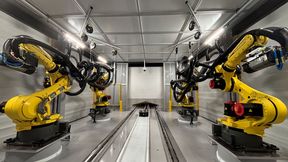
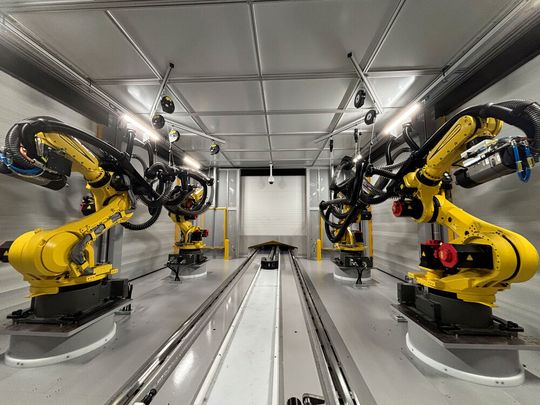
Matching machining accuracy to the application can open up alternatives to large CNC machine tools. Fives’ Liné Machines Robo TDM targets large components with tolerances around 0.1 mm, combining robotic flexibility with milling, trimming and drilling capabilities. Development trials reportedly cut cycle times by up to 70 per cent in trimming and milling.
With Robo TDM, set up is quicker and programming is easier, all while negating the cost and footprint of a large CNC machine.
(Source: Fives)
Machining large components requires a large CNC machine tool, right? Well, not always. What happens when the required tolerance is measured in tenths rather than hundredths of a millimeter? For some applications, investing in a CNC machine results in paying for unnecessary capability. Fives High Precision Machines (Fives HPM) provides a different approach with the Liné Machines Robo TDM, a high-precision robotic machining solution that brings direct milling, trimming, and drilling to large workpieces.
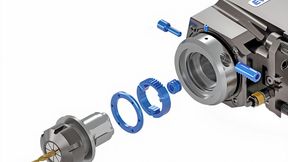
Not every large component demands ultra-high precision. For applications where tolerances down to approximately 0.1 mm are acceptable, the Liné Machines Robo TDM provides a highly attractive alternative. By equipping an industrial robot with a specialized end effector incorporating a spindle, toolholder, and cutter, the system can perform material removal directly on the workpiece.
The result is a flexible approach to large-part machining that reduces equipment requirements while delivering significant productivity gains. Potential operations include metal face milling or deburring, such as removing burrs from castings and trimming excess weld beads. It could also include drilling pilot holes on large aerospace panels or automotive body parts, as well as trimming, routing, drilling, edge contouring, and pocketing on large composite or thermoplastic fabrications.
Matching the machine to the tolerance
Using a CNC machine tool for these applications will typically involve substantial set-up time and programming. The Liné Machines Robo TDM, part of Fives’ Material Removal (MR) business line, changes the equation. Rather than bringing the entire component into a large machine envelope, the machining capability is brought directly to the workpiece.
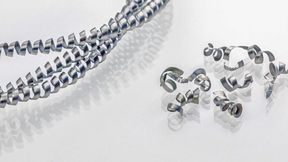
For suitable applications, this strategy can deliver major advantages in flexibility, cost and cycle time. A Fives’ R&D project and development trials spanning several years have demonstrated cycle time reductions of up to 70 percent in trimming and milling, with some individual applications achieving even greater savings.
The technology therefore addresses a simple but increasingly important manufacturing question: does the application actually necessitate a large CNC machine, or does it simply require a reliable and accurate way of putting a cutting tool in the right place?
Closing the accuracy gap
Industrial robots have traditionally struggled to answer that question. Their inherent flexibility comes at the expense of positional accuracy, with conventional systems typically achieving tolerances of around 0.3 mm — insufficient for many machining applications.
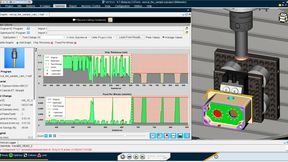
The development work for Robo TDM focused on closing the accuracy gap through high-precision robotic machining (HPRM). Here, robot calibration techniques, together with advanced look-ahead and motion-planning algorithms, allow the processing of programs containing more than one million points without the latency that can otherwise compromise robot motion. The result is smoother trajectory execution, supporting multi-axis contouring and complex machining operations in a way that is more closely comparable with CNC machining.
According to the company Robo TDM can reduce machining deviation up to 100 μm (0.1 mm). This represents a threefold improvement over conventional robotic accuracy and changes the range of applications for which robotic machining becomes viable.
A robot built for machining
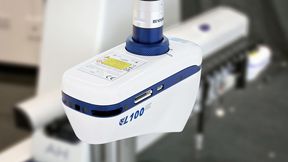
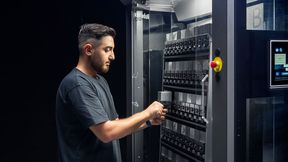
It is possible to configure the machining end effector with different spindle sizes, power ratings, torque, and speed according to the task. Available systems can provide spindle power of up to 125 kW, torque of up to 80 Nm, and speeds reaching 30,000 rpm, with HSK A63, HSK F63, or HSK A100 taper toolholders.
In addition, Robo TDM can incorporate automatic tool changing, tool measurement, tool-breakage detection, and part probing, while a vision system can support drilling applications.
Date: 08.12.2025
Naturally, we always handle your personal data responsibly. Any personal data we receive from you is processed in accordance with applicable data protection legislation. For detailed information please see our privacy policy.
Consent to the use of data for promotional purposes
I hereby consent to Vogel Communications Group GmbH & Co. KG, Max-Planck-Str. 7-9, 97082 Würzburg including any affiliated companies according to §§ 15 et seq. AktG (hereafter: Vogel Communications Group) using my e-mail address to send editorial newsletters. A list of all affiliated companies can be found here
Newsletter content may include all products and services of any companies mentioned above, including for example specialist journals and books, events and fairs as well as event-related products and services, print and digital media offers and services such as additional (editorial) newsletters, raffles, lead campaigns, market research both online and offline, specialist webportals and e-learning offers. In case my personal telephone number has also been collected, it may be used for offers of aforementioned products, for services of the companies mentioned above, and market research purposes.
Additionally, my consent also includes the processing of my email address and telephone number for data matching for marketing purposes with select advertising partners such as LinkedIn, Google, and Meta. For this, Vogel Communications Group may transmit said data in hashed form to the advertising partners who then use said data to determine whether I am also a member of the mentioned advertising partner portals. Vogel Communications Group uses this feature for the purposes of re-targeting (up-selling, cross-selling, and customer loyalty), generating so-called look-alike audiences for acquisition of new customers, and as basis for exclusion for on-going advertising campaigns. Further information can be found in section “data matching for marketing purposes”.
In case I access protected data on Internet portals of Vogel Communications Group including any affiliated companies according to §§ 15 et seq. AktG, I need to provide further data in order to register for the access to such content. In return for this free access to editorial content, my data may be used in accordance with this consent for the purposes stated here. This does not apply to data matching for marketing purposes.
Right of revocation
I understand that I can revoke my consent at will. My revocation does not change the lawfulness of data processing that was conducted based on my consent leading up to my revocation. One option to declare my revocation is to use the contact form found at https://contact.vogel.de. In case I no longer wish to receive certain newsletters, I have subscribed to, I can also click on the unsubscribe link included at the end of a newsletter. Further information regarding my right of revocation and the implementation of it as well as the consequences of my revocation can be found in the data protection declaration, section editorial newsletter.
However, machining is not the only technology suitable for integration. Robo TDM systems are also configurable for processes including waterjet cutting, laser profiling, and ultrasonic cutting.
Large-scale flexibility
The physical flexibility of a robot is again valuable when manufacturing components that are too large or awkward to justify moving through a conventional machine tool.
Robo TDM is configurable with multiple workstations and customized peripheral equipment, while its relatively modest foundation requirements simplify installation compared with a large CNC machine tool. This factor can prove particularly attractive in sectors such as aerospace, defense, maritime, and energy, where component dimensions can be substantial and production requirements vary considerably.
The technology does not pretend to solve every machining challenge. Where tolerances tighter than 0.1 mm are necessary, a high-precision CNC machine remains the appropriate choice. In this respect, Robo TDM is complementary to Liné Machines' and the wider Fives HPM portfolio of high-precision machine tools.
Precision at scale takes different forms
Robo TDM represents another interpretation of Fives HPM's ‘precision at scale’ cross-brand mantra. In this case, scale means finding a smarter way to manufacture large components while applying precisely the level of accuracy demanded by the application.
The technology also illustrates the value of bringing specialist capabilities of many individual brands together under the newly unified Fives HPM banner. Here, the Liné Machines brand contributes decades of expertise and pioneering in large-scale milling and material-removal processes.
Engineered for the application
The development of Robo TDM originated directly from the requirements of customers. It reflects Fives HPM's approach to engineering solutions around specific manufacturing challenges rather than forcing applications to fit standard equipment.
Notably, Fives Liné Machines Inc, now parts of Fives HPM, has had a strong presence on the North American continent for almost 50 years with its facility in Granby, Quebec, Canada. The manufacturing plant produces both Liné CNC machine tools and robotic solutions, including the Robo TDM. The site also provides access to support activities that include engineering, integration, automation, service, training, and more across equipment lifecycles.
Ultimately, by achieving a level of accuracy that is sufficient for a range of large-part applications, Robo TDM gives manufacturers another option between conventional robotics and the cost of a large CNC machine tools. For the right component, it can mean lower capital investment, simpler installation, greater flexibility, and dramatically shorter cycle times.