In mould and die making, individual machining processes are increasingly being combined into automated production cells with integrated handling. The main advantage is a higher degree of machine utilisation, as the systems can operate unattended 24/7. Two prerequisites for realisation of such autonomous systems are more intensive digitalisation of the processes consistent with Industry 4.0 and an increased level of investment.
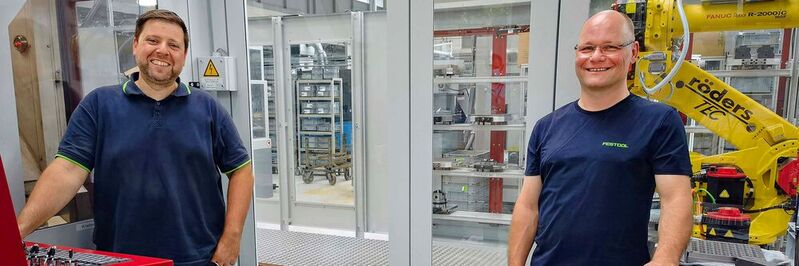
Festool's Tomislav Jurisa (left) and Jürgen Kopsieker are happy with their automated toolmaking cell.
(Source: Hurco)
One company that has followed the route of automation is German power tool manufacturer Festool, which produces complex die casting mould tools and plastic injection moulds for producing its products at a factory in Neidlingen. The toolmaking department has installed a robotic production cell based on machining centres manufactured by German firm, Roeders. Similar technology is available in the UK and Ireland through the latter's sole agent, Hurco Europe, High Wycombe.
Jürgen Kopsieker, head of tool and mould making in Neidlingen explained that his department has to compete with other toolmakers to win business from within the group, while it is also free to offer its services on the open market. The department therefore has no option but to organise itself as a profit centre to ensure it keeps up with market demands in terms of quality, technology and price.
About three years ago the manufacturer still had an old-style toolmaking department with five individual machines, three machining centres including a 5-axis model plus a wire and a die-sink EDM machine. “All were constantly supervised by operators who, in addition to monitoring the machining processes, were responsible for fixturing workpieces, loading and unloading the machines, and setting and changing tools. In addition, supervisors took care of quality assurance,” Manufacturing team coordinator Tomislav Jurisa remembers. Utilisation of the machines was therefore unsatisfactory so at this point, in mid-2019, the company decided to comprehensively upgrade the shop. “We wanted an automated manufacturing cell in which milling, EDM, coordinate measuring and aqueous cleaning were fully integrated”, says Jurisa.
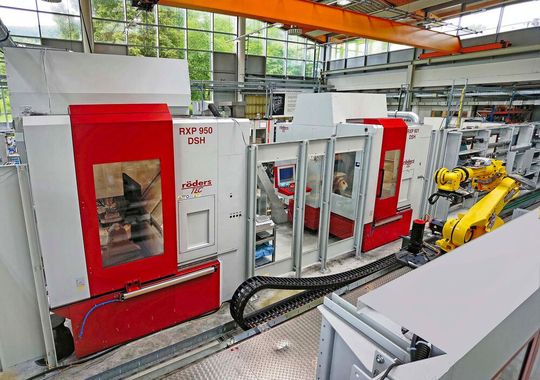
The core of the automated toolmaking cell at Festool's Neidlingen facility are two Roeders RXP machining centres and a handling robot on a linear rail.
(Source: Hurco)
Additionally, to ensure completely unattended operation, the firm was keen to add storage facilities for milling cutters and electrodes, as well as for workpieces mounted on Erowa pallets, with all transport tasks performed by a handling robot. The idea was that operators would simply supply the cell with workpieces and tools and create the NC programs.
Realisation of this goal became the responsibility of Roeders, which was chosen for the project for two reasons. First, other companies within the Festool group had many years of experience operating Roeders machining centres and reported that they are reliable and precise. Second, the supplier could point to numerous successful installations of complete solutions based on automated manufacturing cells, including the integration of third-party products from a range of different sources.
To implement the installation, Roeders supplied two of its RXP 5-axis machining centres and RMS Main job manager software, which is linked to Festool's IK Office enterprise resource planning system. It also supplied a Fanuc R-2000iC handling robot running on a linear rail. Located within the cell also are a Hexagon coordinate measuring machine, an Exeron die-sink EDM machine and an automatic washing system from Mafac.
In addition, a storage room accommodates 110 palletised workpieces and 258 tools, which is supplemented by the capacity of the tool magazines in the machining centres themselves.
Within the cell, a Roeders RXP 601 DSH is used mainly for hard machining. Materials include 1.2343 hot work tool steel and sometimes 1.2379 cold work tool steel.
Raw material is rough machined in the hardened condition (54 — 60 HRC) and subsequently finished while still in the same fixture. Compared with the previous procedure of roughing in the soft state, then hardening and finally finishing in a second operation, the new method is significantly faster and less expensive. Cost savings are principally the result of significant reductions in manual operations.
Kopsieker enthused, “I am thrilled about how well the individual elements in the cell work together. The RMS Main job manager is an open system with interfaces for communication with our own IT system as well as other machine manufacturers' software. Cooperation was excellent between the Roeders engineers and those at Hexagon, Exeron and Mafac. All systems in the cell worked together without any problems and the projected productivity increase and component quality were reliably achieved right from the start.”
Date: 08.12.2025
Naturally, we always handle your personal data responsibly. Any personal data we receive from you is processed in accordance with applicable data protection legislation. For detailed information please see our privacy policy.
Consent to the use of data for promotional purposes
I hereby consent to Vogel Communications Group GmbH & Co. KG, Max-Planck-Str. 7-9, 97082 Würzburg including any affiliated companies according to §§ 15 et seq. AktG (hereafter: Vogel Communications Group) using my e-mail address to send editorial newsletters. A list of all affiliated companies can be found here
Newsletter content may include all products and services of any companies mentioned above, including for example specialist journals and books, events and fairs as well as event-related products and services, print and digital media offers and services such as additional (editorial) newsletters, raffles, lead campaigns, market research both online and offline, specialist webportals and e-learning offers. In case my personal telephone number has also been collected, it may be used for offers of aforementioned products, for services of the companies mentioned above, and market research purposes.
Additionally, my consent also includes the processing of my email address and telephone number for data matching for marketing purposes with select advertising partners such as LinkedIn, Google, and Meta. For this, Vogel Communications Group may transmit said data in hashed form to the advertising partners who then use said data to determine whether I am also a member of the mentioned advertising partner portals. Vogel Communications Group uses this feature for the purposes of re-targeting (up-selling, cross-selling, and customer loyalty), generating so-called look-alike audiences for acquisition of new customers, and as basis for exclusion for on-going advertising campaigns. Further information can be found in section “data matching for marketing purposes”.
In case I access protected data on Internet portals of Vogel Communications Group including any affiliated companies according to §§ 15 et seq. AktG, I need to provide further data in order to register for the access to such content. In return for this free access to editorial content, my data may be used in accordance with this consent for the purposes stated here. This does not apply to data matching for marketing purposes.
Right of revocation
I understand that I can revoke my consent at will. My revocation does not change the lawfulness of data processing that was conducted based on my consent leading up to my revocation. One option to declare my revocation is to use the contact form found at https://contact.vogel.de. In case I no longer wish to receive certain newsletters, I have subscribed to, I can also click on the unsubscribe link included at the end of a newsletter. Further information regarding my right of revocation and the implementation of it as well as the consequences of my revocation can be found in the data protection declaration, section editorial newsletter.
He added that Festool's staff was fully on-board with the project, not only accepting the necessity and advantages but actively committed, even in stressful situations when ongoing production had to be maintained in the midst of the changeover.
The fact that the Roeders software is based on the Windows operating system made it comparatively easy to learn, which proved to be an advantage. The structure and handling of the programming for the machine controls and the RMS Main job manager were also well adapted to a machine shop, so the training needed was minimal.



:quality(80)/p7i.vogel.de/wcms/b0/7a/b07a7095a06502f296a68cc23c0333fd/0133339310v4.jpeg "The positive trends experienced in the machine tool industry are continuing into the second quarter: incoming orders increased by 12 percent compared to the previous year. (Source: VDW)")
:quality(80)/p7i.vogel.de/wcms/4b/e2/4be222cca85fc9ccbdf26c552cfc3c4c/0132990447v1.jpeg "A research project highlights potential of high-quality material loops for cars. (Source: BMW Group)")
:quality(80)/p7i.vogel.de/wcms/55/47/55478646728684cec46485443d736f85/0132634476v1.jpeg "Geopolitical tensions and weak demand weighed heavily on Italy's machine tool industry (Source: free licensed / KI-generiert)")
:quality(80)/p7i.vogel.de/wcms/2f/7a/2f7ac201c1abc14dc40a30d947684069/0132348722v1.jpeg "The Nova5e110T, a latest-generation all-electric injection moulding machine, produces a food-packaging application using liquid silicone rubber injection moulding. (Source: Negri Bossi)")
:quality(80)/p7i.vogel.de/wcms/48/a5/48a599231b179ed4c8f2fc4f00fc80ac/0133459364v2.jpeg "Fakuma 2026 will mark its 30th edition in Friedrichshafen from 12 to 16 October, with around 1,600 exhibitors from 40 countries, innovation awards, expert discussions and career initiatives. (Source: Fakuma)")
:quality(80)/p7i.vogel.de/wcms/13/22/13224a29676f9fba818db663bcc63729/0133443239v1.jpeg "That’s a wrap for another AMB in Stuttgart. In around two years, metalworking innovations will once again take centre stage in Baden-Württemberg. Here, the organiser and industry representatives reflect on this year’s event ... (Source: Th. Wagner / Messe Stuttgart)")
:quality(80)/p7i.vogel.de/wcms/9f/3d/9f3da0d0fff1def9de2203feda4fde5d/0133450626v2.jpeg "Taipeiplas 2026 brought buyers and exhibitors together for active business discussions. (Source: Taitra)")
:quality(80)/p7i.vogel.de/wcms/2b/f2/2bf20a06091e070dbf7c60a61a67d784/0133441304v1.jpeg "A vertical Allrounder 475 produces keyfobs (remote keys) for mobility. (Source: Arburg)")
:quality(80)/p7i.vogel.de/wcms/18/cb/18cbc67d9db9584a02e1cb87adeb4955/0133336478v1.jpeg "The Meusburger compact slide 1:1 E 6100 was specially designed for use in stamping. (Source: Meusburger)")
:quality(80)/p7i.vogel.de/wcms/50/12/5012028b260c3beee1f6e7058bd71d39/0133204757v2.jpeg "For the hydraulic connection of the cylinders Meusburger offers suitable fittings, screw plugs and flat-sealing hydraulic couplings. (Source: Meusburger)")
:quality(80)/p7i.vogel.de/wcms/4b/0a/4b0a16305af8bb26afeba230a64b94cb/0133087107v1.jpeg "At Fakuma 2026, Hasco will present new developments for tool and mould making. (Source: Hasco)")
:quality(80)/p7i.vogel.de/wcms/85/0a/850a63867131938c36290a2ffab91545/0132699768v2.jpeg "A key focus at Meusburger’s trade fair stand is the comprehensive range of plates and mould bases. (Source: Meusburger)")
:quality(80)/p7i.vogel.de/wcms/32/44/32440bdff907b379245f456130355549/0133341463v1.jpeg "Stratasys F870 FDM system, a large-format additive manufacturing platform designed for industrial manufacturers, automotive OEMs, aerospace & defense production lines, looking to scale production on the factory floor. (Source: Stratasys)")
:quality(80)/p7i.vogel.de/wcms/f6/6e/f66e3f322d7e2a8fe7e80f808c67e607/0133319745v2.jpeg "Formnext brings together the global AM community and showcases the latest innovations in industrial 3D Printing and advanced production technologies. (Source: Mesago / Marc Jacquemin)")
:quality(80)/p7i.vogel.de/wcms/13/15/13156077bb6086d11a98b5375da5e858/0133159292v2.jpeg "Quickparts runs production through both its own in-house facilities and a certified network of manufacturing partners across North America, Europe, and Asia. (Source: Quickparts)")
:quality(80)/p7i.vogel.de/wcms/b2/2b/b22b2227432aa36f4e4a52349ce2da5d/0133002892v1.jpeg "he serial production of spare parts within GMH Gruppe marks the beginning of point for ProMateria’s next phase of development. (Source: GMH Gruppe)")
:quality(80)/p7i.vogel.de/wcms/03/8e/038ec919753fabff71f6e3473c772f74/0133130761v2.jpeg "The core reason behind the adoption of humanoid robots in the manufacturing or tool and mould making industry is the lack of labour in these markets. (Source: © Maksudul - stock.adobe.com)")
:quality(80)/p7i.vogel.de/wcms/71/b5/71b582e7f0d98b40e0c5d0b8e1f11671/0133376631v1.jpeg "Mazak’s new CP-450 automation system integrated with a CV5-500 machining centre. (Source: Mazak)")
:quality(80)/p7i.vogel.de/wcms/98/17/9817f21be8809ce0840ac3cb0bd14757/0133317721v1.jpeg "A model produced by Ogle for an automotive industry customer. (Source: Hurco)")
:quality(80)/p7i.vogel.de/wcms/2d/94/2d94e25cc66fda54b8b17f7d55e2f2e5/0133316643v1.jpeg "The Brother Speedio in action (Source: Whitehouse Machine Tools )")
:quality(80)/p7i.vogel.de/wcms/4d/da/4dda0d3b2a4c0b1c1e21dc2deba9264e/0133445150v1.jpeg "Capture machine data in real time and display it clearly with Hummingbird. (Source: Open Mind)")
:quality(80)/p7i.vogel.de/wcms/e1/7d/e17db1eab6fedf3237a12e0ffb739cb9/0133378692v2.jpeg "Meet at the Machine is Siemens’ new initiative designed to bring together machine builders, software and automation technologies to accelerate innovation across the machine tool industry and help manufacturers achieve productivity faster. (Source: Siemens)")
:quality(80)/p7i.vogel.de/wcms/da/36/da36247b3e7af69fece5d3840ab65dd5/0133337118v1.jpeg "Eva understands questions asked in natural language, detects deviations in the process, and suggests concrete solutions — an assistant that goes well beyond a typical chatbot. (Source: Engel)")
:quality(80)/p7i.vogel.de/wcms/66/ce/66cee106850827fbcf9a46eb0682f3d0/0133197817v1.jpeg "Designed for maximum flexibility, the Solidcam Simulator is a fully self-contained simulation system that runs independently. (Source: Machine Works)")
:quality(80)/p7i.vogel.de/wcms/9f/d6/9fd6f5e480734eb5fea4560d6cfdf484/0132969018v1.jpeg "Meusburger blocks for eroding with starting hole and thread (Source: Meusburger)")
:quality(80)/p7i.vogel.de/wcms/5f/66/5f66d32bcf6e2e2fb01b3d98f1c33930/0131994480v1.jpeg "A Mitsubishi Electric MV2400S wire-cut EDM machine will be the first demonstration model to arrive at the Kenilworth showroom and technical centre of recently-appointed sales agent, Whitehouse Machine Tools. (Source: Whitehouse Machine Tools)")
:quality(80)/p7i.vogel.de/wcms/d5/1d/d51def0b31e213e756bbfb9479fa9c7e/0129925621v2.jpeg "Automatic electrode feeding: Together with Sodick and Erowa, the Robot Compact 80 (ERC80) was integrated — including connection to the Zeiss measuring machine and chip-based job management. (Source: Sodick)")
:quality(80)/p7i.vogel.de/wcms/f9/ca/f9ca9cace88200a5ec0946f193264963/0129209504v1.jpeg "Neil Taylor, who has worked in the toolroom at Pre-Met for 20 years. (Source: Pre-Met)")
:quality(80)/p7i.vogel.de/wcms/c8/5b/c85b37436b1df84a1bfe39b5c6d1e201/0133199632v1.jpeg "Enspec is a new professional-grade bridge coordinate measuring machine (CMM) designed to make high-precision inspection more accessible for manufacturers and subcontractors. (Source: Hexagon)")
:quality(80)/p7i.vogel.de/wcms/73/44/73448e9feaa91c6c35ad23c500d770c1/0133160891v1.jpeg "Smartshot i is an intelligent cold runner system for LSR injection moulding. (Source: Elmet)")
:quality(80)/p7i.vogel.de/wcms/d6/ba/d6ba94485018261fa2476c7233b3c1ee/0132634611v1.jpeg "The new AI Knowledge Assistant, delivers natural language responses drawn from the full product documentation library, enabling faster onboarding and reducing the learning curve for new users. (Source: Metrologic DCS )")
:quality(80)/p7i.vogel.de/wcms/b6/77/b677375070249449de37c041cc40ec87/0132635157v1.jpeg "Simulation of sweep scanning inspection of a turbine blade in LK Metrology’s Camio 2026 R1 programming, analysis and reporting software, which now provides comprehensive support for Renishaw’s Revo 5-axis scanning probe system. (Source: LK Metrology)")
:quality(80)/p7i.vogel.de/wcms/ca/d1/cad1c8eeb1436e5df9a72b11101b7df5/0133377800v1.jpeg "The STC0440-BT40 now gives manufacturers and integrators a high-power platform for material-removal tasks. (Source: Pushcorp)")
:quality(80)/p7i.vogel.de/wcms/9e/85/9e855e6054e89e8a0db2b80562615f9f/0133227871v2.jpeg "Effective lubrication helps CNC machines maintain precision while reducing friction, heat and wear. (Source: Exxon Mobil)")
:quality(80)/p7i.vogel.de/wcms/34/bd/34bdcfe0ae89fb6384c256732af2d155/0133068647v1.jpeg "SMW’s C80 Giga inductive coupling system transmits up to 75 W of power and real-time signals at speeds of up to 1 Gbit/s. (SourceSMW-Autoblok / SMW-electronics)")
:quality(80)/p7i.vogel.de/wcms/b5/66/b5665ab546c34e5e9e520858774e4990/0133087166v2.jpeg "Combining standard processes — such as steam degreasing, spray and immersion cleaning, and injection flush washing — with technologies like Ultrasound, Ultrasound Plus, and Pulsated Pressure Cleaning (PPC) enables the efficient and sustainable cleaning of various parts with high cleanliness requirements. (Source: Ecoclean)")
:quality(80)/p7i.vogel.de/wcms/0b/08/0b08341f8be2aa039063d7585d16e204/0133087099v1.jpeg "The Ruby Dark Mold Polishing Stone is designed for controlled material removal and consistent surface finishes in demanding mold polishing applications. (Source: Jacqueline Southby/ Boride)")
:quality(80)/p7i.vogel.de/wcms/44/e0/44e0d70e930c0ee85447518eda459259/0132763637v2.jpeg "The Focus was developed to meet changing requirements in parts cleaning. This cost-effective solvent cleaning system ensures a high level of cleanliness even with a relatively low cleaning volume. (Source: Karl Roll)")
:quality(80)/p7i.vogel.de/wcms/b8/6f/b86f649863182a925480692939ac91f8/0131684985v1.jpeg "Extreme high-speed Laser Material Deposition (EHLA) enables the additive deposition of functional surfaces with high precision and speed. This allows components to be efficiently coated, repaired, or manufactured with close-to-final-contour precision. (Source: Fraunhofer ILT)")
:quality(80)/p7i.vogel.de/wcms/d5/05/d5057e4ec3f7c3acbed8a4241d0683c6/0131673703v2.jpeg "Copper gauze for cleaning and polishing exposed round or conical surfaces. (Source: Guill)")
:quality(80)/p7i.vogel.de/wcms/5a/e5/5ae5dfc67c07f0ca8347161642c36df3/0130721540v1.jpeg "Müller Präzisionswerkzeuge supports its customers with customised, application-specific tools. (Source: Müller)")
:quality(80)/p7i.vogel.de/wcms/2a/08/2a08f8bd2df95ca843d52cbce64bf355/0131212753v1.jpeg "It has taken time, but the full force of the government’s steel policy is beginning to have a devastating impact on the downstream manufacturing sector according to the President of the Confederation of British Metalforming (CBM). (Source: CBM)")
:quality(80)/p7i.vogel.de/wcms/9e/bd/9ebd826ceed28c644a9205bdbf82beb4/0131007997v2.jpeg "The lead-free aluminium solutions that combine high performance with stable and reliable machining processes. (Source: Eural Gnutt)")
:quality(80)/p7i.vogel.de/wcms/d5/e6/d5e68c74fabff18ef737ee767b7b359f/0130415707v1.jpeg "Efficiency in machining and a reduced carbon footprint will be at the centre of Swiss Steel Group’s presentation at Wire 2026 in Düsseldorf. (Source: Swiss Steel Group)")
:quality(80)/p7i.vogel.de/wcms/c0/b8/c0b806ad8153cc46307de1b9142504e0/0133449473v2.jpeg "Peter Jungwirth will assume the role of Managing Director of Engel Serbia. (Source: Engel)")
:quality(80)/p7i.vogel.de/wcms/d9/2f/d92fb796119e91350f908a0124548525/0133342044v2.jpeg "(from left to right): Mr. Xu Bin, General Manager of Global Industry Line, Haitian International; Mr. Zhang Bin, CEO of Haitian Group; Mr. Thomas Wildt, CEO of Hennecke; Mr. Jens Winiarz, Sales Director of Hennecke GmbH; Mr. Andrew Chan, CEO of Hennecke China. (Source: Haitian)")
:quality(80)/p7i.vogel.de/wcms/df/be/dfbe11ae0e8a76348550a11e48b46bfb/0133319718v1.jpeg "Clarity Plastics, which was formed in 2025 following the acquisitions of Barkley Plastics and LVS, has seen its collective efforts lead to successful accreditation to ISO 14001. (Source: Clarity Plastics)")
:quality(80)/p7i.vogel.de/wcms/1e/19/1e190f7c55aecc4a5624e47bcb2a68f8/0133198916v2.jpeg "Dr Georg Holzinger, Managing Executive Officer of Shibaura Machine and spokesperson for the management board of Shibaura Machine LWB, and Emilio Modesto Puebla Vallina of Puebla Vendrell Engineering System have agreed on a sales partnership for the Spanish market, effective immediately. (Source: Shibaura Machine LWB)")
:fill(fff,0)/images.vogel.de/vogelonline/companyimg/86000/86052/65.jpg "JONGEN-Logo-blau-150dpi_RGB.jpg ()")
:fill(fff,0)/images.vogel.de/vogelonline/companyimg/26200/26226/65.jpg "Logo.jpg ()")
:quality(80)/p7i.vogel.de/wcms/ce/73/ce73b45969285c550f6c67c7d92b61e7/0131613641v2.jpeg "The robot handles the loading of the parts to be inspected into the storage area. Then it successively retrieves the stored pallets one by one and places them on the surface of the three-dimensional measuring machine, which is equipped with a clamping device, ensuring precise positioning and stability throughout the measurement process. (Source: Mitutoyo)")
:quality(80)/p7i.vogel.de/wcms/d5/1d/d51def0b31e213e756bbfb9479fa9c7e/0129925621v2.jpeg "Automatic electrode feeding: Together with Sodick and Erowa, the Robot Compact 80 (ERC80) was integrated — including connection to the Zeiss measuring machine and chip-based job management. (Source: Sodick)")