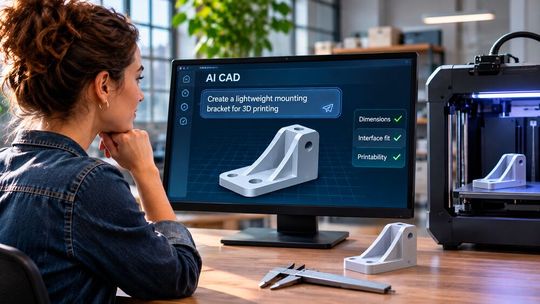
AI-assisted CAD tools could make 3D printing more accessible to small businesses by simplifying the creation and modification of digital models. However, an analysis by IDTechEx highlights significant limitations in generating functional components, showing why design validation remains essential for commercial applications.
AI-assisted CAD could make 3D printing more accessible to small businesses by simplifying the creation of digital models. However, generated designs still require engineering validation before production.
(Source: Dall-E / AI generated / KI-generiert)
Artificial intelligence (AI) could make computer-aided design (CAD) more accessible to small businesses using 3D printing. Natural-language tools can help create and modify geometry, reducing the specialist work between an idea and a printable model. However, ID Techex analysis shows that visual quality and engineering usefulness still differ, making validation central to the commercial opportunity.
Lower-priced desktop printers are allowing small businesses to build production capacity gradually. Print farms can add machines as orders increase, while commercial users can manufacture customized products and short production runs. Yet access to affordable hardware does not remove the work needed to design a new part. A business may have printing capacity available but lack the CAD skills to develop the product it wants to sell.
ID Techex identifies AI as a potential enabler of small-business adoption, alongside affordable equipment and easier production workflows. Its small-business forecast covers sales of printers and materials, rather than CAD software or income from selling printed products. The commercial case for AI therefore depends on whether it can reduce design effort while preserving the checks needed to produce useful parts.
AI changes the design workflow
Conventional CAD requires users to translate an intended function into geometry through sketches, dimensions and modeling operations. Design changes can involve several linked features, and a usable model must preserve the dimensions and interfaces that make the part work. This knowledge remains valuable even when software generates the first version.
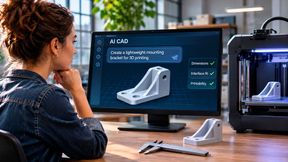
AI-assisted CAD introduces a different way to interact with these tools. A user can describe a component or request a modification in natural language. For example, a request to make a bracket lighter can provide a starting point for generating alternative geometry. The design still needs defined constraints, including mounting locations, material and the loads it must withstand.
The output also matters. A polygon mesh can represent a shape that is suitable for 3D printing, while parametric code or an editable engineering model can make dimensional changes easier to manage. The relevant test is whether the geometry supports the intended task. A visually convincing model does not, by itself, demonstrate accurate dimensions or a correctly designed mechanical interface.
The opportunity extends beyond initial CAD generation. Geometry preparation can require mesh repair and file conversion before a model reaches the printer. Build preparation then determines orientation, nesting and support structures, affecting material consumption and print quality. AI and optimization tools can assist these decisions, although an automated feature should not automatically be described as AI. Their value depends on the application and printing process.
Functional requirements expose the limits of generated designs
To examine these limitations, ID Techex asked several language models to generate Open Scad code for a screwdriver handle that accepts standard bits. The request combined a recognizable shape with a functional requirement: the handle needed a socket for the bit. The exercise produced visibly different designs and inconsistent results in meeting that requirement.
Some outputs appeared plausible but used an incorrect socket or omitted it. Another generated the expected hexagonal opening. This distinction matters commercially because an attractive rendering can conceal a failure to meet the basic purpose of a part. In this example, the presence of a handle shape was insufficient to establish a usable screwdriver.
The exercise illustrates differences in requirement-following rather than establishing a general ranking of AI models. It also does not demonstrate physical fit, strength or durability. Those properties require further evaluation using the relevant geometry, material and production conditions. Changes in prompts or model versions could also change the generated results.
Date: 08.12.2025
Naturally, we always handle your personal data responsibly. Any personal data we receive from you is processed in accordance with applicable data protection legislation. For detailed information please see our privacy policy.
Consent to the use of data for promotional purposes
I hereby consent to Vogel Communications Group GmbH & Co. KG, Max-Planck-Str. 7-9, 97082 Würzburg including any affiliated companies according to §§ 15 et seq. AktG (hereafter: Vogel Communications Group) using my e-mail address to send editorial newsletters. A list of all affiliated companies can be found here
Newsletter content may include all products and services of any companies mentioned above, including for example specialist journals and books, events and fairs as well as event-related products and services, print and digital media offers and services such as additional (editorial) newsletters, raffles, lead campaigns, market research both online and offline, specialist webportals and e-learning offers. In case my personal telephone number has also been collected, it may be used for offers of aforementioned products, for services of the companies mentioned above, and market research purposes.
Additionally, my consent also includes the processing of my email address and telephone number for data matching for marketing purposes with select advertising partners such as LinkedIn, Google, and Meta. For this, Vogel Communications Group may transmit said data in hashed form to the advertising partners who then use said data to determine whether I am also a member of the mentioned advertising partner portals. Vogel Communications Group uses this feature for the purposes of re-targeting (up-selling, cross-selling, and customer loyalty), generating so-called look-alike audiences for acquisition of new customers, and as basis for exclusion for on-going advertising campaigns. Further information can be found in section “data matching for marketing purposes”.
In case I access protected data on Internet portals of Vogel Communications Group including any affiliated companies according to §§ 15 et seq. AktG, I need to provide further data in order to register for the access to such content. In return for this free access to editorial content, my data may be used in accordance with this consent for the purposes stated here. This does not apply to data matching for marketing purposes.
Right of revocation
I understand that I can revoke my consent at will. My revocation does not change the lawfulness of data processing that was conducted based on my consent leading up to my revocation. One option to declare my revocation is to use the contact form found at https://contact.vogel.de. In case I no longer wish to receive certain newsletters, I have subscribed to, I can also click on the unsubscribe link included at the end of a newsletter. Further information regarding my right of revocation and the implementation of it as well as the consequences of my revocation can be found in the data protection declaration, section editorial newsletter.
Progress will depend on effective feedback between generation and evaluation. A model should be checked against the requested dimensions and functional interfaces before a design moves into production. Simulation and physical testing can provide additional feedback where performance requires it. AI may help carry out or coordinate parts of this process, but generating a solid model alone does not establish engineering validity.
For a small business, the benefit would be a shorter and more accessible route to developing a product or adapting an existing design. However, reducing the time spent drawing geometry only creates value if errors do not reappear as failed builds, poor fit or product rework. ID Techex expects reliable iteration and validation to remain central to the adoption of AI CAD for commercial 3D printing.