The Temperchip machining temperature sensor provides real time machining data that protects workpieces, allows users to meet stringent specification requirements and enables optimal utilization of cutting tools.
Validation test results showed excellent compatibility between the calibrated signal and the measured signal.
(Source: Eli Yudkevich)
In machining, tool life is often judged by experience rather than real-time process data — a gap that BYM Systems aims to close with the Temperchip and contactless temperature monitoring directly at the workpiece contact zone. The technology provides real-time visibility and warns operators before workpieces overheat, helping to prevent material damage and production losses. Understanding and predicting tool life is a crucial factor in machining. By accurately monitoring the temperature in the workpiece contact zone, the patented device supports machine performance and contributes to more efficient machining.
When working with cutting tools, machine operators can often only roughly estimate tool life. Tool vendors may provide tool-life data, but this information is frequently generalized and may be inaccurate because of the wide variety of cutting tool applications. A new development is now emerging to support machinists seeking more reliable process data.
Gallery
Temperchip is a contactless temperature measurement device for machining applications that is installed on machine holders. The patented device is designed for machining various materials and enables continuous temperature monitoring during the process. It can track several work parameters between the machine and the work material, providing a basis for monitoring tool life and machining efficiency.
Temperchip originated as a response to a series of overheating problems that occurred during the cutting of composite materials, particularly carbon fiber-reinforced polymers (CFRP), and metallic alloys specified for a major commercial aircraft program. The main cause of tool failure was identified as uncontrolled temperature during the milling and cutting process.
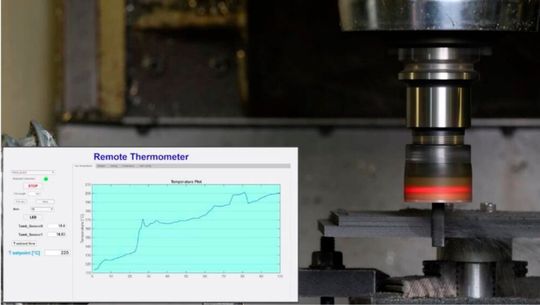
Advancing the idea into development took time. Around 12 months later, the first prototype device was ready for testing. In addition to the Temperchip device, a dedicated software application with a graphical user interface was developed to communicate with the device, interpret the measured signals as temperature data and predict the maximum tool and material temperature.
This was followed by field tests comparing ambient temperature with the highest signals measured during validation.
Estimating the performance life of a tool can lead to operational challenges. In many cases, the decision to replace a tool depends on the machine operator’s judgement. This creates the risk of human error, with tools being replaced either too early or too late.
Temperchip addresses this issue with a design that includes interactive communication functions. Operators can be alerted by red LED lights, a smartphone application and/or the machine control system. The device consists of various sensors, a miniature battery, an electronic control board, a BLE communication chip and a recharge chip.
The measurement device can also be calibrated according to critical points, typically 10 to 15 percent below the limits at which damage may be expected. Calibration is carried out according to the work specimen and/or workpiece material type.
For example, the glass transition temperature (Tg) of carbon fiber-reinforced polymer (CFRP) can cause a loss of mechanical properties, while delamination may occur at around 130°C. Under these conditions, the device would be calibrated to approximately 110 to 115°C.
Based on the data collected by the Temperchip device, operators can adjust the machine’s working parameters, stop the operation or replace the tool as needed. The available measurement parameters include process temperature, load and torque, vibrations and cutter wear.
When the machining process reaches the defined threshold points, an LED light on the device warns the operator. The operator can then stop the machine manually or replace the tool.
Date: 08.12.2025
Naturally, we always handle your personal data responsibly. Any personal data we receive from you is processed in accordance with applicable data protection legislation. For detailed information please see our privacy policy.
Consent to the use of data for promotional purposes
I hereby consent to Vogel Communications Group GmbH & Co. KG, Max-Planck-Str. 7-9, 97082 Würzburg including any affiliated companies according to §§ 15 et seq. AktG (hereafter: Vogel Communications Group) using my e-mail address to send editorial newsletters. A list of all affiliated companies can be found here
Newsletter content may include all products and services of any companies mentioned above, including for example specialist journals and books, events and fairs as well as event-related products and services, print and digital media offers and services such as additional (editorial) newsletters, raffles, lead campaigns, market research both online and offline, specialist webportals and e-learning offers. In case my personal telephone number has also been collected, it may be used for offers of aforementioned products, for services of the companies mentioned above, and market research purposes.
Additionally, my consent also includes the processing of my email address and telephone number for data matching for marketing purposes with select advertising partners such as LinkedIn, Google, and Meta. For this, Vogel Communications Group may transmit said data in hashed form to the advertising partners who then use said data to determine whether I am also a member of the mentioned advertising partner portals. Vogel Communications Group uses this feature for the purposes of re-targeting (up-selling, cross-selling, and customer loyalty), generating so-called look-alike audiences for acquisition of new customers, and as basis for exclusion for on-going advertising campaigns. Further information can be found in section “data matching for marketing purposes”.
In case I access protected data on Internet portals of Vogel Communications Group including any affiliated companies according to §§ 15 et seq. AktG, I need to provide further data in order to register for the access to such content. In return for this free access to editorial content, my data may be used in accordance with this consent for the purposes stated here. This does not apply to data matching for marketing purposes.
Right of revocation
I understand that I can revoke my consent at will. My revocation does not change the lawfulness of data processing that was conducted based on my consent leading up to my revocation. One option to declare my revocation is to use the contact form found at https://contact.vogel.de. In case I no longer wish to receive certain newsletters, I have subscribed to, I can also click on the unsubscribe link included at the end of a newsletter. Further information regarding my right of revocation and the implementation of it as well as the consequences of my revocation can be found in the data protection declaration, section editorial newsletter.
Optionally, the machine can receive communication transmitted by the device and initiate preventive measures such as tool replacement via the magazine, feed-rate reduction, spindle-speed reduction or chip-load reduction. In line with Industry 4.0 principles, the machine controller can be programmed with algorithms that apply the most efficient preventive step according to the specific scenario.
By providing reliable data on tool performance when cutting composite materials, Temperchip gives machine operators the evidence needed to predict tool life more accurately. It also helps reduce production costs, supports high-efficiency tool use and can reduce the need for a separate tool-life validation process.
* *Eli Yudkevich is an aerospace manufacturing specialist.



:quality(80)/p7i.vogel.de/wcms/4b/e2/4be222cca85fc9ccbdf26c552cfc3c4c/0132990447v1.jpeg "A research project highlights potential of high-quality material loops for cars. (Source: BMW Group)")
:quality(80)/p7i.vogel.de/wcms/55/47/55478646728684cec46485443d736f85/0132634476v1.jpeg "Geopolitical tensions and weak demand weighed heavily on Italy's machine tool industry (Source: free licensed / KI-generiert)")
:quality(80)/p7i.vogel.de/wcms/2f/7a/2f7ac201c1abc14dc40a30d947684069/0132348722v1.jpeg "The Nova5e110T, a latest-generation all-electric injection moulding machine, produces a food-packaging application using liquid silicone rubber injection moulding. (Source: Negri Bossi)")
:quality(80)/p7i.vogel.de/wcms/3b/82/3b82cfa915f0ccab71a4ef859598567a/0131980110v1.jpeg "After three difficult years, the machine tool industry can breathe a first sigh of relief: incoming orders increased in the first three months of 2026 by 15 percent. (Source: VDW)")
:quality(80)/p7i.vogel.de/wcms/10/f5/10f5d9769f58266f4d96e984f3a48ee5/0133088888v1.jpeg "Workshops and interactive sessions round out the conference program for the Digital Innovation Days in Würzburg. (Source: SKZ)")
:quality(80)/p7i.vogel.de/wcms/61/b1/61b1b0d85dc9d52df4c1ebae957e73b5/0133087151v1.jpeg "Taipeiplas 2026 will take place September 15 to 19 at Taipei Nangang Exhibition Center, in Taiwan. (Source: Taitra)")
:quality(80)/p7i.vogel.de/wcms/8d/f2/8df2d740937f78edb534aa345ec257a6/0132555049v1.jpeg "On 1 and 2 December 2026, the T3 – Transform The Tomorrow conference will explore strategies that help companies future-proof their operations. (Bild: © Vogel Corporate Solutions / AdobeStock 1280236166, Oksana)")
:quality(80)/p7i.vogel.de/wcms/d8/13/d81399800b7bf23a05c13f61dbbc5fc3/0132528216v1.jpeg "More than 500 working machines will be on display when Lamiera returns to Fieramilano Rho from 11 to 14 May 2027, showcasing the full breadth of sheet-metal forming and cutting technology. (Source: Ucimu/ Fieramilano)")
:quality(80)/p7i.vogel.de/wcms/50/12/5012028b260c3beee1f6e7058bd71d39/0133204757v2.jpeg "For the hydraulic connection of the cylinders Meusburger offers suitable fittings, screw plugs and flat-sealing hydraulic couplings. (Source: Meusburger)")
:quality(80)/p7i.vogel.de/wcms/4b/0a/4b0a16305af8bb26afeba230a64b94cb/0133087107v1.jpeg "At Fakuma 2026, Hasco will present new developments for tool and mould making. (Source: Hasco)")
:quality(80)/p7i.vogel.de/wcms/85/0a/850a63867131938c36290a2ffab91545/0132699768v2.jpeg "A key focus at Meusburger’s trade fair stand is the comprehensive range of plates and mould bases. (Source: Meusburger)")
:quality(80)/p7i.vogel.de/wcms/84/90/8490a5fe51470f02b54dc6487d34faa6/0132698534v1.jpeg "Clear tubing test (Source: Guill)")
:quality(80)/p7i.vogel.de/wcms/f6/6e/f66e3f322d7e2a8fe7e80f808c67e607/0133319745v2.jpeg "Formnext brings together the global AM community and showcases the latest innovations in industrial 3D Printing and advanced production technologies. (Source: Mesago / Marc Jacquemin)")
:quality(80)/p7i.vogel.de/wcms/13/15/13156077bb6086d11a98b5375da5e858/0133159292v2.jpeg "Quickparts runs production through both its own in-house facilities and a certified network of manufacturing partners across North America, Europe, and Asia. (Source: Quickparts)")
:quality(80)/p7i.vogel.de/wcms/b2/2b/b22b2227432aa36f4e4a52349ce2da5d/0133002892v1.jpeg "he serial production of spare parts within GMH Gruppe marks the beginning of point for ProMateria’s next phase of development. (Source: GMH Gruppe)")
:quality(80)/p7i.vogel.de/wcms/1e/38/1e380883458e8b4594684aaf37a45398/0132985879v1.jpeg "The 4D_Additive software can be used to create complex lattice structures and specialised SLM supports. (Source: Core Technologie)")
:quality(80)/p7i.vogel.de/wcms/98/17/9817f21be8809ce0840ac3cb0bd14757/0133317721v1.jpeg "A model produced by Ogle for an automotive industry customer. (Source: Hurco)")
:quality(80)/p7i.vogel.de/wcms/2d/94/2d94e25cc66fda54b8b17f7d55e2f2e5/0133316643v1.jpeg "The Brother Speedio in action (Source: Whitehouse Machine Tools )")
:quality(80)/p7i.vogel.de/wcms/77/1d/771d8692680a2ebcf307291dce50925f/0133166935v1.jpeg "The MLmax Pro expands the Datron milling machine portfolio into a new size category. (Source: Datron)")
:quality(80)/p7i.vogel.de/wcms/7f/8f/7f8f235230798312d45e1f70cc49f07c/0132940787v1.jpeg "One feature of the Soraluce TRM series multitasking bed-type milling machine is its continuously swivelling T-design milling head, with a 37 kW drive and a maximum spindle speed of 6,000 rpm. (Source: Bimatec Soraluce)")
:quality(80)/p7i.vogel.de/wcms/66/ce/66cee106850827fbcf9a46eb0682f3d0/0133197817v1.jpeg "Designed for maximum flexibility, the Solidcam Simulator is a fully self-contained simulation system that runs independently. (Source: Machine Works)")
:quality(80)/p7i.vogel.de/wcms/af/a9/afa9497b955f4e47b3925daea40c8771/0133143701v2.jpeg "AI is steadily working its way into CAD/CAM systems to make design and manufacturing workflows in the tool and mould making industry faster, smarter and less dependent on manual trial and error. (Source: © LA Stock Vision - stock.adobe.com)")
:quality(80)/p7i.vogel.de/wcms/77/54/7754c62ff29d08192f6663b908f1e8b0/0133087125v1.jpeg "Aptean’s AI-native AppCentral platform brings together applications, data and workflows from ERP, MES, CAQ and EAM systems in a cloud-based environment. (Source: Aptean)")
:quality(80)/p7i.vogel.de/wcms/29/11/291168cb8f37169c16f1dda6b9a435fa/0132998362v1.jpeg "Feature Script is Onshape's unique programming language for CAD automation. (Source: Onshape)")
:quality(80)/p7i.vogel.de/wcms/9f/d6/9fd6f5e480734eb5fea4560d6cfdf484/0132969018v1.jpeg "Meusburger blocks for eroding with starting hole and thread (Source: Meusburger)")
:quality(80)/p7i.vogel.de/wcms/5f/66/5f66d32bcf6e2e2fb01b3d98f1c33930/0131994480v1.jpeg "A Mitsubishi Electric MV2400S wire-cut EDM machine will be the first demonstration model to arrive at the Kenilworth showroom and technical centre of recently-appointed sales agent, Whitehouse Machine Tools. (Source: Whitehouse Machine Tools)")
:quality(80)/p7i.vogel.de/wcms/d5/1d/d51def0b31e213e756bbfb9479fa9c7e/0129925621v2.jpeg "Automatic electrode feeding: Together with Sodick and Erowa, the Robot Compact 80 (ERC80) was integrated — including connection to the Zeiss measuring machine and chip-based job management. (Source: Sodick)")
:quality(80)/p7i.vogel.de/wcms/f9/ca/f9ca9cace88200a5ec0946f193264963/0129209504v1.jpeg "Neil Taylor, who has worked in the toolroom at Pre-Met for 20 years. (Source: Pre-Met)")
:quality(80)/p7i.vogel.de/wcms/c8/5b/c85b37436b1df84a1bfe39b5c6d1e201/0133199632v1.jpeg "Enspec is a new professional-grade bridge coordinate measuring machine (CMM) designed to make high-precision inspection more accessible for manufacturers and subcontractors. (Source: Hexagon)")
:quality(80)/p7i.vogel.de/wcms/73/44/73448e9feaa91c6c35ad23c500d770c1/0133160891v1.jpeg "Smartshot i is an intelligent cold runner system for LSR injection moulding. (Source: Elmet)")
:quality(80)/p7i.vogel.de/wcms/d6/ba/d6ba94485018261fa2476c7233b3c1ee/0132634611v1.jpeg "The new AI Knowledge Assistant, delivers natural language responses drawn from the full product documentation library, enabling faster onboarding and reducing the learning curve for new users. (Source: Metrologic DCS )")
:quality(80)/p7i.vogel.de/wcms/b6/77/b677375070249449de37c041cc40ec87/0132635157v1.jpeg "Simulation of sweep scanning inspection of a turbine blade in LK Metrology’s Camio 2026 R1 programming, analysis and reporting software, which now provides comprehensive support for Renishaw’s Revo 5-axis scanning probe system. (Source: LK Metrology)")
:quality(80)/p7i.vogel.de/wcms/9e/85/9e855e6054e89e8a0db2b80562615f9f/0133227871v2.jpeg "Effective lubrication helps CNC machines maintain precision while reducing friction, heat and wear. (Source: Exxon Mobil)")
:quality(80)/p7i.vogel.de/wcms/34/bd/34bdcfe0ae89fb6384c256732af2d155/0133068647v1.jpeg "SMW’s C80 Giga inductive coupling system transmits up to 75 W of power and real-time signals at speeds of up to 1 Gbit/s. (SourceSMW-Autoblok / SMW-electronics)")
:quality(80)/p7i.vogel.de/wcms/b5/66/b5665ab546c34e5e9e520858774e4990/0133087166v2.jpeg "Combining standard processes — such as steam degreasing, spray and immersion cleaning, and injection flush washing — with technologies like Ultrasound, Ultrasound Plus, and Pulsated Pressure Cleaning (PPC) enables the efficient and sustainable cleaning of various parts with high cleanliness requirements. (Source: Ecoclean)")
:quality(80)/p7i.vogel.de/wcms/9c/d7/9cd79135af24c6dd0834ff0a170faa46/0132991739v1.jpeg "Carbide prices are soaring, Vomat reports. This makes these materials strategic resources that should be kept within as closed a material loop as possible. Vomat’s fine filtration technology could help achieve this ... (Source: Vomat)")
:quality(80)/p7i.vogel.de/wcms/0b/08/0b08341f8be2aa039063d7585d16e204/0133087099v1.jpeg "The Ruby Dark Mold Polishing Stone is designed for controlled material removal and consistent surface finishes in demanding mold polishing applications. (Source: Jacqueline Southby/ Boride)")
:quality(80)/p7i.vogel.de/wcms/44/e0/44e0d70e930c0ee85447518eda459259/0132763637v2.jpeg "The Focus was developed to meet changing requirements in parts cleaning. This cost-effective solvent cleaning system ensures a high level of cleanliness even with a relatively low cleaning volume. (Source: Karl Roll)")
:quality(80)/p7i.vogel.de/wcms/b8/6f/b86f649863182a925480692939ac91f8/0131684985v1.jpeg "Extreme high-speed Laser Material Deposition (EHLA) enables the additive deposition of functional surfaces with high precision and speed. This allows components to be efficiently coated, repaired, or manufactured with close-to-final-contour precision. (Source: Fraunhofer ILT)")
:quality(80)/p7i.vogel.de/wcms/d5/05/d5057e4ec3f7c3acbed8a4241d0683c6/0131673703v2.jpeg "Copper gauze for cleaning and polishing exposed round or conical surfaces. (Source: Guill)")
:quality(80)/p7i.vogel.de/wcms/5a/e5/5ae5dfc67c07f0ca8347161642c36df3/0130721540v1.jpeg "Müller Präzisionswerkzeuge supports its customers with customised, application-specific tools. (Source: Müller)")
:quality(80)/p7i.vogel.de/wcms/2a/08/2a08f8bd2df95ca843d52cbce64bf355/0131212753v1.jpeg "It has taken time, but the full force of the government’s steel policy is beginning to have a devastating impact on the downstream manufacturing sector according to the President of the Confederation of British Metalforming (CBM). (Source: CBM)")
:quality(80)/p7i.vogel.de/wcms/9e/bd/9ebd826ceed28c644a9205bdbf82beb4/0131007997v2.jpeg "The lead-free aluminium solutions that combine high performance with stable and reliable machining processes. (Source: Eural Gnutt)")
:quality(80)/p7i.vogel.de/wcms/d5/e6/d5e68c74fabff18ef737ee767b7b359f/0130415707v1.jpeg "Efficiency in machining and a reduced carbon footprint will be at the centre of Swiss Steel Group’s presentation at Wire 2026 in Düsseldorf. (Source: Swiss Steel Group)")
:quality(80)/p7i.vogel.de/wcms/df/be/dfbe11ae0e8a76348550a11e48b46bfb/0133319718v1.jpeg "Clarity Plastics, which was formed in 2025 following the acquisitions of Barkley Plastics and LVS, has seen its collective efforts lead to successful accreditation to ISO 14001. (Source: Clarity Plastics)")
:quality(80)/p7i.vogel.de/wcms/1e/19/1e190f7c55aecc4a5624e47bcb2a68f8/0133198916v2.jpeg "Dr Georg Holzinger, Managing Executive Officer of Shibaura Machine and spokesperson for the management board of Shibaura Machine LWB, and Emilio Modesto Puebla Vallina of Puebla Vendrell Engineering System have agreed on a sales partnership for the Spanish market, effective immediately. (Source: Shibaura Machine LWB)")
:quality(80)/p7i.vogel.de/wcms/87/59/875985a8d2b5a2293d4777a1aa335ed1/0133103055v1.jpeg "Voltatron’s acquisition of Kurz Elektronik adds engineering expertise and production capabilities in areas including cable assembly, plastic injection moulding, toolmaking and electronics manufacturing. (Source: free licensed)")
:quality(80)/p7i.vogel.de/wcms/00/56/0056da45aa8bb86bd52c217296561c34/0132968929v1.jpeg "(Source: free licensed / KI-generiert)")
:fill(fff,0)/p7i.vogel.de/companies/66/0e/660e93698db24/hasco-logo-or-b50.jpeg "hasco-logo-or-b50 (HASCO)")
:fill(fff,0)/images.vogel.de/vogelonline/companyimg/118400/118496/65.jpg "Renishaw_EMBLEM_orange_RGB.jpg ()")
:fill(fff,0)/images.vogel.de/vogelonline/companyimg/64200/64280/65.png "Diprofil_logo.png ()")
:quality(80)/p7i.vogel.de/wcms/70/ea/70ea983200c9873b2ace6a8b7a824bd0/0131608692v1.jpeg "Temperature calibration using the Temperchip device.(Source: Eli Yudkevich)")
:quality(80)/p7i.vogel.de/wcms/0b/c3/0bc360517d23496d3713875a5016fc8a/0131608682v1.jpeg "The Temperchip contributes to the efficiency of machining.(Source: Eli Yudkevich)")
:quality(80)/p7i.vogel.de/wcms/86/de/86deece0b5eb611f8c2503036ca8b2cf/0131608685v1.jpeg "Validation test results showed excellent compatibility between the calibrated signal and the measured signal.(Source: Eli Yudkevich)")
:quality(80)/p7i.vogel.de/wcms/13/d7/13d7be99270c47e2dc250b3b586fd8c5/0131608681v1.jpeg "A specific software application with graphical user interface was developed to communicate and interpret the measured signals into temperature measurements and predict the maximum tool / material temperature.(Source: Eli Yudkevich)")
:quality(80)/p7i.vogel.de/wcms/93/dd/93ddf13b060a9173e3eca57e838dc0c6/0127344947v1.jpeg "Part in Optimizer: Screenshot of the part in Vericut Optimizer (Source: Vericut)")
:quality(80)/p7i.vogel.de/wcms/ae/38/ae38d9055a94a30815da8c0cb9d3bd22/0131212819v1.jpeg "The Lasertec 65 DED hybrid 2 from DMG Mori. (Source: DMG Mori)")