Materials took centre stage at the first 3D Plast Lab during Plast 2026, where researchers, companies and designers explored how additive manufacturing is moving beyond shape alone. The projects ranged from plant-based composites and transparent wood to recycled automotive plastics, bioactive wearables and ultra-thin printed devices..
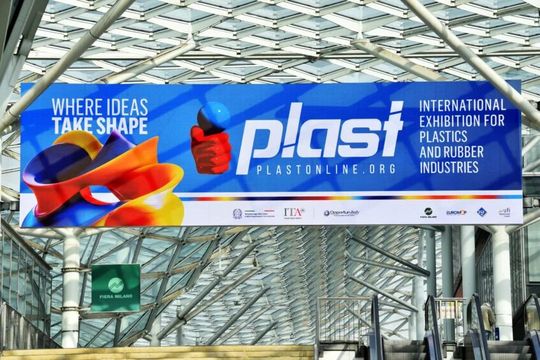
Plast 2026: 3D Plastlab closes its first edition and establishes itself as a new international reference point for innovation in Additive Manufacturing
(Source: Milan Exhibition)
The first edition of 3D Plast Lab, the format dedicated to innovation in additive manufacturing hosted within Plast 2026, has drawn to a close. For four days, the area brought together researchers, designers, start-ups, universities and companies from multiple countries, becoming one of the most visited spaces at the fair. The formula — fostering dialogue between research, industry and design through prototypes and direct exchanges with innovators — placed ideas at the centre, ahead of technologies themselves.
The renewed identity of 3D Plast Lab was born from the collaboration between the Plast organisational secretariat and Simone Maccagnan, Business Development Manager at Gimac and CEO & Founder of eXgineering, and was developed, designed and coordinated by Pierpaolo Ruttico, Founder and Managing Director of Indexlab, the digital fabrication laboratory at the Politecnico di Milano.
“The aim of 3D Plast Lab was not simply to create a space dedicated to 3D printing, but to build a meeting point for people, skills and visions united by the desire to innovate,” says Simone Maccagnan. “We believe that innovation grows when research, industry, design and universities come together. 3D Plast Lab was created to foster these connections, accelerate the sector’s technological development and generate new business opportunities for the entire additive manufacturing ecosystem.”
When material becomes the true protagonist
The thread connecting the researchers and companies hosted at 3D Plast Lab is a paradigm shift: additive manufacturing no longer controls only the shape of objects, but the very nature of the matter that composes them — matter that becomes designable, sustainable and even “intelligent”.
This is clearly visible starting from reinvented nature. Marinella Levi (Politecnico di Milano, +LAB) presents a new generation of 3D-printable composites entirely of plant origin, culminating in a remarkable alternative to leather — a plant-based “crocodile skin” derived from agar-agar and cork — alongside industrially mature thermoset composites reinforced with fibres, from which the spin-offs MOI Composites and MOI Dental were born. Also from the plant world comes the transparent wood of the AI-TW project: Giulio Malucelli (Politecnico di Torino, Disat) leads the technical core, removing or modifying lignin and infiltrating the wood with transparent polymers to obtain a material that transmits light, provides thermal insulation and could replace glass, with artificial intelligence predicting its behaviour and accelerating scalability; Beatrice Lerma and Doriana Dal Palù (Politecnico di Torino, DAD) explore its perceptual and design dimensions, investigating how both the public and professionals envisage using it in architecture, interiors and sustainable mobility — from bicycles to boats.
From nature, the focus shifts to waste becoming a resource. Elena Casolari (Politecnico di Milano) transforms the heterogeneous plastics from end-of-life vehicles — normally destined for downcycling — into reliable products for the construction industry; Giulia Pelliccia (SDU Create, University of Southern Denmark) through the Laygrade project, converts sawdust, resin and beeswax into gradient biocomposites capable of varying optical and mechanical properties point by point, for architectural components that modulate light.
The final step is matter rendered functional and programmable. Kostas Grigoriadis (Bartlett School of Architecture, UCL) designs multi-material facades in which structural, solar and ventilation performance are embedded directly in the voxel distribution of the material, eliminating many mechanical systems; Serena Graziosi (Politecnico di Milano) derives from food by-products printable bioactive composites, shaped into wearable, personalised pads for the non-invasive relief of breast pain; Jochen Mueller (Johns Hopkins University) pushes the same logic to the micron scale, printing elastic films just 18 microns thick inside complex devices, from origami structures to electro-active actuators for soft robotics. From the micron to the façade, these projects speak to the same frontier: a future in which geometry, material, sustainability and function are designed together.
Rounding out the picture is Hayden Taylor (UC Berkeley), who proposes a radical paradigm shift from layer-by-layer 3D printing through Computed Axial Lithography (CAL): a technique that adapts the principles of computed tomography to additive manufacturing. An optimised set of light patterns is projected through a rotating volume of photopolymer, and the absorbed dose accumulates volumetrically to generate the complete three-dimensional object within minutes, without support structures.
Date: 08.12.2025
Naturally, we always handle your personal data responsibly. Any personal data we receive from you is processed in accordance with applicable data protection legislation. For detailed information please see our privacy policy.
Consent to the use of data for promotional purposes
I hereby consent to Vogel Communications Group GmbH & Co. KG, Max-Planck-Str. 7-9, 97082 Würzburg including any affiliated companies according to §§ 15 et seq. AktG (hereafter: Vogel Communications Group) using my e-mail address to send editorial newsletters. A list of all affiliated companies can be found here
Newsletter content may include all products and services of any companies mentioned above, including for example specialist journals and books, events and fairs as well as event-related products and services, print and digital media offers and services such as additional (editorial) newsletters, raffles, lead campaigns, market research both online and offline, specialist webportals and e-learning offers. In case my personal telephone number has also been collected, it may be used for offers of aforementioned products, for services of the companies mentioned above, and market research purposes.
Additionally, my consent also includes the processing of my email address and telephone number for data matching for marketing purposes with select advertising partners such as LinkedIn, Google, and Meta. For this, Vogel Communications Group may transmit said data in hashed form to the advertising partners who then use said data to determine whether I am also a member of the mentioned advertising partner portals. Vogel Communications Group uses this feature for the purposes of re-targeting (up-selling, cross-selling, and customer loyalty), generating so-called look-alike audiences for acquisition of new customers, and as basis for exclusion for on-going advertising campaigns. Further information can be found in section “data matching for marketing purposes”.
In case I access protected data on Internet portals of Vogel Communications Group including any affiliated companies according to §§ 15 et seq. AktG, I need to provide further data in order to register for the access to such content. In return for this free access to editorial content, my data may be used in accordance with this consent for the purposes stated here. This does not apply to data matching for marketing purposes.
Right of revocation
I understand that I can revoke my consent at will. My revocation does not change the lawfulness of data processing that was conducted based on my consent leading up to my revocation. One option to declare my revocation is to use the contact form found at https://contact.vogel.de. In case I no longer wish to receive certain newsletters, I have subscribed to, I can also click on the unsubscribe link included at the end of a newsletter. Further information regarding my right of revocation and the implementation of it as well as the consequences of my revocation can be found in the data protection declaration, section editorial newsletter.
The Call for Ideas: four visions that anticipate the future
The Call for Ideas confirmed the format’s vocation not merely to recount innovation, but to bring it to light. Open to students, researchers, designers and young innovators, it led to the selection of four winning concepts, all sharing a bioinspired approach: OsteoGyroid by William Solórzano-Requejo, a gradient-porosity hip prosthesis inspired by the human femur; Topo IV Disc, conceived by Alejandro de Blas de Miguel together with William Solórzano-Requejo, Francisco Franco Martínez and Andrés Díaz Lantada, a lattice-structure intervertebral disc for more biocompatible spinal implants; Nature Trace #00 by Payvand Azadmanesh and Milan Dragojlovic, which translates nature’s growth processes into lightweight, materially efficient structures; and Alpha EEG Headset by Chrystal Bryant, a next-generation device for monitoring brain activity. The projects were printed during the fair and brought to life thanks to the advanced additive manufacturing systems made available by X-Engineering and 3DHub Ferba, two companies at the forefront of industrial 3D printing of complex objects — proof of 3D Plast Lab’s ambition to become an open laboratory connecting emerging talent and industry.
Further enhancing the immersive quality of 3D Plast Lab was a special sound installation conceived by sound designer Marco Bordini. Through an electroacoustic composition in quadraphony, the productive and human identity of the organisations involved was transformed into an artistic experience that accompanied visitors throughout the event.
Machinery, materials, production environments and voices were recorded, analysed and reworked through granular, spectral and sample-based synthesis techniques, giving rise to an immersive soundtrack distributed across four independent channels. The result was a three-dimensional listening journey that transformed elements of everyday industrial life into narrative material, reinforcing the dialogue between technology, creativity and the human dimension.



:quality(80)/p7i.vogel.de/wcms/b0/7a/b07a7095a06502f296a68cc23c0333fd/0133339310v4.jpeg "The positive trends experienced in the machine tool industry are continuing into the second quarter: incoming orders increased by 12 percent compared to the previous year. (Source: VDW)")
:quality(80)/p7i.vogel.de/wcms/4b/e2/4be222cca85fc9ccbdf26c552cfc3c4c/0132990447v1.jpeg "A research project highlights potential of high-quality material loops for cars. (Source: BMW Group)")
:quality(80)/p7i.vogel.de/wcms/55/47/55478646728684cec46485443d736f85/0132634476v1.jpeg "Geopolitical tensions and weak demand weighed heavily on Italy's machine tool industry (Source: free licensed / KI-generiert)")
:quality(80)/p7i.vogel.de/wcms/2f/7a/2f7ac201c1abc14dc40a30d947684069/0132348722v1.jpeg "The Nova5e110T, a latest-generation all-electric injection moulding machine, produces a food-packaging application using liquid silicone rubber injection moulding. (Source: Negri Bossi)")
:quality(80)/p7i.vogel.de/wcms/8e/25/8e2561d12b8caeba7125507a0c957e6e/0133564611v1.jpeg "Nexgem brings together companies from the worlds of mechanical engineering, IT and software. (Source: VDW)")
:quality(80)/p7i.vogel.de/wcms/48/a5/48a599231b179ed4c8f2fc4f00fc80ac/0133459364v2.jpeg "Fakuma 2026 will mark its 30th edition in Friedrichshafen from 12 to 16 October, with around 1,600 exhibitors from 40 countries, innovation awards, expert discussions and career initiatives. (Source: Fakuma)")
:quality(80)/p7i.vogel.de/wcms/13/22/13224a29676f9fba818db663bcc63729/0133443239v1.jpeg "That’s a wrap for another AMB in Stuttgart. In around two years, metalworking innovations will once again take centre stage in Baden-Württemberg. Here, the organiser and industry representatives reflect on this year’s event ... (Source: Th. Wagner / Messe Stuttgart)")
:quality(80)/p7i.vogel.de/wcms/9f/3d/9f3da0d0fff1def9de2203feda4fde5d/0133450626v2.jpeg "Taipeiplas 2026 brought buyers and exhibitors together for active business discussions. (Source: Taitra)")
:quality(80)/p7i.vogel.de/wcms/18/cb/18cbc67d9db9584a02e1cb87adeb4955/0133336478v1.jpeg "The Meusburger compact slide 1:1 E 6100 was specially designed for use in stamping. (Source: Meusburger)")
:quality(80)/p7i.vogel.de/wcms/50/12/5012028b260c3beee1f6e7058bd71d39/0133204757v2.jpeg "For the hydraulic connection of the cylinders Meusburger offers suitable fittings, screw plugs and flat-sealing hydraulic couplings. (Source: Meusburger)")
:quality(80)/p7i.vogel.de/wcms/4b/0a/4b0a16305af8bb26afeba230a64b94cb/0133087107v1.jpeg "At Fakuma 2026, Hasco will present new developments for tool and mould making. (Source: Hasco)")
:quality(80)/p7i.vogel.de/wcms/85/0a/850a63867131938c36290a2ffab91545/0132699768v2.jpeg "A key focus at Meusburger’s trade fair stand is the comprehensive range of plates and mould bases. (Source: Meusburger)")
:quality(80)/p7i.vogel.de/wcms/32/44/32440bdff907b379245f456130355549/0133341463v1.jpeg "Stratasys F870 FDM system, a large-format additive manufacturing platform designed for industrial manufacturers, automotive OEMs, aerospace & defense production lines, looking to scale production on the factory floor. (Source: Stratasys)")
:quality(80)/p7i.vogel.de/wcms/f6/6e/f66e3f322d7e2a8fe7e80f808c67e607/0133319745v2.jpeg "Formnext brings together the global AM community and showcases the latest innovations in industrial 3D Printing and advanced production technologies. (Source: Mesago / Marc Jacquemin)")
:quality(80)/p7i.vogel.de/wcms/13/15/13156077bb6086d11a98b5375da5e858/0133159292v2.jpeg "Quickparts runs production through both its own in-house facilities and a certified network of manufacturing partners across North America, Europe, and Asia. (Source: Quickparts)")
:quality(80)/p7i.vogel.de/wcms/b2/2b/b22b2227432aa36f4e4a52349ce2da5d/0133002892v1.jpeg "he serial production of spare parts within GMH Gruppe marks the beginning of point for ProMateria’s next phase of development. (Source: GMH Gruppe)")
:quality(80)/p7i.vogel.de/wcms/24/07/2407a4874f3c763937892a12e3e7d125/0133564963v2.jpeg "(Source: Walter)")
:quality(80)/p7i.vogel.de/wcms/03/8e/038ec919753fabff71f6e3473c772f74/0133130761v2.jpeg "The core reason behind the adoption of humanoid robots in the manufacturing or tool and mould making industry is the lack of labour in these markets. (Source: © Maksudul - stock.adobe.com)")
:quality(80)/p7i.vogel.de/wcms/71/b5/71b582e7f0d98b40e0c5d0b8e1f11671/0133376631v1.jpeg "Mazak’s new CP-450 automation system integrated with a CV5-500 machining centre. (Source: Mazak)")
:quality(80)/p7i.vogel.de/wcms/98/17/9817f21be8809ce0840ac3cb0bd14757/0133317721v1.jpeg "A model produced by Ogle for an automotive industry customer. (Source: Hurco)")
:quality(80)/p7i.vogel.de/wcms/4d/da/4dda0d3b2a4c0b1c1e21dc2deba9264e/0133445150v1.jpeg "Capture machine data in real time and display it clearly with Hummingbird. (Source: Open Mind)")
:quality(80)/p7i.vogel.de/wcms/e1/7d/e17db1eab6fedf3237a12e0ffb739cb9/0133378692v2.jpeg "Meet at the Machine is Siemens’ new initiative designed to bring together machine builders, software and automation technologies to accelerate innovation across the machine tool industry and help manufacturers achieve productivity faster. (Source: Siemens)")
:quality(80)/p7i.vogel.de/wcms/da/36/da36247b3e7af69fece5d3840ab65dd5/0133337118v1.jpeg "Eva understands questions asked in natural language, detects deviations in the process, and suggests concrete solutions — an assistant that goes well beyond a typical chatbot. (Source: Engel)")
:quality(80)/p7i.vogel.de/wcms/66/ce/66cee106850827fbcf9a46eb0682f3d0/0133197817v1.jpeg "Designed for maximum flexibility, the Solidcam Simulator is a fully self-contained simulation system that runs independently. (Source: Machine Works)")
:quality(80)/p7i.vogel.de/wcms/9f/d6/9fd6f5e480734eb5fea4560d6cfdf484/0132969018v1.jpeg "Meusburger blocks for eroding with starting hole and thread (Source: Meusburger)")
:quality(80)/p7i.vogel.de/wcms/5f/66/5f66d32bcf6e2e2fb01b3d98f1c33930/0131994480v1.jpeg "A Mitsubishi Electric MV2400S wire-cut EDM machine will be the first demonstration model to arrive at the Kenilworth showroom and technical centre of recently-appointed sales agent, Whitehouse Machine Tools. (Source: Whitehouse Machine Tools)")
:quality(80)/p7i.vogel.de/wcms/d5/1d/d51def0b31e213e756bbfb9479fa9c7e/0129925621v2.jpeg "Automatic electrode feeding: Together with Sodick and Erowa, the Robot Compact 80 (ERC80) was integrated — including connection to the Zeiss measuring machine and chip-based job management. (Source: Sodick)")
:quality(80)/p7i.vogel.de/wcms/f9/ca/f9ca9cace88200a5ec0946f193264963/0129209504v1.jpeg "Neil Taylor, who has worked in the toolroom at Pre-Met for 20 years. (Source: Pre-Met)")
:quality(80)/p7i.vogel.de/wcms/c8/5b/c85b37436b1df84a1bfe39b5c6d1e201/0133199632v1.jpeg "Enspec is a new professional-grade bridge coordinate measuring machine (CMM) designed to make high-precision inspection more accessible for manufacturers and subcontractors. (Source: Hexagon)")
:quality(80)/p7i.vogel.de/wcms/73/44/73448e9feaa91c6c35ad23c500d770c1/0133160891v1.jpeg "Smartshot i is an intelligent cold runner system for LSR injection moulding. (Source: Elmet)")
:quality(80)/p7i.vogel.de/wcms/d6/ba/d6ba94485018261fa2476c7233b3c1ee/0132634611v1.jpeg "The new AI Knowledge Assistant, delivers natural language responses drawn from the full product documentation library, enabling faster onboarding and reducing the learning curve for new users. (Source: Metrologic DCS )")
:quality(80)/p7i.vogel.de/wcms/b6/77/b677375070249449de37c041cc40ec87/0132635157v1.jpeg "Simulation of sweep scanning inspection of a turbine blade in LK Metrology’s Camio 2026 R1 programming, analysis and reporting software, which now provides comprehensive support for Renishaw’s Revo 5-axis scanning probe system. (Source: LK Metrology)")
:quality(80)/p7i.vogel.de/wcms/c7/0c/c70ce96cc0e31dd84ca136e5f580b010/0133561039v1.jpeg "Diagram show the interface between an EWS Varia base unit (right), which remains in the lathe turret, and a toolholder and cutter mounted in a quick-change adapter. This rapid tool exchange mechanism is used across the company’s entire range of VX, VXT and VXP lathe toolholders. (Source: EWS)")
:quality(80)/p7i.vogel.de/wcms/ca/d1/cad1c8eeb1436e5df9a72b11101b7df5/0133377800v1.jpeg "The STC0440-BT40 now gives manufacturers and integrators a high-power platform for material-removal tasks. (Source: Pushcorp)")
:quality(80)/p7i.vogel.de/wcms/9e/85/9e855e6054e89e8a0db2b80562615f9f/0133227871v2.jpeg "Effective lubrication helps CNC machines maintain precision while reducing friction, heat and wear. (Source: Exxon Mobil)")
:quality(80)/p7i.vogel.de/wcms/34/bd/34bdcfe0ae89fb6384c256732af2d155/0133068647v1.jpeg "SMW’s C80 Giga inductive coupling system transmits up to 75 W of power and real-time signals at speeds of up to 1 Gbit/s. (SourceSMW-Autoblok / SMW-electronics)")
:quality(80)/p7i.vogel.de/wcms/0b/08/0b08341f8be2aa039063d7585d16e204/0133087099v1.jpeg "The Ruby Dark Mold Polishing Stone is designed for controlled material removal and consistent surface finishes in demanding mold polishing applications. (Source: Jacqueline Southby/ Boride)")
:quality(80)/p7i.vogel.de/wcms/44/e0/44e0d70e930c0ee85447518eda459259/0132763637v2.jpeg "The Focus was developed to meet changing requirements in parts cleaning. This cost-effective solvent cleaning system ensures a high level of cleanliness even with a relatively low cleaning volume. (Source: Karl Roll)")
:quality(80)/p7i.vogel.de/wcms/b8/6f/b86f649863182a925480692939ac91f8/0131684985v1.jpeg "Extreme high-speed Laser Material Deposition (EHLA) enables the additive deposition of functional surfaces with high precision and speed. This allows components to be efficiently coated, repaired, or manufactured with close-to-final-contour precision. (Source: Fraunhofer ILT)")
:quality(80)/p7i.vogel.de/wcms/d5/05/d5057e4ec3f7c3acbed8a4241d0683c6/0131673703v2.jpeg "Copper gauze for cleaning and polishing exposed round or conical surfaces. (Source: Guill)")
:quality(80)/p7i.vogel.de/wcms/5a/e5/5ae5dfc67c07f0ca8347161642c36df3/0130721540v1.jpeg "Müller Präzisionswerkzeuge supports its customers with customised, application-specific tools. (Source: Müller)")
:quality(80)/p7i.vogel.de/wcms/2a/08/2a08f8bd2df95ca843d52cbce64bf355/0131212753v1.jpeg "It has taken time, but the full force of the government’s steel policy is beginning to have a devastating impact on the downstream manufacturing sector according to the President of the Confederation of British Metalforming (CBM). (Source: CBM)")
:quality(80)/p7i.vogel.de/wcms/9e/bd/9ebd826ceed28c644a9205bdbf82beb4/0131007997v2.jpeg "The lead-free aluminium solutions that combine high performance with stable and reliable machining processes. (Source: Eural Gnutt)")
:quality(80)/p7i.vogel.de/wcms/d5/e6/d5e68c74fabff18ef737ee767b7b359f/0130415707v1.jpeg "Efficiency in machining and a reduced carbon footprint will be at the centre of Swiss Steel Group’s presentation at Wire 2026 in Düsseldorf. (Source: Swiss Steel Group)")
:quality(80)/p7i.vogel.de/wcms/eb/2e/eb2ec2f935e6eded7702883eb129e64e/0133564614v2.jpeg "Gerald Bloom, Chairman of Big Bear Plastic Products in Droitwich, was given the Lifetime Achievement Award at the National Family Business Dinner for his 70-year contribution to industry. (Source: Big Bear Plastic Products)")
:quality(80)/p7i.vogel.de/wcms/c0/b8/c0b806ad8153cc46307de1b9142504e0/0133449473v2.jpeg "Peter Jungwirth will assume the role of Managing Director of Engel Serbia. (Source: Engel)")
:quality(80)/p7i.vogel.de/wcms/d9/2f/d92fb796119e91350f908a0124548525/0133342044v2.jpeg "(from left to right): Mr. Xu Bin, General Manager of Global Industry Line, Haitian International; Mr. Zhang Bin, CEO of Haitian Group; Mr. Thomas Wildt, CEO of Hennecke; Mr. Jens Winiarz, Sales Director of Hennecke GmbH; Mr. Andrew Chan, CEO of Hennecke China. (Source: Haitian)")
:quality(80)/p7i.vogel.de/wcms/df/be/dfbe11ae0e8a76348550a11e48b46bfb/0133319718v1.jpeg "Clarity Plastics, which was formed in 2025 following the acquisitions of Barkley Plastics and LVS, has seen its collective efforts lead to successful accreditation to ISO 14001. (Source: Clarity Plastics)")
:fill(fff,0)/images.vogel.de/vogelonline/companyimg/84400/84424/65.jpg "logo.jpg ()")
:fill(fff,0)/p7i.vogel.de/companies/67/d9/67d95fe309f52/logo-300-169-rgb.jpeg "logo-300-169-rgb (AMPCO METAL)")
:quality(80)/p7i.vogel.de/wcms/0b/6b/0b6b5c7e8a7736f29e63fbd545c8a01b/0131918868v1.jpeg "Xometry marketplace accelerates solutions for complex manufacturing demands (Source: Noah Willman/ Xometry)")
:quality(80)/p7i.vogel.de/wcms/d6/85/d685f438a6430ad866e2fe56536e51c4/0131826173v1.jpeg "Schematic of photopolymerisation-extrusion coupled moulding: rheology, UV curing, precision-defect trade-off. 3 strategies (UV stepping, filler optimization, molecular engineering) yield isotropic, dense, crack‑free ceramics with strong, low-shrinkage. (Source: Linzhe Zhang/Yanshan University, et. al)")
:quality(80)/p7i.vogel.de/wcms/b2/73/b2735e537e1eb3efe40b5610b62e5cc3/0130952440v2.jpeg "Printing at 10–50 micron layer heights, BMF Clear achieves superior surface quality, reducing post-processing time while improving optical transmission. (Source: Boston Micro Fabrication)")
:quality(80)/p7i.vogel.de/wcms/f4/02/f4027622e3270a98aaa1efb1239ee43d/0131120382v1.jpeg "Bausano develops extrusion technologies for plastics processing, combining mechanical engineering expertise with digital solutions for increasingly connected and efficient production environments. (Source: Bausano)")