Automation for CNC-class applications requires more than standard robotics. CNC Solutions has developed a Technology Package that seamlessly integrates CAM, motion control and robot execution. By combining offline programming, CNC-style control and high-precision robotics, the system delivers predictable multi-axis performance and significantly reduces commissioning time.
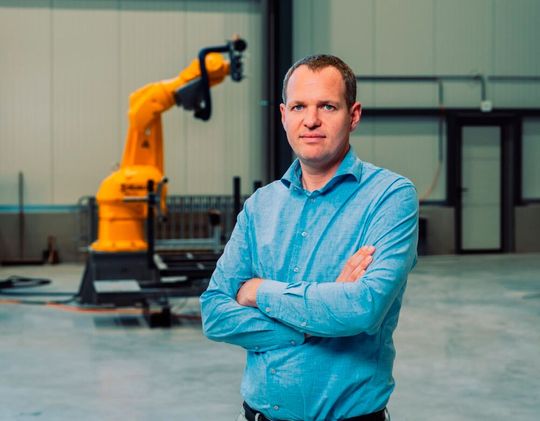
“For CNC processes you’re talking millions of points — you can’t teach a robot that; you need CAM,” recalls managing director Lander Debruyne.
(Source: Ency)
On paper, a robot is just a set of joints and motors. On a production floor, however, it becomes something entirely different. CNC Solutions in Belgium learned that the hard way years ago, when teach-in methods that worked for simple pick-and-place began to crumble under CNC-class workloads. In milling, sanding, laser or plasma cutting paths, the motion isn’t a few hundred points; it’s millions. “For CNC processes you’re talking millions of points — you can’t teach a robot that; you need CAM,” recalls Managing Director Lander Debruyne.
The problem they refused to accept
CNC Solutions had been building CNC-based paths since the 1990s and delivering turnkey cells long before “robot CNC” was fashionable. But as jobs grew more demanding — multi-axis milling, abrasive sanding, high-speed trimming — the usual controller-centric approach buckled. The team needed a flow that started in CAM, simulated the real cell, and then drove the robot like a CNC — deterministic, predictable, and fast. Over more than a decade of projects (and hard-won lessons with Stäubli robots), they accumulated the know-how to do exactly that.
Gallery
What made Stäubli the constant? Precision and repeatability, yes — but also sealed construction that shrugs off dust and chips, and the ability to interface a CNC-style motion layer to the robot cleanly for trajectory execution. For abrasive work like grinding and milling, that combination proved decisive.
From project playbook to product
The turning point was deciding to package the method, not just repeat it. CNC Solutions codified everything into a Technology Package: one stack that bundles the software layer, the motion control layer, and the robot — ready for an integrator to extend with their own PLCs, fixturing, and process equipment. The processes (milling, welding, sanding, laser cutting, and more) arrive predefined and tuned to the machine, so teams start from a validated baseline instead of a blank page.
Under the hood are three pillars. First, Ency Robot, an offline programming (OLP) software, that accurately calculates toolpaths and simulates the entire cell for industrial robots. Second, a Beckhoff motion controller that commands the robot like a standard CNC — feeds, modes, frames, the works. Third, a Stäubli robot that executes those paths with the accuracy and duty cycle that production demands.
That stack didn’t materialize overnight. As Debruyne explains, the team “deepened its expertise step by step,” optimizing robot axis motions until the commissioning process behaved more like a CNC machine than a bespoke experiment. The result is a productized nucleus that other integrators can now drop into their cells.
Why Ency became the accelerator
CNC Solutions anchored the offline robot programming layer on Ency. Instead of spending hours on online programming with the robot idle, Ency simulates the whole cell, checks axis limits, avoids singularities, and runs full collision control — so commissioning time turns into production time. It is genuinely all-in-one: design, technology setup, toolpath calculation, and simulation in one environment, with a zero-code digital-twin builder and libraries of post-processors and robot models. In short, the CAM you trust becomes the robot’s language — cleanly, predictably, repeatably.
“Start from a familiar CNC environment and translate CAM strategies to robot motion” — that’s how the team describes the philosophy. The choice of Ency reflects that pragmatism: broad functionality for simple two-axis jobs and complex multi-axis cells, with code paths and models managed in-house so behavior stays transparent.
Out-of-the-box processes include milling, grinding, deburring, polishing, blasting (wet/dry), plasma and laser cutting/welding, waterjet cutting, cladding, painting, cleaning, gluing, and more.
Robots only pay back when you build a real solution around them.
Lander Debruyne, Managing Director, CNC Solutions
Plug-and-play, in the literal sense
The Technology Package goes beyond software. Plug-and-play wiring means the Stäubli robot ties to the controller over a single cable; the package arrives with predefined processes specific to the cell. CNC-style modes (Auto, Manual, Home), feed overrides, and emergEncy-stop logic are standard. The system exposes process I/O and communication hooks for the plant network and supports speed control during automatic runs. Even the encoder-wheel-style manual moves are accounted for.
Date: 08.12.2025
Naturally, we always handle your personal data responsibly. Any personal data we receive from you is processed in accordance with applicable data protection legislation. For detailed information please see our privacy policy.
Consent to the use of data for promotional purposes
I hereby consent to Vogel Communications Group GmbH & Co. KG, Max-Planck-Str. 7-9, 97082 Würzburg including any affiliated companies according to §§ 15 et seq. AktG (hereafter: Vogel Communications Group) using my e-mail address to send editorial newsletters. A list of all affiliated companies can be found here
Newsletter content may include all products and services of any companies mentioned above, including for example specialist journals and books, events and fairs as well as event-related products and services, print and digital media offers and services such as additional (editorial) newsletters, raffles, lead campaigns, market research both online and offline, specialist webportals and e-learning offers. In case my personal telephone number has also been collected, it may be used for offers of aforementioned products, for services of the companies mentioned above, and market research purposes.
Additionally, my consent also includes the processing of my email address and telephone number for data matching for marketing purposes with select advertising partners such as LinkedIn, Google, and Meta. For this, Vogel Communications Group may transmit said data in hashed form to the advertising partners who then use said data to determine whether I am also a member of the mentioned advertising partner portals. Vogel Communications Group uses this feature for the purposes of re-targeting (up-selling, cross-selling, and customer loyalty), generating so-called look-alike audiences for acquisition of new customers, and as basis for exclusion for on-going advertising campaigns. Further information can be found in section “data matching for marketing purposes”.
In case I access protected data on Internet portals of Vogel Communications Group including any affiliated companies according to §§ 15 et seq. AktG, I need to provide further data in order to register for the access to such content. In return for this free access to editorial content, my data may be used in accordance with this consent for the purposes stated here. This does not apply to data matching for marketing purposes.
Right of revocation
I understand that I can revoke my consent at will. My revocation does not change the lawfulness of data processing that was conducted based on my consent leading up to my revocation. One option to declare my revocation is to use the contact form found at https://contact.vogel.de. In case I no longer wish to receive certain newsletters, I have subscribed to, I can also click on the unsubscribe link included at the end of a newsletter. Further information regarding my right of revocation and the implementation of it as well as the consequences of my revocation can be found in the data protection declaration, section editorial newsletter.
And because every real cell drifts from spec, the details that usually chew up a month are already in the box: absolute/TCP/frame calibration, singularity handling, OPC UA connectivity, real-time path adjustments, and tool-wear compensation.
The most telling measure is how quickly integrators can move from “robot installed” to “first good part.” With Ency removing online robot teaching and the motion layer behaving like a CNC, teams skip the fragile hand-offs and focus on fixtures, tools, and process windows. That change — compressing risk and time where it matters — turned CNC Solutions’ project know-how into a product. When the company brought the Technology Package to EMO Hannover 2025, it did so on two fronts: at Stäubli, where the package ran live, and at Ency, where the latest generation of the software demonstrated the exact CAD-to-cell workflow behind it.
What makes this package convincing
High-accuracy robot CNC isn’t pick-and-place. Paths are dense, physics is unforgiving, and production hates surprises. Without offline programming tied to a CNC-style motion layer, you pay in idle robots, creeping timelines, and inconsistent quality. The Technology Package eliminates those penalties by making the robot behave like the machine your operators already trust — so you stop babysitting a pendant and start shipping parts.
Debruyne sums up the journey without fanfare: “Robots only pay back when you build a real solution around them.” The Technology Package is that solution for CNC-class robot work — engineered, tested, and validated — born from a decade of production and the right combination of tools.



:quality(80)/p7i.vogel.de/wcms/f7/af/f7afe417b4adb08dbfef13888357d068/0133977694v2.jpeg "Developed by the Life Biobcompo project, a cellulose-fibre biocomposite enables injection-moulded automotive parts to weigh around 8 percent less than conventional mineral-filled alternatives. (Source: free licensed)")
:quality(80)/p7i.vogel.de/wcms/b0/7a/b07a7095a06502f296a68cc23c0333fd/0133339310v4.jpeg "The positive trends experienced in the machine tool industry are continuing into the second quarter: incoming orders increased by 12 percent compared to the previous year. (Source: VDW)")
:quality(80)/p7i.vogel.de/wcms/4b/e2/4be222cca85fc9ccbdf26c552cfc3c4c/0132990447v1.jpeg "A research project highlights potential of high-quality material loops for cars. (Source: BMW Group)")
:quality(80)/p7i.vogel.de/wcms/55/47/55478646728684cec46485443d736f85/0132634476v1.jpeg "Geopolitical tensions and weak demand weighed heavily on Italy's machine tool industry (Source: free licensed / KI-generiert)")
:quality(80)/p7i.vogel.de/wcms/16/87/1687179c0b718c098d3af839b5cdb7ab/0134114121v2.jpeg "Following the opening ceremony, Taiwan President Lai Ching-te tours the exhibition floor—accompanied by Alan Hsieh (Chairman of THTMA), Legislator Ho Hsin-tsun, and Legislator Yang Chiung-ying—engaging directly with Taiwanese exhibitors to learn about high-quality hand tools and smart manufacturing innovations. (Source: Lanza International )")
:quality(80)/p7i.vogel.de/wcms/3d/ea/3dea5ec4219f1efc4140abbcddcbd4a8/0134114112v2.jpeg "Bettina Schall, managing director of Schall trade fair promoters, presented a personalised award to 12 companies that exhibited at the very first Fakuma in 1981 and are still among the exhibitors today. (Source: Schall)")
:quality(80)/p7i.vogel.de/wcms/ba/32/ba32a55aaa4e196d2a1026cf913ded48/0133978461v2.jpeg "Live machine demonstrations at Industrial Spring will allow visitors to assess machining quality, operating speed and automation options. (Source: Targi Kielce)")
:quality(80)/p7i.vogel.de/wcms/8e/e8/8ee8d2f8dea56aaa761493cf2426f212/0133946057v1.jpeg "(Source: Fakuma)")
:quality(80)/p7i.vogel.de/wcms/79/08/79089acfc67977e1b309b80a97019206/0133974920v1.jpeg "Meusburger’s range of products includes various components that are designed to meet the requirements of clean production environments. (Source: Meusburger)")
:quality(80)/p7i.vogel.de/wcms/ef/d9/efd965669c2b340c38a2c20dcf4afa81/0133864608v2.jpeg "In its portal, Meusburger has brought together the content and functions that are especially relevant for designers. (Source: Meusburger)")
:quality(80)/p7i.vogel.de/wcms/be/e8/bee8bde13322fc346ce002a4c89532e7/0133864600v2.jpeg "Dry Station “Krake” by Nonnenmann (Source: Nonnenmann)")
:quality(80)/p7i.vogel.de/wcms/e6/c3/e6c340d00ffdfcd19deb929048e947b6/0133867133v2.jpeg "Strack Norma’s Z41 flat latch lock features a new latch geometry designed to handle higher pulling and locking forces in injection moulds while maintaining a compact design. (Source: Strack Norma)")
:quality(80)/p7i.vogel.de/wcms/0e/5e/0e5e45874954fe0754e31c740d88ef18/0134114130v2.jpeg "Production partners such as Oechsler form part of Carbon's expanding global manufacturing ecosystem of over 40 partners worldwide, supporting the transition from product development to repeatable commercial manufacturing. (Source: Carbon)")
:quality(80)/p7i.vogel.de/wcms/14/ee/14ee6aafef7bdb1028be7db5bff4bcc4/0133954044v2.jpeg "Renishaw’s Miskin expansion combines additional manufacturing capacity with investment in employee facilities, apprenticeships and engineering skills. (Source: Renishaw)")
:quality(80)/p7i.vogel.de/wcms/19/ea/19ead0e1b537e322629604b4e5c9a30b/0133747715v2.jpeg "Large-format 3D printing application: an automotive inspection fixture that is precise and light enough to handle without a crane. (Source: Herrmann Additive)")
:quality(80)/p7i.vogel.de/wcms/5d/3e/5d3ef4c4bdab296c816e624b38e624c6/0133609076v2.jpeg "BMFs PSL micro-precision 3D printing enables complex 3D microfluidic channels and intricate internal geometries for rapid design validation (Source: BMF)")
:quality(80)/p7i.vogel.de/wcms/61/40/6140c0d362a891e62473b4b73fbc3353/0134112284v1.jpeg "The Brother Speedio W1000Xd2, which has an X-axis travel of one metre, on the shop floor at DPE’s Birkenhead factory. About half of the programs are entered at the control, with the remainder prepared offline with the assistance of One CNC CADCAM software. (Source: Whitehouse Machine Tools )")
:quality(80)/p7i.vogel.de/wcms/45/01/4501752ebc868bfb7b476a2a163f8ecc/0133744823v1.jpeg "(Source: Yamazaki Mazak )")
:quality(80)/p7i.vogel.de/wcms/2e/16/2e164579148a37acfe863dd3fbd9efb4/0133610821v2.jpeg "The FG-400 Neo, built for large-scale heavy-duty structural tube processing, will also be on display at Euroblech 2026. (Source: Mazak)")
:quality(80)/p7i.vogel.de/wcms/24/07/2407a4874f3c763937892a12e3e7d125/0133564963v2.jpeg "(Source: Walter)")
:quality(80)/p7i.vogel.de/wcms/d9/7d/d97d67bf74d61234a4e2dd138ca6e6c8/0133863615v2.jpeg "Presentation of the Research Project of the Year 2026 award to Eike Rodenbäck on 17 September 2026. From left: Dr Stephan Kohlsmann, Chairman of the VDW Research Institute; Eike Rodenbäck, DFKI; and Dr Alexander Broos, Managing Director of the VDW Research Institute. (Source: Messe Stuttgart / Thomas Wagner)")
:quality(80)/p7i.vogel.de/wcms/0e/12/0e126bbc8ee665727406bf4872abc6f0/0133749684v1.jpeg "Pump impeller produced using additive manufacturing followed by subtractive machining. (Source: Open Mind)")
:quality(80)/p7i.vogel.de/wcms/4d/da/4dda0d3b2a4c0b1c1e21dc2deba9264e/0133445150v1.jpeg "Capture machine data in real time and display it clearly with Hummingbird. (Source: Open Mind)")
:quality(80)/p7i.vogel.de/wcms/e1/7d/e17db1eab6fedf3237a12e0ffb739cb9/0133378692v2.jpeg "Meet at the Machine is Siemens’ new initiative designed to bring together machine builders, software and automation technologies to accelerate innovation across the machine tool industry and help manufacturers achieve productivity faster. (Source: Siemens)")
:quality(80)/p7i.vogel.de/wcms/9f/d6/9fd6f5e480734eb5fea4560d6cfdf484/0132969018v1.jpeg "Meusburger blocks for eroding with starting hole and thread (Source: Meusburger)")
:quality(80)/p7i.vogel.de/wcms/5f/66/5f66d32bcf6e2e2fb01b3d98f1c33930/0131994480v1.jpeg "A Mitsubishi Electric MV2400S wire-cut EDM machine will be the first demonstration model to arrive at the Kenilworth showroom and technical centre of recently-appointed sales agent, Whitehouse Machine Tools. (Source: Whitehouse Machine Tools)")
:quality(80)/p7i.vogel.de/wcms/d5/1d/d51def0b31e213e756bbfb9479fa9c7e/0129925621v2.jpeg "Automatic electrode feeding: Together with Sodick and Erowa, the Robot Compact 80 (ERC80) was integrated — including connection to the Zeiss measuring machine and chip-based job management. (Source: Sodick)")
:quality(80)/p7i.vogel.de/wcms/f9/ca/f9ca9cace88200a5ec0946f193264963/0129209504v1.jpeg "Neil Taylor, who has worked in the toolroom at Pre-Met for 20 years. (Source: Pre-Met)")
:quality(80)/p7i.vogel.de/wcms/d8/22/d822065f3d0f05529ff69d7a3f2a5ffb/0133863655v1.jpeg "Omnisurf 5.0 surface roughness analysis software makes it easy to see and explore surface texture data. (Source: Digital Metrology)")
:quality(80)/p7i.vogel.de/wcms/3b/e8/3be8715a291f1d15b36648bd9d680d33/0133863643v1.jpeg "The camera-based Inform-QC system compares component surfaces against a reference condition, reveals deviations and can be integrated directly into existing production lines. (Source: Fraunhofer IGD)")
:quality(80)/p7i.vogel.de/wcms/c8/5b/c85b37436b1df84a1bfe39b5c6d1e201/0133199632v1.jpeg "Enspec is a new professional-grade bridge coordinate measuring machine (CMM) designed to make high-precision inspection more accessible for manufacturers and subcontractors. (Source: Hexagon)")
:quality(80)/p7i.vogel.de/wcms/cd/78/cd788389a1df7689c7ca611e81604444/0133863713v1.jpeg "Diagram show the interface between an EWS Varia base unit (right), which remains in the lathe turret, and a toolholder and cutter mounted in a quick-change adapter. This rapid tool exchange mechanism is used across the company’s entire range of VX, VXT and VXP lathe toolholders. (Source: Nydaloxe)")
:quality(80)/p7i.vogel.de/wcms/af/60/af6036fa7db7018cbe579fe969ee5ff9/0133608414v1.jpeg "Pictured is the zero-point interface version of the Easyfix automatic vice from DMG Mori, which clamps a succession of workpieces of different size in automated manufacturing processes, without the need for manual intervention. (Source: DMG Mori)")
:quality(80)/p7i.vogel.de/wcms/1f/52/1f5247c5477670cf53dc07472f04163c/0133600239v1.jpeg "A Stark.spheric three-point workholding arrangement for supporting an irregularly shaped part, or one that has distorted after stresses have been released after initial machining. Clamping is effected by the Stark.spheric pedestals pulling down on threaded studs previously attached to the underside of the component (or its fixture). (Source: Roemheld)")
:quality(80)/p7i.vogel.de/wcms/c7/0c/c70ce96cc0e31dd84ca136e5f580b010/0133561039v1.jpeg "Diagram show the interface between an EWS Varia base unit (right), which remains in the lathe turret, and a toolholder and cutter mounted in a quick-change adapter. This rapid tool exchange mechanism is used across the company’s entire range of VX, VXT and VXP lathe toolholders. (Source: EWS)")
:quality(80)/p7i.vogel.de/wcms/0b/08/0b08341f8be2aa039063d7585d16e204/0133087099v1.jpeg "The Ruby Dark Mold Polishing Stone is designed for controlled material removal and consistent surface finishes in demanding mold polishing applications. (Source: Jacqueline Southby/ Boride)")
:quality(80)/p7i.vogel.de/wcms/44/e0/44e0d70e930c0ee85447518eda459259/0132763637v2.jpeg "The Focus was developed to meet changing requirements in parts cleaning. This cost-effective solvent cleaning system ensures a high level of cleanliness even with a relatively low cleaning volume. (Source: Karl Roll)")
:quality(80)/p7i.vogel.de/wcms/b8/6f/b86f649863182a925480692939ac91f8/0131684985v1.jpeg "Extreme high-speed Laser Material Deposition (EHLA) enables the additive deposition of functional surfaces with high precision and speed. This allows components to be efficiently coated, repaired, or manufactured with close-to-final-contour precision. (Source: Fraunhofer ILT)")
:quality(80)/p7i.vogel.de/wcms/d5/05/d5057e4ec3f7c3acbed8a4241d0683c6/0131673703v2.jpeg "Copper gauze for cleaning and polishing exposed round or conical surfaces. (Source: Guill)")
:quality(80)/p7i.vogel.de/wcms/5a/e5/5ae5dfc67c07f0ca8347161642c36df3/0130721540v1.jpeg "Müller Präzisionswerkzeuge supports its customers with customised, application-specific tools. (Source: Müller)")
:quality(80)/p7i.vogel.de/wcms/2a/08/2a08f8bd2df95ca843d52cbce64bf355/0131212753v1.jpeg "It has taken time, but the full force of the government’s steel policy is beginning to have a devastating impact on the downstream manufacturing sector according to the President of the Confederation of British Metalforming (CBM). (Source: CBM)")
:quality(80)/p7i.vogel.de/wcms/9e/bd/9ebd826ceed28c644a9205bdbf82beb4/0131007997v2.jpeg "The lead-free aluminium solutions that combine high performance with stable and reliable machining processes. (Source: Eural Gnutt)")
:quality(80)/p7i.vogel.de/wcms/d5/e6/d5e68c74fabff18ef737ee767b7b359f/0130415707v1.jpeg "Efficiency in machining and a reduced carbon footprint will be at the centre of Swiss Steel Group’s presentation at Wire 2026 in Düsseldorf. (Source: Swiss Steel Group)")
:quality(80)/p7i.vogel.de/wcms/2b/4a/2b4a9f2f2aed076fb1f464809f5623b3/0133979238v1.jpeg "Nonnenmann’s newly acquired Weber rotary units business supplies electric and hydraulic systems for multi-component injection moulding, with rotary table diameters from 460 to 1,200 mm. (Source: Nonnenmann)")
:quality(80)/p7i.vogel.de/wcms/79/76/7976718874e2ad83917e8187ce86f21a/0133864578v2.jpeg "Der Produktions- und Logistikstandort für BSH Hausgeräte GmbH in Mellrichstadt. Bildquelle: Panattoni. (Source: Panattoni)")
:quality(80)/p7i.vogel.de/wcms/81/f6/81f64931beca3c0adaee49112bba9181/0133742651v2.jpeg "Dr Martin Kováčik, Executive Vice President Thermoplast Sales and Service EMEA at Shibaura Machine LWB, and Tomaž Rihtaršič, Managing Director of Triproject Bled, have agreed on a partnership covering Croatia and Slovenia with immediate effect. (Source: Shibaura Machine LWB)")
:quality(80)/p7i.vogel.de/wcms/4e/0b/4e0bfa9522bc2c8b0bd07e1dd310eff9/0133682273v1.jpeg "By expanding in-house production, more products can be manufactured directly in Lüdenscheid. (Source: Hasco)")
:fill(fff,0)/images.vogel.de/vogelonline/companyimg/86000/86052/65.jpg "JONGEN-Logo-blau-150dpi_RGB.jpg ()")
:fill(fff,0)/p7i.vogel.de/companies/67/d9/67d95fe309f52/logo-300-169-rgb.jpeg "logo-300-169-rgb (AMPCO METAL)")
:quality(80)/p7i.vogel.de/wcms/6e/48/6e487ebc4e8332824f45a9174a171a4c/0129666289v1.jpeg "“For CNC processes you’re talking millions of points — you can’t teach a robot that; you need CAM,” recalls managing director Lander Debruyne.(Source: Ency)")
:quality(80)/p7i.vogel.de/wcms/95/f7/95f7992b2219ff9f19dcb07bdbc76579/0129666293v1.jpeg "When the company brought the Technology Package to EMO Hannover 2025, it did so on two fronts: at Stäubli, where the package ran live, and at Ency, where the latest generation of the software demonstrated the exact CAD-to-cell workflow behind it.(Source: Ency)")
:quality(80)/p7i.vogel.de/wcms/66/10/661089f61affbba13ec14e7eef6c6c70/0129666294v1.jpeg "Plug-and-play wiring means the Stäubli robot ties to the controller over a single cable.(Source: Ency)")
:quality(80)/p7i.vogel.de/wcms/81/13/8113d140217e43377645b68e866331f5/0129666290v1.jpeg "Instead of spending hours on online programming with the robot idle, Ency simulates the whole cell, checks axis limits, avoids singularities, and runs full collision control.(Source: Ency)")
:quality(80)/p7i.vogel.de/wcms/35/47/3547d08fbcda84a284bc154f0f5760f2/0132636439v1.jpeg "A new Kuka driver in Ency Hyper streams large CAM toolpaths to the robot controller in small sections during operation, enabling complex robotic milling without path simplification, manual program splitting or controller upgrades. (Source: Ency)")
:quality(80)/p7i.vogel.de/wcms/43/0c/430cb8b657b4cefefff0376b34e9f416/0132390023v1.jpeg "Ency 3.0 introduces new tools for CAM automation, advanced CNC machining, robot programming and connected manufacturing workflows. (Source: Ency)")