


:quality(80)/p7i.vogel.de/wcms/73/8a/738a9f20229e20ae938c5e690b37a5df/0129780274v1.jpeg "With the acquisition of Knudsen Plast, MGS expands its European cleanroom injection moulding capacity and strengthens regional support for pharma, diagnostics and MedTech customers. (Source: MGS)")
:quality(80)/p7i.vogel.de/wcms/d2/63/d26376330f084c718f9ab83fc66eb39f/0129319680v1.jpeg "Situation in mechanical engineering: VDMA Chief Economist Dr. Johannes Gernandt looks back on the past year, with a particular focus on December: “Given the recent developments, we expect a slight increase in 2026. Sentiment is improving, but there is no reason for celebration.” (Source: VDMA / Sarah Kastner Fotografie)")
:quality(80)/p7i.vogel.de/wcms/4f/a9/4fa94db21a092a12fdb0822e3d5c8150/0129504798v1.jpeg "Riccardo Rosa, president of Ucimu, pointed out: “The overall outcome of the order collection regarding 2025 is in line with that of the last two years and thus disappointing once again”. (Source: Ucimu/ Ruggiero Scardigno)")
:quality(80)/p7i.vogel.de/wcms/8d/b7/8db71c3fe25cd48399bfd8faaa5e90f7/0129228188v1.jpeg "The Contract Manufacturing Index shows the value of the market for contract and subcontract manufacturing services for machining, fabrication, and other processes. (Source: Qimtek)")
:quality(80)/p7i.vogel.de/wcms/d5/95/d5954dbd50e0262743b46bdc6d6734f8/0129685950v2.jpeg "Industry players praise the special user benefits as well as the unique spirit of this practical trade fair with its lively atmosphere. (Source: P.E. Schall)")
:quality(80)/p7i.vogel.de/wcms/af/56/af56bd4ae5b0e079ca69c244525b2cd1/0129646105v2.jpeg "This year’s expo cluster not only reflects the strong position of the Metal trade fair but also marks the debut of the Nonferra and the premiere of the Filvent Expo. (Source: Targi Kiecle)")
:quality(80)/p7i.vogel.de/wcms/ba/ea/baea897f2d161c46f0872c77cd26fb6b/0129039787v1.jpeg "The momentum of smart manufacturing is accelerating – TMTS 2026 showcases Taiwan's industrial strength. (Source: TMTS)")
:quality(80)/p7i.vogel.de/wcms/a6/06/a606d5e06236baca21d7f53019dedf42/0129504701v1.jpeg "Vomat filters clean in full flow and separate dirty and clean oil 100 percent. (Source: Vomat)")
:quality(80)/p7i.vogel.de/wcms/63/53/6353c75a9072fc20846b40065c12f724/0129533055v1.jpeg "Industrial connectors operate at critical interfaces in automated production, where reliability under vibration, heat and contaminants directly affects uptime and maintenance effort. (Source: Mencom)")
:quality(80)/p7i.vogel.de/wcms/b7/e0/b7e0832ad0be13fb559a7028f2ef02c7/0129386806v2.jpeg "(Source: Husky)")
:quality(80)/p7i.vogel.de/wcms/5d/3c/5d3cd553a019b4033e441e61f98b23d6/0129229293v1.jpeg "Featured also will be the Roemheld Moduhub equipment range, designed to help operators handle heavy or awkward components safely and efficiently during manual assembly. It also has the facility to feed back production data. (Source: Roemheld)")
:quality(80)/p7i.vogel.de/wcms/82/e7/82e72d20cefdef73713b584312be57d0/0129209599v2.jpeg "Asim Spahović, Hasco (third from left), in discussion with BSI customers Erwin Bekto, Redžo Bekto and Mehmed Šehić (from left to right). (Source: Hasco)")
:quality(80)/p7i.vogel.de/wcms/9e/fb/9efb9e849306cbd56d7a57a35684ee8f/0129796773v1.jpeg "Closing the loop: the Unimelt system converts Siemens Energy’s spent nickel alloy powder into high performance additive manufacturing powders (Source: 6K Additive)")
:quality(80)/p7i.vogel.de/wcms/e4/6a/e46a1dab4065fa3aa0343d8243cd8615/0129665716v1.jpeg "According to Wohlers Report 2026, global AM revenues reached 24.2 billion dollars in 2025. (Source: ASTM International)")
:quality(80)/p7i.vogel.de/wcms/3e/61/3e61ccb050c57809ce8f7cde582ef4c2/0129679889v1.jpeg "The Equator-X dual-method gauging system brings unique capability to the shop floor with its dual measurement functionality. (Source: Renishaw)")
:quality(80)/p7i.vogel.de/wcms/ae/7c/ae7cfa25bd4cbdee97cf91514a80a569/0129333424v1.jpeg "Formnext 2026 strengthens industry focus with UK as partner country. (Source: Mesago/ Marc Jacquemin)")
:quality(80)/p7i.vogel.de/wcms/76/cb/76cb34489d92452e54fcd6157586be12/0129796759v2.jpeg "In addition to reliable chip-breaking, LFV lowers cutting resistance, prevents stringy swarf from damaging the component, inhibits the formation of built-up edge to prolong tool life, and extends the period between successive chip disposals, as the swarf volume is smaller. (Source: Citizen Machinery )")
:quality(80)/p7i.vogel.de/wcms/21/1b/211b0274a9a8ee51eb7d39767a632837/0129639547v1.jpeg "DMG Mori’s deep hole drilling technology cycle deskills a machining process that previously required an experienced operator. (Source: DMG Mori)")
:quality(80)/p7i.vogel.de/wcms/69/59/6959edab3090fb6cf478998605b90f26/0129542165v1.jpeg "Hurco’s stand was busy throughout the three days at Southern Manufacturing & Electronics 2026. (Source: Hurco)")
:quality(80)/p7i.vogel.de/wcms/c8/43/c843d8084b4db01b20506a3773a8e56d/0129505472v2.jpeg "Viking Precision Engineers has invested in four Yamazaki Mazak Quick Turn 250 lathes. (Source: Keith Mindham/ Mazak)")
:quality(80)/p7i.vogel.de/wcms/6e/48/6e487ebc4e8332824f45a9174a171a4c/0129666289v1.jpeg "“For CNC processes you’re talking millions of points — you can’t teach a robot that; you need CAM,” recalls managing director Lander Debruyne. (Source: Ency)")
:quality(80)/p7i.vogel.de/wcms/96/16/9616c2fc580d720e8b3f91bbffcc5a01/0129504787v1.jpeg "Hummingbird MES offers real time insight into machine performance. (Source: Open Mind)")
:quality(80)/p7i.vogel.de/wcms/9b/5d/9b5db33353f3e5a256e2f634ddc349c7/0129333056v1.jpeg "Browser-based simulation results showing improved cooling times after accepting SimForm's automated channel recommendations. (Source: Machine Works)")
:quality(80)/p7i.vogel.de/wcms/0a/e1/0ae1b7a9cc45bf10ebcbce27be707eda/0129230371v1.jpeg "Vericut Optimizer is a standalone optimisation solution that works directly from NC code. (Source: Vericut)")
:quality(80)/p7i.vogel.de/wcms/f9/ca/f9ca9cace88200a5ec0946f193264963/0129209504v1.jpeg "Neil Taylor, who has worked in the toolroom at Pre-Met for 20 years. (Source: Pre-Met)")
:quality(80)/p7i.vogel.de/wcms/2f/61/2f61dd20be68049fa2320a2e5aa860d7/0123789183v2.jpeg "from left to right: Sodick President Giuseppe Addelia and Vice President Salvatore Cocco (Source: Sodick)")
:quality(80)/p7i.vogel.de/wcms/c5/49/c54973f28495dada1c7605f913717341/0121533734v1.jpeg "The set-up of the complex parts on the new Sodick ALC600G (Source: Sodick)")
:quality(80)/p7i.vogel.de/wcms/94/8f/948f81f46645691d1d90152ef605a0ae/0120806008v2.jpeg "Some of the billets clamped and ready for lights out machining at Bellcliffe. (Source: ETG)")
:quality(80)/p7i.vogel.de/wcms/46/85/46854ab7a2679db67354f556f2bc1db9/0129539660v2.jpeg "Nikon Eclipse MA200 LED is an inverted microscope with reflected illumination that is ideal for inspecting industrial parts. (Source: Nikon)")
:quality(80)/p7i.vogel.de/wcms/88/a2/88a2be18834640f6e34db6bcaa98da06/0129504771v1.jpeg "The new Ready Corex 250 industrial X-ray CT system from LK Metrology is designed for inspection and measurement on the shop floor. (Source: LK Metrology)")
:quality(80)/p7i.vogel.de/wcms/04/3d/043d3f95c300d98d7188d2c2f0673aa5/0129365083v1.jpeg "The extremely high demands placed on manufacturing precision in high-tech industries include the cleanliness of components. These sometimes extremely strict requirements call for appropriately designed cleaning processes and systems as well as a suitable manufacturing environment. (Source: Ecoclean)")
:quality(80)/p7i.vogel.de/wcms/c0/37/c037359c39028ff19aeb84bb7f6d6b9f/0129665312v1.jpeg "The new Kemmler KSG600 conveniently houses inductive heating and air cooling in one highly controllable workstation. (Source: Kemmler)")
:quality(80)/p7i.vogel.de/wcms/8b/54/8b54feb68d4c545e53445acd0f4ad451/0129553957v1.jpeg "Data-based monitoring of cooling lubricants links process chemistry and machine data to stabilise grinding quality, reduce energy consumption and enable more efficient, sustainable production. (Source: free licensed)")
:quality(80)/p7i.vogel.de/wcms/4a/3e/4a3ee5cd13d05629db9d3e88aa22ff01/0129103256v1.jpeg "Full-flow microfiltration to 3 to 5 µm, demand-based backwashing, precise temperature control, and modular system architecture make the cooling lubricant peripherals a real performance factor for the entire production chain. (Source: Vomat)")
:quality(80)/p7i.vogel.de/wcms/6b/b4/6bb456c148f06af9d65155da63665c22/0129102929v1.jpeg "Thanks to a dual spindle, hybrid machines can grind PCD tools (top) and erode them (bottom) in a single set-up, increasing efficiency in terms of both time and quality. (Source: Vollmer Werke Maschinenfabrik)")
:quality(80)/p7i.vogel.de/wcms/66/52/6652eb3a653a0908d5b03fb638f16260/0129646074v2.jpeg "The powerful EVO42 turbine with throwing blades made from hardened tool steel is ideally suited for the harsh conditions in foundries (Source: Rösler Oberflächentechnik)")
:quality(80)/p7i.vogel.de/wcms/57/9c/579c8e2bcff2e800a19fcb0926e574fa/0129056117v1.jpeg "Fortis mill grinding wheels from weiler abrasives are designed for hot and cold rolling mills, combining advanced ceramic grain technology with longer service life to reduce downtime and increase productivity. (Source: Weiler Abrasives)")
:quality(80)/p7i.vogel.de/wcms/4a/5f/4a5fd6bde5784db58812f15386c2126f/0126112832v2.jpeg "Boride Engineered Abrasives offers mould makers worldwide a complete toolkit for achieving top-quality surface finishes. (Source: Boride)")
:quality(80)/p7i.vogel.de/wcms/6b/9c/6b9cab1e262f77caed8179ed3dc29807/0129104421v1.jpeg "GMH Gruppe has consolidated Kind & Co., Schmiedewerke Gröditz and Buderus Edelstahl into a unified Open-Die Forging Group, supported by a 30 million euro investment programme to strengthen Europe-based tool steel and forging supply. (Source: Oliver Pracht/ GMH Gruppe)")
:quality(80)/p7i.vogel.de/wcms/49/58/4958084fe5c4ed0a7758f7cfb3051e92/0128854986v1.jpeg "Intelligent material procurement connects components, materials, and processes into one seamless flow. (Bild: FACTUREE - The Online Manufacturer)")
:quality(80)/p7i.vogel.de/wcms/39/a3/39a32d830d6bb6e4471c79e537c5ca52/chimei-ecologue-frosch-6000x3373v1v1.jpeg "The green frog represents the Ecologue portfolio at CHIMEI. It reflects the company's commitment to innovation, safety, and sustainability – aiming to drive progress in various industries while also contributing to addressing global environmental challenges. (Image:CHIMEI)")
:quality(80)/p7i.vogel.de/wcms/2b/29/2b297a2773f13d3017fc6d49424a57b1/0127570680v1.jpeg "Dr Aphrodite Tomou heads up the technical department of Goodfellow (Source: Goodfellow)")
:quality(80)/p7i.vogel.de/wcms/c8/08/c808e33876bb5b8b90300f4c26e8ef5f/0129796785v1.jpeg "Tactotek and Symbiose have entered a strategic partnership to expand industrial capacity for In-Mold Structural Electronics in automotive mass production. (Source: Tactotek)")
:quality(80)/p7i.vogel.de/wcms/8b/8d/8b8db0a97eb1239cbbb61059ec5ab72f/0129661137v1.jpeg "Ben Mechelmans, Managing Director of Arburg N.V. in Belgium since 1 January 2026. (Source: Arburg)")
:quality(80)/p7i.vogel.de/wcms/0a/5c/0a5c9d0ec1ed36e089efc5720b03652c/0129646071v1.jpeg "Steve Thomson has been Managing Director of Arburg Ltd. in Warwick since 1 December 2025. (Source: Arburg)")
:quality(80)/p7i.vogel.de/wcms/e8/42/e8420aac00eff6b06cfa52168be1b59e/0129638993v1.jpeg "Vigel is one of the pioneers in the design and manufacture of multi-spindle machining centers. (Source: Vigel)")
Dampening Tools Internal back-turning: a new possibility to increase productivity
“Back-turning” is not new, but interesting and can increase productivity substantially when making “internal back turning”. MAQ explains how this method can be used to increase machining productivity.
Related Vendors
:fill(fff,0)/images.vogel.de/vogelonline/companyimg/118400/118496/65.jpg "Renishaw_EMBLEM_orange_RGB.jpg ()")
:fill(fff,0)/images.vogel.de/vogelonline/companyimg/64200/64280/65.png "Diprofil_logo.png ()")
:fill(fff,0)/p7i.vogel.de/companies/62/42/6242c3030adfd/etmm.png "etmm (ETMM)")
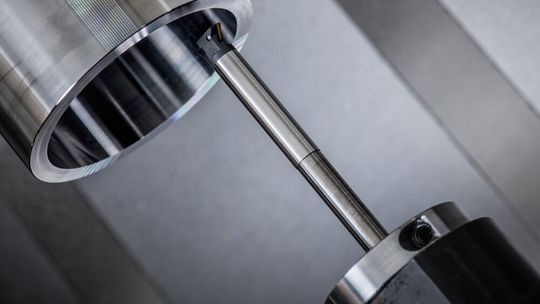
Just like the “G0” NC code, experienced machine operators are fond of making back-turning to reduce machining time and increase the tool life, measured by the number of workpieces. When it comes to internal turning, a back-turning, with roughing in forward and finishing backward, can reduce the number of tool changes and increase the duty cycle to save cost. However, back turning has its challenges when making internal turning operations.
A back turning operation in internal turning will use two different lead angles, and the lead angle has a detrimental effect on the vibration of a cutting tool. The figure below makes a relative illustration of the vibration tendency in a machining operation with forward-turning and backward-turning.

In other words, back-turning demands high-performance damped tools in internal turning operations.
The MAQ vibration damped tool holders have a wider operation window, which in this case gives the possibility to have a wider selection of “Lead Angle”. In the given machining example, we made a forward turning to make a roughing operation with a 1 mm depth of cut and then a finishing operation with a 0.1 mm depth of cut and as you can see the result is excellent.
Choosing MAQ products brings operators more freedom to plan their machining differently to save time and money. It is possible only because of the STMD technology that automatically adjusts itself to the working condition.
If you are planning to try back turning, MAQ’s advice is:
- Use a V shape or D shape insert which directs the cutting force in the longitudinal direction, such that the vibration tendency is less.
- Use a depth of cut smaller than the nose radius of your insert when making back turning.
(ID:48240062)
:quality(80)/p7i.vogel.de/wcms/c0/1b/c01b2dc4355fcb0ba5b4403c9bac75b7/0124943843v1.jpeg "The Dofeed-Tri tool system from Tungaloy features a milling cutter with six cutting edges on a reversible cutting insert. This makes roughing a breeze. (Bild: Tungaloy)")
:quality(80)/p7i.vogel.de/wcms/65/72/65720bc04b91a9dca469c07e398dc233/0129209582v2.jpeg "Horn Supermini type 105 universal boring system with sintered GM chip-breaker geometry. (Source: Horn Cutting Tools)")