In 2024, the 3D printing space saw challenges and slower growth, with several prominent materials players exiting the industry. In the long-term, there are still key trends within the additive manufacturing industry that will drive the uptake of this technology, according to ID Techex in their latest report.
Changes in interest rates throughout 2024 has been one of the main causes of recent limited growth for the additive manufacturing industry.
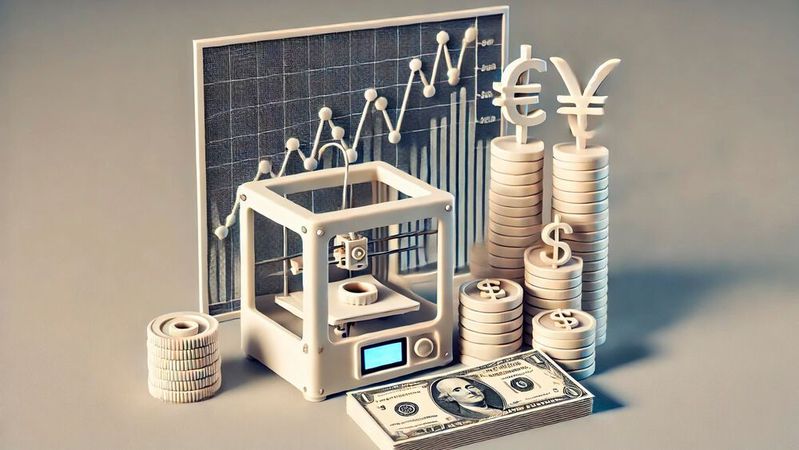
(Source: Dall-E / KI-generiert)
Changes in interest rates throughout 2024 has been one of the main causes of recent limited growth for the additive manufacturing industry, with the first interest rate cut since the pandemic taking effect in the US in September and further cuts since. In Europe, interest rates were also cut many times in 2024 to help ease inflation, and these cuts had a major effect on the purchasing of 3D printing equipment. Lowering interest rates may have persuaded 3D printing customers to delay purchasing until interest rates lower again or stabilize. ID Techex predicts that 2025 could see stabilizing rates, which may result in customers once again feeling confident in their equipment purchasing. Despite the capabilities of this technology and a cautiously optimistic outlook, there are still ongoing global economic challenges that will affect the market.
Poor macro-economic conditions were seen in 2024, particularly in Europe: one of the key regions for 3D printing. Companies in key sectors were deciding against capital investment in countries like Germany, one of the key adopters of 3D printing technology. GDP shrunk in this economy for the second year in 2024, meaning growth across many sectors, including additive manufacturing, was limited, as spending was reduced and capital investment was delayed. ID Techex reports that companies in other regions have also expressed a need to delay investments due to this economic and geopolitical uncertainty.
Players and notable closings
The effects of the economic environment can be seen in several 3D printing players, namely large material suppliers, leaving the market in 2024. Forward AM filed for insolvency after separating from BASF, while other companies such as Sintratec and Uniformity Labs closed their businesses. Despite some 3D printing companies being known for having achieved strong growth within the market, many of these closed down. Regardless of these ongoing challenges and closures, many 3D printing companies did see growth in 2024 and have positive expectations for 2025. Still, any continued growth will likely be steady rather than rapid, requiring customer support and investments.
Positive trends influencing the uptake of 3D printing
Reshoring alludes to bringing manufacturing operations back from overseas, closer to where the end products will be used. Reshoring has been a goal for many countries since the pandemic disrupted supply chains. Other motivations for reshoring will be tariffs imposed on different industries within the US, meaning American companies will want to bring manufacturing back to the US to protect their businesses. 3D printing companies believe these factors will increase adoption as 3D printing supports distributed manufacturing operations and the scale-up of local manufacturing industries.
Reducing cost per part will be another major influence in increasing the uptake of 3D printing technologies. With the largest barrier to additive manufacturing being cost, manufacturers focus on increasing the throughput of printers to print more in less time, thus bringing cost per part down, with new printers specifically designed to meet this goal.
Improvements and new approaches to polymer powder bed fusion may reduce waste and increase sustainability, which is an additional target for the 3D printing industry. Increasing the utilization of already used powder will help reduce the amount of material used and prevent unnecessary excess. While some printers can use between 70-80 percent used powder, changes are being made to some software to enable printing that uses 100 percent used powder, which will increase the sustainability of some powder bed fusion processes.
The desire to decrease labor costs and increase productivity will also help increase the uptake of 3D printing technology, in which automation will play a huge role in. Reducing the knowledge requirements for additive manufacturing processes and making large production more feasible will be possible with automated print farms where printers can run 24/7 without much intervention, which some companies in the space have already demonstrated. Additionally, automating 3D printing will help with reshoring and reducing cost per part, as the need for labour and educating employees will be reduced, meaning productivity has room to increase.
Date: 08.12.2025
Naturally, we always handle your personal data responsibly. Any personal data we receive from you is processed in accordance with applicable data protection legislation. For detailed information please see our privacy policy.
Consent to the use of data for promotional purposes
I hereby consent to Vogel Communications Group GmbH & Co. KG, Max-Planck-Str. 7-9, 97082 Würzburg including any affiliated companies according to §§ 15 et seq. AktG (hereafter: Vogel Communications Group) using my e-mail address to send editorial newsletters. A list of all affiliated companies can be found here
Newsletter content may include all products and services of any companies mentioned above, including for example specialist journals and books, events and fairs as well as event-related products and services, print and digital media offers and services such as additional (editorial) newsletters, raffles, lead campaigns, market research both online and offline, specialist webportals and e-learning offers. In case my personal telephone number has also been collected, it may be used for offers of aforementioned products, for services of the companies mentioned above, and market research purposes.
Additionally, my consent also includes the processing of my email address and telephone number for data matching for marketing purposes with select advertising partners such as LinkedIn, Google, and Meta. For this, Vogel Communications Group may transmit said data in hashed form to the advertising partners who then use said data to determine whether I am also a member of the mentioned advertising partner portals. Vogel Communications Group uses this feature for the purposes of re-targeting (up-selling, cross-selling, and customer loyalty), generating so-called look-alike audiences for acquisition of new customers, and as basis for exclusion for on-going advertising campaigns. Further information can be found in section “data matching for marketing purposes”.
In case I access protected data on Internet portals of Vogel Communications Group including any affiliated companies according to §§ 15 et seq. AktG, I need to provide further data in order to register for the access to such content. In return for this free access to editorial content, my data may be used in accordance with this consent for the purposes stated here. This does not apply to data matching for marketing purposes.
Right of revocation
I understand that I can revoke my consent at will. My revocation does not change the lawfulness of data processing that was conducted based on my consent leading up to my revocation. One option to declare my revocation is to use the contact form found at https://contact.vogel.de. In case I no longer wish to receive certain newsletters, I have subscribed to, I can also click on the unsubscribe link included at the end of a newsletter. Further information regarding my right of revocation and the implementation of it as well as the consequences of my revocation can be found in the data protection declaration, section editorial newsletter.
Key markets for 3D printing expected this year
ID Techex outlines the defense industry as one of the major sectors of interest for 3D printing, as reported by many printer manufacturers in 2024. With the demand for legacy parts, spare parts, and on demand parts, and the desire for more resilience that can be brought about by 3D printing, growth in the defence industry is expected to carry on in 2025. The automotive sector will also drive growth for 3D printing, as it could provide a good solution for the market as it faces tariffs and economic uncertainties with other supply chains.



:quality(80)/p7i.vogel.de/wcms/8d/b7/8db71c3fe25cd48399bfd8faaa5e90f7/0129228188v1.jpeg "The Contract Manufacturing Index shows the value of the market for contract and subcontract manufacturing services for machining, fabrication, and other processes. (Source: Qimtek)")
:quality(80)/p7i.vogel.de/wcms/fc/44/fc4431baf22faf49f91d695e7725b0de/0129227575v2.jpeg "Rejlek Group has commissioned a Sumitomo (SHI) Demag Intelect 130 with integrated SAM-C robot in Vienna, advancing energy-efficient, high-precision and sustainable injection moulding production. (Source: Sumitomo (SHI) Demag )")
:quality(80)/p7i.vogel.de/wcms/49/58/4958084fe5c4ed0a7758f7cfb3051e92/0128854986v1.jpeg "Intelligent material procurement connects components, materials, and processes into one seamless flow. (Bild: FACTUREE - The Online Manufacturer)")
:quality(80)/p7i.vogel.de/wcms/ad/39/ad3982b17d8034c9134821a24e023d12/0128991046v2.jpeg "Alpla uses the extrusion blow moulding (EBM) process to manufacture innovative plastic packaging for various sectors in the FMCG market. (Source: Alpla)")
:quality(80)/p7i.vogel.de/wcms/2f/34/2f344c97b0e4a9613850f3bb3b519101/0129337496v2.jpeg "Die & Mould India Expo 2026 will spotlight the latest developments and advanced technological innovations in tooling, mould-making, plastic injection moulding, and precision manufacturing. (Source: Tagma)")
:quality(80)/p7i.vogel.de/wcms/52/8c/528c3c99265c6d8951e6bb1dcf4ed7c2/0129224981v1.jpeg "For significantly greater efficiency: Smart grinding technologies mark a decisive step toward robust, self-optimizing manufacturing systems. (Source: KSF)")
:quality(80)/p7i.vogel.de/wcms/28/95/28952358db60b91461ebfda8196fad46/0129221819v1.jpeg "A Hurco / Kawasaki automated machining cell based on a 5-axis, swivelling-spindle Hurco machine. At Mach 2026, the robot system will feed a cantilever-type 5-axis model, VC500i. (Source: Hurco Europe )")
:quality(80)/p7i.vogel.de/wcms/d0/bd/d0bd3f70a8063a08274ed663509a1053/0129219028v2.jpeg "The Engel team presented the first autonomous injection moulding cell at Swiss Plastics Expo 2026. The solution reduces setup times, saves material and ensures consistently high quality – winning over the professional audience. (Source: Engel)")
:quality(80)/p7i.vogel.de/wcms/5d/3c/5d3cd553a019b4033e441e61f98b23d6/0129229293v1.jpeg "Featured also will be the Roemheld Moduhub equipment range, designed to help operators handle heavy or awkward components safely and efficiently during manual assembly. It also has the facility to feed back production data. (Source: Roemheld)")
:quality(80)/p7i.vogel.de/wcms/82/e7/82e72d20cefdef73713b584312be57d0/0129209599v2.jpeg "Asim Spahović, Hasco (third from left), in discussion with BSI customers Erwin Bekto, Redžo Bekto and Mehmed Šehić (from left to right). (Source: Hasco)")
:quality(80)/p7i.vogel.de/wcms/52/76/5276fd0bc681a34a30c4d7dc0ac4784c/0129107063v1.jpeg "Meusburger’s digital customer portal streamlines mould and die procurement by replacing lengthy email-based ordering with fast online shopping cart imports, smart configurators and full order transparency (Source: Meusburger)")
:quality(80)/p7i.vogel.de/wcms/d6/f8/d6f8f7b5bc0b08eb7357806e4b4d6df3/0128993006v1.jpeg "Hasco has expanded its Cimatron database with more than 50 new and updated catalogue components. (Source: Hasco)")
:quality(80)/p7i.vogel.de/wcms/ae/7c/ae7cfa25bd4cbdee97cf91514a80a569/0129333424v1.jpeg "Formnext 2026 strengthens industry focus with UK as partner country. (Source: Mesago/ Marc Jacquemin)")
:quality(80)/p7i.vogel.de/wcms/50/7e/507e92bc6eb96c6646801c23695fd698/0128867905v2.jpeg "Branding plate for Alstom trains produced in series. (Source: Replique )")
:quality(80)/p7i.vogel.de/wcms/cd/8c/cd8c3ca788be29055f3af26645fa0262/0128810840v1.jpeg "New materials and enhanced sourcing controls extend Xometry’s marketplace capabilities for aerospace, defence and medical manufacturing. (Source: Noah Willman)")
:quality(80)/p7i.vogel.de/wcms/40/59/4059f2264fa9693e048ee11050839486/0128700610v1.jpeg "By directly generating laser paths from implicit geometry, the hybrid toolpath drastically improves surface finish, mechanical strength, and computational efficiency for microscale lattices. (Source: Junhao Ding et al.)")
:quality(80)/p7i.vogel.de/wcms/07/74/07746815a405db2865052931aa3b9655/0129103565v1.jpeg "Mr Slimm at the control of the automated DMG Mori CMX 70 U VMC. The robot enclosure with safety fence and light curtain may be seen in the background. (Source: Whitehouse Machine Tools )")
:quality(80)/p7i.vogel.de/wcms/05/11/05119b92ebfd03919d063b254eec1b27/0129056177v1.jpeg "Setting up the FZP42 at Schütz (Source: Zimmermann)")
:quality(80)/p7i.vogel.de/wcms/9b/5d/9b5db33353f3e5a256e2f634ddc349c7/0129333056v1.jpeg "Browser-based simulation results showing improved cooling times after accepting SimForm's automated channel recommendations. (Source: Machine Works)")
:quality(80)/p7i.vogel.de/wcms/0a/e1/0ae1b7a9cc45bf10ebcbce27be707eda/0129230371v1.jpeg "Vericut Optimizer is a standalone optimisation solution that works directly from NC code. (Source: Vericut)")
:quality(80)/p7i.vogel.de/wcms/f4/e9/f4e9eabb65e0b34fe9911620718ea8e2/0129055594v1.jpeg "HCL CAM Works 2025 integrates CAM programming into the 3D Experience Solidworks platform, combining cloud-based collaboration with machine-aware CNC programming. (Source: HCL Software)")
:quality(80)/p7i.vogel.de/wcms/ba/7b/ba7bc9220708dc4bd16b8c815db267c2/0128938301v1.jpeg "The certification from Solidworks positions Ency as a Solidworks-compatible solution for combined CNC and robot programming, supporting stable, synchronized processes from design through to manufacturing. (Source: Ency)")
:quality(80)/p7i.vogel.de/wcms/f9/ca/f9ca9cace88200a5ec0946f193264963/0129209504v1.jpeg "Neil Taylor, who has worked in the toolroom at Pre-Met for 20 years. (Source: Pre-Met)")
:quality(80)/p7i.vogel.de/wcms/2f/61/2f61dd20be68049fa2320a2e5aa860d7/0123789183v2.jpeg "from left to right: Sodick President Giuseppe Addelia and Vice President Salvatore Cocco (Source: Sodick)")
:quality(80)/p7i.vogel.de/wcms/c5/49/c54973f28495dada1c7605f913717341/0121533734v1.jpeg "The set-up of the complex parts on the new Sodick ALC600G (Source: Sodick)")
:quality(80)/p7i.vogel.de/wcms/94/8f/948f81f46645691d1d90152ef605a0ae/0120806008v2.jpeg "Some of the billets clamped and ready for lights out machining at Bellcliffe. (Source: ETG)")
:quality(80)/p7i.vogel.de/wcms/3e/fb/3efbcc73e59a0c19de0676cf569c6f28/0129201505v1.jpeg "A screen shot from LK’s online virtual showroom. (Source: LK Metrology)")
:quality(80)/p7i.vogel.de/wcms/9e/59/9e59861a06c0d20831e0d7d5191188ed/0129056166v2.jpeg "At Southern Manufacturing 2026, Carfulan Group is showcasing its full portfolio of advanced production and metrology technologies, including the first public presentation of OGP UK’s Smart Scope M7, alongside live demonstrations of additive manufacturing, optical measurement and tool presetting. (Source: Carfulan)")
:quality(80)/p7i.vogel.de/wcms/41/93/4193f3985dc04080399cb574e810a79c/0128985792v1.jpeg "Faro Technologies and Creaform, both part of Ametek, reorganise their activities into two new business units. (Source: Creaform)")
:quality(80)/p7i.vogel.de/wcms/ce/94/ce94bd1d0acf451687549f8e3efdb07a/0128981060v1.jpeg "EMG offers a range of force and/or displacement management solutions combining force and displacement sensors connected to a display for 100 percent part control. (Source: EMG)")
:quality(80)/p7i.vogel.de/wcms/4a/3e/4a3ee5cd13d05629db9d3e88aa22ff01/0129103256v1.jpeg "Full-flow microfiltration to 3 to 5 µm, demand-based backwashing, precise temperature control, and modular system architecture make the cooling lubricant peripherals a real performance factor for the entire production chain. (Source: Vomat)")
:quality(80)/p7i.vogel.de/wcms/6b/b4/6bb456c148f06af9d65155da63665c22/0129102929v1.jpeg "Thanks to a dual spindle, hybrid machines can grind PCD tools (top) and erode them (bottom) in a single set-up, increasing efficiency in terms of both time and quality. (Source: Vollmer Werke Maschinenfabrik)")
:quality(80)/p7i.vogel.de/wcms/f3/4d/f34d32adcd63bdf5332e4d57ae75611a/0128850501v1.jpeg "The new AW Series Oil Mist Collectors from Filtermist (Source: Filtermist)")
:quality(80)/p7i.vogel.de/wcms/7c/a2/7ca2adf016cad8d1de510c4df0ff57bc/0128810813v1.jpeg "Vomat, based in Treuen, stands for fine filtration technology in industrial metalworking, which not only sets technical standards but also impresses with its exceptional vertical range of manufacture. (Source: KSKOMM)")
:quality(80)/p7i.vogel.de/wcms/57/9c/579c8e2bcff2e800a19fcb0926e574fa/0129056117v1.jpeg "Fortis mill grinding wheels from weiler abrasives are designed for hot and cold rolling mills, combining advanced ceramic grain technology with longer service life to reduce downtime and increase productivity. (Source: Weiler Abrasives)")
:quality(80)/p7i.vogel.de/wcms/4a/5f/4a5fd6bde5784db58812f15386c2126f/0126112832v2.jpeg "Boride Engineered Abrasives offers mould makers worldwide a complete toolkit for achieving top-quality surface finishes. (Source: Boride)")
:quality(80)/p7i.vogel.de/wcms/87/3c/873c56a315b598e5491cef38d9ef72f1/0123364440v1.jpeg "The fully synthetic corrosion protection Z2690/… comes with NSF-H1 registration. (Source: Hasco)")
:quality(80)/p7i.vogel.de/wcms/00/2a/002ad74723b737fd6e4729e3434f16ab/0123040413v1.jpeg "The Evo-Series features advanced technology for simple and efficient operation. (Source: Asco)")
:quality(80)/p7i.vogel.de/wcms/6b/9c/6b9cab1e262f77caed8179ed3dc29807/0129104421v1.jpeg "GMH Gruppe has consolidated Kind & Co., Schmiedewerke Gröditz and Buderus Edelstahl into a unified Open-Die Forging Group, supported by a 30 million euro investment programme to strengthen Europe-based tool steel and forging supply. (Source: Oliver Pracht/ GMH Gruppe)")
:quality(80)/p7i.vogel.de/wcms/39/a3/39a32d830d6bb6e4471c79e537c5ca52/chimei-ecologue-frosch-6000x3373v1v1.jpeg "The green frog represents the Ecologue portfolio at CHIMEI. It reflects the company's commitment to innovation, safety, and sustainability – aiming to drive progress in various industries while also contributing to addressing global environmental challenges. (Image:CHIMEI)")
:quality(80)/p7i.vogel.de/wcms/2b/29/2b297a2773f13d3017fc6d49424a57b1/0127570680v1.jpeg "Dr Aphrodite Tomou heads up the technical department of Goodfellow (Source: Goodfellow)")
:quality(80)/p7i.vogel.de/wcms/13/ec/13ece74e59d459301ea38becf80c9706/0129200881v1.jpeg "DN Solutions CEO Won-jong Kim (Left) with Heller CEO Thorsten Schmidt. (Source: DN Solutions)")
:quality(80)/p7i.vogel.de/wcms/fe/9b/fe9b79ee842142ff26180132de72b2d5/0129103360v1.jpeg "Innova Engineered Plastics has expanded its Mexicali manufacturing site with new injection moulding capacity to meet growing demand for heavy gauge plastic enclosures in highly regulated industries. (Source: Innova Engineered Plastics)")
:quality(80)/p7i.vogel.de/wcms/2a/7e/2a7e5ced0986e88a6c24123fba954dee/0128871141v2.jpeg "Leadership transition at Hasco: Markus Büngers steps into the role of CEO. (Source: Hasco)")
:quality(80)/p7i.vogel.de/wcms/1d/2a/1d2a6bc382131d8cc1f325617e1dced8/0128870377v1.jpeg "On 12 January 2026, Dr Volker Nilles took up the position as Chief Executive Officer of Arburg. (Source: Arburg)")
:fill(fff,0)/p7i.vogel.de/companies/66/0e/660e93698db24/hasco-logo-or-b50.jpeg "hasco-logo-or-b50 (HASCO)")
:fill(fff,0)/images.vogel.de/vogelonline/companyimg/84400/84424/65.jpg "logo.jpg ()")
:fill(fff,0)/images.vogel.de/vogelonline/companyimg/118400/118496/65.jpg "Renishaw_EMBLEM_orange_RGB.jpg ()")
:quality(80)/p7i.vogel.de/wcms/83/c8/83c8835548a791c97ef125d86e2d2d81/0124841425v1.jpeg "Growth in the Metal Additive Manufacturing market by process (Source: ID Techex)")
:quality(80)/p7i.vogel.de/wcms/df/0b/df0b8272f49f672f3290e7a3102f87ab/0122987611v2.jpeg "Spain has been announced as the partner country for Formnext 2025, the leading global exhibition for additive manufacturing (AM) technologies and next-generation production. (Source: Mesago Messe Frankfurt/ Mathias Kutt)")