Metal additive manufacturing is evolving from a prototyping tool into a driver of high-value production across industries like aerospace and automotive. A new ID Techex report forecasts the market will nearly triple by 2035, with laser powder bed fusion leading the way, China emerging as a growth powerhouse, and tariffs posing both risks and opportunities for future adoption.
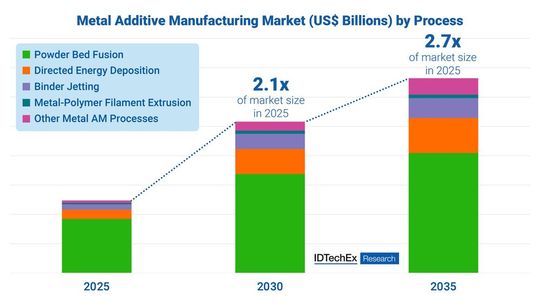
Growth in the Metal Additive Manufacturing market by process
(Source: ID Techex)
With the broader 3D printing industry, which encompasses material subspecialities like polymers, ceramics, and electronics, metal additive manufacturing (AM) has particularly shown strength in recent years. As more users identify end-use applications for metal 3D-printed parts in sectors like aerospace, automotive, manufacturing, etc., it is clear that the industry is maturing beyond prototyping and tooling to penetrate high-value applications. This will help the metal AM hardware and materials market nearly triple its market size by 2035, according to ID Techex’s report “Metal Additive Manufacturing 2025-2035: Technologies, Players, and Market Outlook”.
Even in this highly differentiated billion-dollar industry, overflowing with many players and unique metal printing technologies, broader trends are still shaping the metal AM industry’s direction, both in the short- and long-term.
Powder bed fusion: Undisputed technology leader of metal AM
In the past several years, there has been significant hype around growing metal AM technologies, including metal binder jetting (MBJ) and metal-polymer filament extrusion (MPFE) (also known as bound metal extrusion). The unique capabilities of these technologies promised increased adoption by end-users who were otherwise not well-served by incumbent metal 3D printing technologies. However, the past several years has proven that laser powder bed fusion (LPBF), the first metal AM technology, has been and will remain the undisputed leader of metal AM technologies, according to ID Techex forecasts.
Part of this stems from LPBF’s maturity as a technology. As the first metal AM technology to be commercialized, it is backed up by years of manufacturer and end-user experience that enable it to be used effectively. In many cases, end-users of growing technologies, like MBJ and MPFE, are still working to address pain points in these processes and to identify applications where these processes, particularly MBJ, are technologically and economically advantageous.
Additionally, LPBF is a highly versatile technology. Depending on the configuration of the printer (i.e. build size, number of lasers, etc.), LPBF can be used for everything from small injection molds to massive rocket engines. In contrast, MPFE is best suited for prototyping, jigs, and fixtures, while MBJ is best for high volumes of small to medium-sized parts that have geometries compatible with the sintering process. The versatility of LPBF ensures that the technology will continue to lead the metal AM industry in revenue over the next decade.
China: Metal AM’s fastest growing region
The regional growth of the Chinese metal 3D printing market is one of metal AM's biggest stories. As the Chinese metal AM market has largely remained domestic, awareness of this fact in North America and Europe was relatively low up until the past few years, but there is no doubt that metal 3D printing has taken off in China. Chinese LPBF manufacturers like BLT, HBD, and Eplus3D have grown substantially over the past decade to serve a domestic audience that largely preferred local, cost-competitive suppliers over incumbent players like EOS and SLM Solutions. The sheer size of China's domestic industries, whether it be aerospace, manufacturing, automotive, etc., provided more than enough customers for these Chinese AM leaders to experience double-digit growth.
Their success enables them to expand to overseas customers, with several Chinese manufacturers opening European or American offices and establishing partnerships with distributors to reach customers. Given that capital cost is a major barrier to adoption for metal 3D printing, Chinese manufacturers' main value proposition of cost-competitive metal AM machines is quite attractive for end-users abroad. However, with ongoing geopolitical tensions and the levying of tariffs, that value proposition may be eroded. Still, the overall strength of the domestic Chinese market will make it an important region for AM for years to come.
Tariffs: A double-edged sword for metal AM
Currently, the implementation of tariffs is creating headwinds and tailwinds for the metal additive manufacturing industry. These tariffs are ostensibly meant to encourage domestic manufacturing in the US. For onshoring to occur, extensive amounts of automation would be required, which can be supported through metal additive manufacturing. Additionally, metal AM's fast turnaround times can help speed up timelines to set up manufacturing operations. In theory, metal AM as an enabler for manufacturing operations means that the metal AM industry could benefit from increased domestic manufacturing caused by tariffs.
Date: 08.12.2025
Naturally, we always handle your personal data responsibly. Any personal data we receive from you is processed in accordance with applicable data protection legislation. For detailed information please see our privacy policy.
Consent to the use of data for promotional purposes
I hereby consent to Vogel Communications Group GmbH & Co. KG, Max-Planck-Str. 7-9, 97082 Würzburg including any affiliated companies according to §§ 15 et seq. AktG (hereafter: Vogel Communications Group) using my e-mail address to send editorial newsletters. A list of all affiliated companies can be found here
Newsletter content may include all products and services of any companies mentioned above, including for example specialist journals and books, events and fairs as well as event-related products and services, print and digital media offers and services such as additional (editorial) newsletters, raffles, lead campaigns, market research both online and offline, specialist webportals and e-learning offers. In case my personal telephone number has also been collected, it may be used for offers of aforementioned products, for services of the companies mentioned above, and market research purposes.
Additionally, my consent also includes the processing of my email address and telephone number for data matching for marketing purposes with select advertising partners such as LinkedIn, Google, and Meta. For this, Vogel Communications Group may transmit said data in hashed form to the advertising partners who then use said data to determine whether I am also a member of the mentioned advertising partner portals. Vogel Communications Group uses this feature for the purposes of re-targeting (up-selling, cross-selling, and customer loyalty), generating so-called look-alike audiences for acquisition of new customers, and as basis for exclusion for on-going advertising campaigns. Further information can be found in section “data matching for marketing purposes”.
In case I access protected data on Internet portals of Vogel Communications Group including any affiliated companies according to §§ 15 et seq. AktG, I need to provide further data in order to register for the access to such content. In return for this free access to editorial content, my data may be used in accordance with this consent for the purposes stated here. This does not apply to data matching for marketing purposes.
Right of revocation
I understand that I can revoke my consent at will. My revocation does not change the lawfulness of data processing that was conducted based on my consent leading up to my revocation. One option to declare my revocation is to use the contact form found at https://contact.vogel.de. In case I no longer wish to receive certain newsletters, I have subscribed to, I can also click on the unsubscribe link included at the end of a newsletter. Further information regarding my right of revocation and the implementation of it as well as the consequences of my revocation can be found in the data protection declaration, section editorial newsletter.
On the other hand, the push and pull of tariffs creates significant uncertainty in the economy. Many companies are pulling back from capital investment during this time, which includes new manufacturing operations. Additionally, many companies are pulling back R&D spending to focus on core business operations; as such, companies are reluctant to invest in new technologies like additive manufacturing. This lack of investment could negatively impact the adoption and expansion of metal AM.
As such, tariffs may be a double-edged sword for metal AM, and it is uncertain exactly how the industry will be impacted in 2025. Economic uncertainty already caused some slowdown in the industry in the second half of 2024, and tariffs may or may not continue that trend in the next few years.
* Sona Dadhania, Principal Technology Analyst at ID Techex



:quality(80)/p7i.vogel.de/wcms/10/b9/10b904e03efac26f870efc9ac032bb30/0131163630v2.jpeg "The traceless material is based on natural polymers derived from agricultural residues. (Source: Traceless Materials)")
:quality(80)/p7i.vogel.de/wcms/bb/74/bb74aefce7687b2ac87e62f6a52cf67e/0130170106v1.jpeg "Incoming orders for the German machine tool industry (Source: VDW)")
:quality(80)/p7i.vogel.de/wcms/73/8a/738a9f20229e20ae938c5e690b37a5df/0129780274v1.jpeg "With the acquisition of Knudsen Plast, MGS expands its European cleanroom injection moulding capacity and strengthens regional support for pharma, diagnostics and MedTech customers. (Source: MGS)")
:quality(80)/p7i.vogel.de/wcms/d2/63/d26376330f084c718f9ab83fc66eb39f/0129319680v1.jpeg "Situation in mechanical engineering: VDMA Chief Economist Dr. Johannes Gernandt looks back on the past year, with a particular focus on December: “Given the recent developments, we expect a slight increase in 2026. Sentiment is improving, but there is no reason for celebration.” (Source: VDMA / Sarah Kastner Fotografie)")
:quality(80)/p7i.vogel.de/wcms/ec/86/ec86dc4bd5fd8425c4bc6fd71409e7ad/0131049990v1.jpeg "The Simtos 2026 manufacturing trade fair recently came to an end. Here the organizer sums up the event. One thing can be said: Not only the philosophy of the trade fair organizers was well received ... (Image:Simtos)")
:quality(80)/p7i.vogel.de/wcms/32/16/3216bea996ced32365d17dcf41b9fd0f/0131076030v1.jpeg "The expert agenda at the Plastics Industry Meeting in 2025 attracted industry representatives from Poland and abroad to Targi Kielce. (Source: Michał Stańczyk/ Targi Kielce)")
:quality(80)/p7i.vogel.de/wcms/d1/ef/d1ef06600622f5bb2f3ce2676d68ec91/0131077323v1.jpeg "The opening ceremony was attended by several industry representatives, including Chief Guest Mr. Manoj Kolhatkar, MD and CEO of Tata Autocomp Systems, and Guests of Honour Mr. F. R. Singhvi, Joint Managing Director, Sansera Engineering and President, Aerospace India Association; Mr. Vinamra Mishra, Joint Secretary, Ministry of MSME; and Mr. Hector U. Villanueva, Chairman, Fadma.
(Source: Tagma)")
:quality(80)/p7i.vogel.de/wcms/60/45/6045cb15d71397154c6cee56d5d95ac7/0131063997v1.jpeg "Grinding from solid material using two CBN profile grinding wheels for roughing. (Source: Kapp)")
:quality(80)/p7i.vogel.de/wcms/0d/6c/0d6c5ea88cb425ab9dd066457225e61b/0131066999v2.jpeg "Temperature-control connection plates in three versions (Source: Nonnenmann)")
:quality(80)/p7i.vogel.de/wcms/03/41/0341f13be7d88e59075184138a9bfc44/0131010620v2.jpeg "Meusburger offers high-quality coupling systems and delivers them immediately from stock. (Source: Meusburger)")
:quality(80)/p7i.vogel.de/wcms/16/fd/16fd246f520f6340c1d7fe77a26f817d/0130918842v2.jpeg "Progressive’s CVe Monitor RT and Profile provide 24/7 performance data streaming for instant visibility of your tool’s activity from anywhere in the world. (Source: Progressive Components)")
:quality(80)/p7i.vogel.de/wcms/f5/ad/f5ad2cefc6d208da995f0768238e4537/0130726865v1.jpeg "Meusburger’s configurators and wizards reduce the need to perform steps manually, minimise sources of error and guide designers through the entire development process. (Source: Meusburger)")
:quality(80)/p7i.vogel.de/wcms/b2/73/b2735e537e1eb3efe40b5610b62e5cc3/0130952440v2.jpeg "Printing at 10–50 micron layer heights, BMF Clear achieves superior surface quality, reducing post-processing time while improving optical transmission. (Source: Boston Micro Fabrication)")
:quality(80)/p7i.vogel.de/wcms/b2/a3/b2a3109b76173f15093c53e031bc3b0f/0130927341v1.jpeg "Printing a nucleation net zone in Vibenite® 480 is simple, yet it enables precise placement of the wear resistant material inside the mold at the most critical positions — significantly extending pump lifetime. (Source: VBN Components)")
:quality(80)/p7i.vogel.de/wcms/53/5f/535f333e84ac99d48506e145f564f7d7/0130933064v2.jpeg "HP introduces the HP Multi Jet Fusion 1200 3D Printer Solution, a compact system designed to bring industrial MJF technology into every workspace. (Source: HP)")
:quality(80)/p7i.vogel.de/wcms/9e/e1/9ee1377d9f07aef4a0bfdd76120777e9/0130750150v1.jpeg "Panel discussion at Formnext 2025 (Source: Formnext Mesago Messe Frankfurt, Marc Jacquemin)")
:quality(80)/p7i.vogel.de/wcms/20/80/2080366dbf8cca84fe9d00659b8de85c/0131056632v1.jpeg "ABB Robotics says it has once again listened to users. As a result, companies can now invest in a new robot cell that is also affordable for SMEs and can automatically handle time-consuming grinding and polishing tasks. (Source: ABB)")
:quality(80)/p7i.vogel.de/wcms/44/b6/44b693400b1e32f96742addc69bd8d7c/0130946952v1.jpeg "AMB will be a fixed date in the industry’s diary in 2026, taking place from 15 to 19 September. (Source: Messe Stuttgart)")
:quality(80)/p7i.vogel.de/wcms/79/cf/79cf780f220d2f7119b8a8b0e33da14f/0130726885v2.jpeg "Citizen Miyano BNJ-51SY with 4-axis LFV. (Source: Citizen Machinery UK )")
:quality(80)/p7i.vogel.de/wcms/fa/61/fa6158da9810738698df5e753e618d65/0130636802v1.jpeg "Winterthur Technology Group grinding solution featuring conventional high-performance grinding wheel and diamond form dressing roller, delivering precision and efficiency. (Source: Winterthur)")
:quality(80)/p7i.vogel.de/wcms/00/9a/009ae0e133b321f8f0dabfb3fe14d2a6/0130776695v1.jpeg "The expanded functions simplify digital manufacturing processes and support the automated procurement of precision components. (Source: Meviy)")
:quality(80)/p7i.vogel.de/wcms/28/43/28438c7998aebec0c2f5fb6f1a16b387/0130764478v2.jpeg "Siemens and Humanoid are bringing physical AI to the factory floor by deploying humanoid robots in industrial operations with NVIDIA. (Source: Siemens)")
:quality(80)/p7i.vogel.de/wcms/d1/5a/d15a3e1b3846c92e2ec610a5fb1f22dd/0130750258v1.jpeg "Background simulation during toolpath calculation (Source: Ency)")
:quality(80)/p7i.vogel.de/wcms/68/41/684118d197bf027713cb709badbb3667/0130804377v7.jpeg "Module Works has created a new executive role and appointed Gürsel Demircali to drive strategy, partner growth and international expansion in digital manufacturing. (Source: Module Works )")
:quality(80)/p7i.vogel.de/wcms/d5/1d/d51def0b31e213e756bbfb9479fa9c7e/0129925621v2.jpeg "Automatic electrode feeding: Together with Sodick and Erowa, the Robot Compact 80 (ERC80) was integrated — including connection to the Zeiss measuring machine and chip-based job management. (Source: Sodick)")
:quality(80)/p7i.vogel.de/wcms/f9/ca/f9ca9cace88200a5ec0946f193264963/0129209504v1.jpeg "Neil Taylor, who has worked in the toolroom at Pre-Met for 20 years. (Source: Pre-Met)")
:quality(80)/p7i.vogel.de/wcms/2f/61/2f61dd20be68049fa2320a2e5aa860d7/0123789183v2.jpeg "from left to right: Sodick President Giuseppe Addelia and Vice President Salvatore Cocco (Source: Sodick)")
:quality(80)/p7i.vogel.de/wcms/c5/49/c54973f28495dada1c7605f913717341/0121533734v1.jpeg "The set-up of the complex parts on the new Sodick ALC600G (Source: Sodick)")
:quality(80)/p7i.vogel.de/wcms/76/aa/76aa92f11f136c10e16cc77a89a5f583/0131009272v2.jpeg "From digital planning to physical verification: the machined component prepared for inspection on the CMM. (Source: Mitutoyo )")
:quality(80)/p7i.vogel.de/wcms/53/c7/53c73ae0a157d4c103e1964e77c1f425/0130023300v1.jpeg "The LK Altera M 20.12.10 CMM at Action Plas Group in Pudsey supports the inspection of high-value machined and additively manufactured components. (Source: LK Metrology)")
:quality(80)/p7i.vogel.de/wcms/68/ab/68abf66929cb9f2dcb823a12e90d1d21/0129922525v1.jpeg "The blast nozzles, placed at the top and bottom of a vertical linear shuttle unit, can be moved up/down and individually turned on or off. (Source: Rösler Oberflchentechnik)")
:quality(80)/p7i.vogel.de/wcms/46/85/46854ab7a2679db67354f556f2bc1db9/0129539660v2.jpeg "Nikon Eclipse MA200 LED is an inverted microscope with reflected illumination that is ideal for inspecting industrial parts. (Source: Nikon)")
:quality(80)/p7i.vogel.de/wcms/4c/dd/4cdd1643347d5f6f72743402d36e93f4/0130628083v2.jpeg "The filter units of the AW oil mist filters are designed to take up minimal space and are characterised by easy maintenance, quiet operation and a high degree of system integration. (Source: Absolent)")
:quality(80)/p7i.vogel.de/wcms/51/3e/513e2d937e96401a4d1ff8db1481cce7/0130242596v1.jpeg "With the GC1240 insert grade, Sandvik Coromant is bringing to the machining world a solution featuring a special coating that makes the tooling system significantly more wear-resistant and boosts productivity ... (Source: Sahdvik Coromant)")
:quality(80)/p7i.vogel.de/wcms/f8/8f/f88f47ba8e4ef50152497010c25dda11/0130168360v1.jpeg "At Grinding Hub, in Hall 7, Booth 7D80, Vomat will showcase high-performance microfiltration solutions for coolant, specifically designed for demanding metalworking applications such as tool grinding. (Source: Vomat)")
:quality(80)/p7i.vogel.de/wcms/be/4d/be4da3d2f0d802d94127979ea4af68b4/0130748997v1.jpeg "At Grindinghub 2026, Weiler Abrasives will present precision grinding solutions for demanding applications in sectors such as aerospace, automotive and steel production, with a focus on higher productivity, process stability and superior surface quality. (Source: Weiler Abrasives )")
:quality(80)/p7i.vogel.de/wcms/66/52/6652eb3a653a0908d5b03fb638f16260/0129646074v2.jpeg "The powerful EVO42 turbine with throwing blades made from hardened tool steel is ideally suited for the harsh conditions in foundries (Source: Rösler Oberflächentechnik)")
:quality(80)/p7i.vogel.de/wcms/9e/bd/9ebd826ceed28c644a9205bdbf82beb4/0131007997v2.jpeg "The lead-free aluminium solutions that combine high performance with stable and reliable machining processes. (Source: Eural Gnutt)")
:quality(80)/p7i.vogel.de/wcms/d5/e6/d5e68c74fabff18ef737ee767b7b359f/0130415707v1.jpeg "Efficiency in machining and a reduced carbon footprint will be at the centre of Swiss Steel Group’s presentation at Wire 2026 in Düsseldorf. (Source: Swiss Steel Group)")
:quality(80)/p7i.vogel.de/wcms/6b/9c/6b9cab1e262f77caed8179ed3dc29807/0129104421v1.jpeg "GMH Gruppe has consolidated Kind & Co., Schmiedewerke Gröditz and Buderus Edelstahl into a unified Open-Die Forging Group, supported by a 30 million euro investment programme to strengthen Europe-based tool steel and forging supply. (Source: Oliver Pracht/ GMH Gruppe)")
:quality(80)/p7i.vogel.de/wcms/49/58/4958084fe5c4ed0a7758f7cfb3051e92/0128854986v1.jpeg "Intelligent material procurement connects components, materials, and processes into one seamless flow. (Bild: FACTUREE - The Online Manufacturer)")
:quality(80)/p7i.vogel.de/wcms/ce/80/ce8008acc51e05d5c33a5890d07e239d/0131117485v1.jpeg "Modiform develops cultivation, transport and packaging solutions for the horticultural supply
chain. (Source: Modiform)")
:quality(80)/p7i.vogel.de/wcms/e7/74/e774210496e99be6481defcde77bab19/0131116903v1.jpeg "Xaloy’s acquisition of Italy-based Maxi Melt is intended to broaden its capabilities in plasticising components and strengthen its European customer support. (Source: Maxi Melt)")
:quality(80)/p7i.vogel.de/wcms/f7/8d/f78df2ee390561b7bca9624e430d6363/0130931883v1.jpeg "The Elmet management team, left to right: Horst Binderlehner (Operations), Thorsten Häuser (Development), Harald Wallner (CEO), Gerhard Mühlberger (Finance), and David Gebeshuber (Sales). (Source: Elmet)")
:quality(80)/p7i.vogel.de/wcms/9a/51/9a5199edfd0557c21666b29fafb56fc5/0130926622v1.jpeg "Guill Tool announced the appointment of Stephen Ovren as the company’s sales manager. (Source: Guill Tool )")
:fill(fff,0)/images.vogel.de/vogelonline/companyimg/26200/26226/65.jpg "Logo.jpg ()")
:fill(fff,0)/images.vogel.de/vogelonline/companyimg/118400/118496/65.jpg "Renishaw_EMBLEM_orange_RGB.jpg ()")
:fill(fff,0)/images.vogel.de/vogelonline/companyimg/64200/64280/65.png "Diprofil_logo.png ()")
:quality(80)/p7i.vogel.de/wcms/1b/0e/1b0e941c5cd87abf76e420f13ef9adaf/0129842848v1.jpeg "Conceptual diagram showing AI-based analysis and prediction of how powder characteristics and process conditions affect defects and component performance in metal 3D printing processes.
(Source: Korea Institute of Materials Science (Kims))")
:quality(80)/p7i.vogel.de/wcms/2c/8d/2c8dde30fb48d7a554574aba721974fa/0125496906v1.jpeg "IMR and Renishaw join forces to develop advanced additive manufacturing solutions for aerospace, targeting scalable production of next-generation optical components for satellite communication. (Source: IMR)")