At K 2025, Arburg will celebrate the world premiere of its new Allrounder 475 V – a compact vertical machine with 1,000 kN clamping force, high energy efficiency and flexible automation options. Designed for sectors from e-mobility to medical technology, it demonstrates how sustainable, high-quality parts can be produced efficiently in turnkey systems.
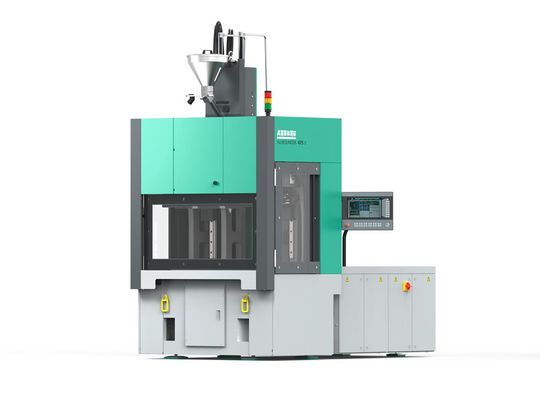
World premiere at the K 2025: The Allrounder 475 V is an energy-efficient, space-saving, cost-effective and flexible vertical injection moulding machine.
(Source: Arburg)
The Allrounder 475 V with a clamping force of 1,000 kN is celebrating its world premiere at the K 2025. It showcases high energy efficiency, a small footprint and an attractive price-performance ratio. The new vertical machine from Arburg can be used flexibly and looks predestined for both manual and automated overmoulding of inserts. At stand 13A13, the Allrounder 475 V can be seen as part of a turnkey system that produces, marks and post-processes high-quality covers for car radio keys from PC/ABS recyclate in combination with in-mould decoration (IMD).
The new vertical machine is specifically designed for standard applications, for example for the growth sector of e-mobility as well as for electronics and medical technology. These include the manual or automated overmoulding of cables, contacts and infusion accessories.
Small footprint — large space for the mould
The footprint is particularly compact but, despite this, the new vertical machine offers extra space also for larger moulds. The standard installation height is 250 millimetres with the option of extending it by 100 or 200 millimetres. Side doors and the upwardly offset clamping cylinder ensure good accessibility to the mould and ejector. An off-centre ejector is available as an option. The table height is 900 millimetres for improved ergonomic working.
Energy consumption reduced by up to 60 percent
The Allrounder 475 V has a clamping force of 1,000 kN and can be equipped with hydraulic injection units in sizes 100 to 400.
For energy-efficient operation, the machine is equipped as standard with the Arburg servo hydraulics system (ASH), which continuously adjusts the water-cooled, speed-controlled servo motors to the actual power requirement. This minimises idling losses and reduces the specific energy requirement by up to 60 percent compared to conventional hydraulic machines.
New Gestica lite control variant
The new “Gestica lite” control variant ensures particularly simple and intuitive operation. Even inexperienced personnel can get to grips with this quickly. The clear dashboard provides everything needed for the work at a glance: information on the job, the current process and the upcoming tasks — all intelligently and actively supported by optional assistance functions that ensure high-quality plasticising and moulded part quality.
Vertical machine can be automated in a flexible manner
If required, the vertical machine can be automated flexibly, for example with a six-axis or linear Multilift robotic system. Arburg can fulfil almost any customer requirement, including simple sprue removal, difficult component handling or customised automation for complex production cells including upstream or downstream process steps. The Arburg turnkey experts supply CE-compliant machines, automation and peripherals from a single source.
Practical example of a wireless key cover
At K 2025, the turnkey system based around an Allrounder 475 V will show how products with high-quality designs and surfaces can be created efficiently for the mobility sector. This is demonstrated by the cover of a wireless key, featuring a design based on the “Generic Keyfob” from company Huf. Its plastic cover is made of post-industrial recyclate (PIR) based on PC/ABS. A high-quality surface is created using the new PLF technology (Protective Layer Finish) for In-Mould Decoration (IMD) from partner Leonhard Kurz in combination with a structured tool insert. For this purpose, a wafer-thin PET film including decoration system is fed into the mould from the outside via a feed unit. There, the decorative film is applied to the plastic surface by means of in-mould lamination. An Arburg logo and a textured surface are also applied to the moulded part via the mould insert. The cover is punched out rectangularly in the mould and the remaining film is rolled up in the installation space of the vertical machine. Subsequent painting is not necessary and the product can be recycled. Different films featuring a variety of designs and colours that can be used flexibly for product variants.
Automated parts handling and R-Cycle
The fully automated application is also a successful practical example of the R-Cycle initiative. Data relating to recycling such as the material composition can be retrieved via a code on the component. Such digital product passports lay the groundwork for data-based material flows and a closed plastics cycle.
Date: 08.12.2025
Naturally, we always handle your personal data responsibly. Any personal data we receive from you is processed in accordance with applicable data protection legislation. For detailed information please see our privacy policy.
Consent to the use of data for promotional purposes
I hereby consent to Vogel Communications Group GmbH & Co. KG, Max-Planck-Str. 7-9, 97082 Würzburg including any affiliated companies according to §§ 15 et seq. AktG (hereafter: Vogel Communications Group) using my e-mail address to send editorial newsletters. A list of all affiliated companies can be found here
Newsletter content may include all products and services of any companies mentioned above, including for example specialist journals and books, events and fairs as well as event-related products and services, print and digital media offers and services such as additional (editorial) newsletters, raffles, lead campaigns, market research both online and offline, specialist webportals and e-learning offers. In case my personal telephone number has also been collected, it may be used for offers of aforementioned products, for services of the companies mentioned above, and market research purposes.
Additionally, my consent also includes the processing of my email address and telephone number for data matching for marketing purposes with select advertising partners such as LinkedIn, Google, and Meta. For this, Vogel Communications Group may transmit said data in hashed form to the advertising partners who then use said data to determine whether I am also a member of the mentioned advertising partner portals. Vogel Communications Group uses this feature for the purposes of re-targeting (up-selling, cross-selling, and customer loyalty), generating so-called look-alike audiences for acquisition of new customers, and as basis for exclusion for on-going advertising campaigns. Further information can be found in section “data matching for marketing purposes”.
In case I access protected data on Internet portals of Vogel Communications Group including any affiliated companies according to §§ 15 et seq. AktG, I need to provide further data in order to register for the access to such content. In return for this free access to editorial content, my data may be used in accordance with this consent for the purposes stated here. This does not apply to data matching for marketing purposes.
Right of revocation
I understand that I can revoke my consent at will. My revocation does not change the lawfulness of data processing that was conducted based on my consent leading up to my revocation. One option to declare my revocation is to use the contact form found at https://contact.vogel.de. In case I no longer wish to receive certain newsletters, I have subscribed to, I can also click on the unsubscribe link included at the end of a newsletter. Further information regarding my right of revocation and the implementation of it as well as the consequences of my revocation can be found in the data protection declaration, section editorial newsletter.
A Kuka six-axis robot is used for the complete part handling. It first removes the moulded part from the mould and feeds it to a laser station, where it is labelled with a code. The robot then transfers the part to a milling station and, with the gripper, guides it along the milling path to remove excess film and generate the final contour. In a subsequent cleaning station, the wireless key cover is deburred before finally getting placed on a conveyor belt by the six-axis robot and ejected from the production cell.



:quality(80)/p7i.vogel.de/wcms/55/47/55478646728684cec46485443d736f85/0132634476v1.jpeg "Geopolitical tensions and weak demand weighed heavily on Italy's machine tool industry (Source: free licensed / KI-generiert)")
:quality(80)/p7i.vogel.de/wcms/2f/7a/2f7ac201c1abc14dc40a30d947684069/0132348722v1.jpeg "The Nova5e110T, a latest-generation all-electric injection moulding machine, produces a food-packaging application using liquid silicone rubber injection moulding. (Source: Negri Bossi)")
:quality(80)/p7i.vogel.de/wcms/3b/82/3b82cfa915f0ccab71a4ef859598567a/0131980110v1.jpeg "After three difficult years, the machine tool industry can breathe a first sigh of relief: incoming orders increased in the first three months of 2026 by 15 percent. (Source: VDW)")
:quality(80)/p7i.vogel.de/wcms/b4/3d/b43d86eeaecc6d7ceb26c70af8944489/0131814374v1.jpeg "Valmet launches 3D Fiber technology, offering packaging producers a competitive end-to-end solution to meet the increasing demand for sustainable alternatives to plastic. (Source: Valmet)")
:quality(80)/p7i.vogel.de/wcms/8d/f2/8df2d740937f78edb534aa345ec257a6/0132555049v1.jpeg "On 1 and 2 December 2026, the T3 – Transform The Tomorrow conference will explore strategies that help companies future-proof their operations. (Bild: © Vogel Corporate Solutions / AdobeStock 1280236166, Oksana)")
:quality(80)/p7i.vogel.de/wcms/d8/13/d81399800b7bf23a05c13f61dbbc5fc3/0132528216v1.jpeg "More than 500 working machines will be on display when Lamiera returns to Fieramilano Rho from 11 to 14 May 2027, showcasing the full breadth of sheet-metal forming and cutting technology. (Source: Ucimu/ Fieramilano)")
:quality(80)/p7i.vogel.de/wcms/fa/f6/faf6d0886365d70f00b667149077c5dd/0132477819v2.jpeg "The 30th Fakuma international trade fair for plastics processing will take place in Friedrichshafen from Monday the 12th through Friday the 16th of October, 2026. (Source: Schall)")
:quality(80)/p7i.vogel.de/wcms/aa/80/aa80745ee94388c8a7d56975e3d53e4b/0132395994v2.jpeg "The AMB Stage features a different focus topic on each day of the exhibition – on Wednesday, 16 September, the spotlight will be on ‘AI in Manufacturing’, with a programme by VDMA and a panel discussion organised by WIN-Verlag. (Source: Valentin Marquardt/ Messe Stuttgart)")
:quality(80)/p7i.vogel.de/wcms/85/0a/850a63867131938c36290a2ffab91545/0132699768v2.jpeg "A key focus at Meusburger’s trade fair stand is the comprehensive range of plates and mould bases. (Source: Meusburger)")
:quality(80)/p7i.vogel.de/wcms/84/90/8490a5fe51470f02b54dc6487d34faa6/0132698534v1.jpeg "Clear tubing test (Source: Guill)")
:quality(80)/p7i.vogel.de/wcms/39/6a/396a28f5f60ea76e398456fa01dfab41/0132476312v1.jpeg "Ejectors are among the components subject to the greatest stress in injection moulding and die casting moulds. (Source: Meusburger)")
:quality(80)/p7i.vogel.de/wcms/49/3c/493c02a94c7dacd68ba121240d30ddd2/0131958758v1.jpeg "Nonnenmann blow-out container for the easy, safer and cleaner purging of temperature-control channels. (Source: Nonnenmann)")
:quality(80)/p7i.vogel.de/wcms/6d/0f/6d0fbeaf421c3bb0c156757f56cd8465/0132347970v1.jpeg "6K Additive’s Unimelt enables the sustainable manufacture of high-performance metal powders, now more readily available to European manufacturers through Ampere Alloys. (Source: 6K Additive)")
:quality(80)/p7i.vogel.de/wcms/10/c3/10c37b86d6277a05ac77d5465ed59a99/0132261879v1.jpeg "The researchers demonstrated multiple different lattice patterns for their microtubule arrays. (Source: Menon Lab/ University of Utah)")
:quality(80)/p7i.vogel.de/wcms/a7/1f/a71f946a63ad7c50b5999c7d2fe94c9c/0132102630v1.jpeg "The Formnext Defence Summit will be held on 17 November on the Messe Frankfurt
exhibition grounds. (Source: Formnext Mesago Messe Frankfurt)")
:quality(80)/p7i.vogel.de/wcms/0b/6b/0b6b5c7e8a7736f29e63fbd545c8a01b/0131918868v1.jpeg "Xometry marketplace accelerates solutions for complex manufacturing demands (Source: Noah Willman/ Xometry)")
:quality(80)/p7i.vogel.de/wcms/57/29/57293442a935cdce6304da435cc3bce7/0132636335v1.jpeg "Yamazaki Mazak’s Integrex i-250ST Neo complete with new grinding package. (Source: Yamazaki Mazak)")
:quality(80)/p7i.vogel.de/wcms/8c/6b/8c6bf220363c75eaaab92c018d1b9443/0132611766v1.jpeg "The new Helitronic and the new Helicheck from Walter Maschinenbau will make their debut at AMB and IMTS. (Source: Walter Maschinenbau)")
:quality(80)/p7i.vogel.de/wcms/59/dd/59dd81a966fe0c35d1502b1d80359b28/0132611486v2.jpeg "The S-cell enables flexible automation of production environments without fixed interlinking. (Source: Schwäbische Werkzeugmaschinen )")
:quality(80)/p7i.vogel.de/wcms/8e/fe/8efecbeed62cc33963842c95f42a6621/0132611466v2.jpeg "In the field of additive manufacturing, DMG Mori will show at AMB not only the powder-bed process in the form of the 3. Generation Lasertec 30 SLM, but also laser deposition welding on a Lasertec 65 DED hybrid (pictured). (Source: DMG Mori)")
:quality(80)/p7i.vogel.de/wcms/35/47/3547d08fbcda84a284bc154f0f5760f2/0132636439v1.jpeg "A new Kuka driver in Ency Hyper streams large CAM toolpaths to the robot controller in small sections during operation, enabling complex robotic milling without path simplification, manual program splitting or controller upgrades. (Source: Ency)")
:quality(80)/p7i.vogel.de/wcms/48/f2/48f2b25126e0371d4bfc5f3244d6fe49/0132530936v1.jpeg "Siemens, Module Works deepen partnership with native CAM integration (Source: Module Works)")
:quality(80)/p7i.vogel.de/wcms/c6/53/c653b78591260ae3bef118150e57819e/0132525395v1.jpeg "Preconfigured dashboards and browser-based setup provide a fast route into production analytics without requiring programming expertise. (Source: Mitsubishi Electric)")
:quality(80)/p7i.vogel.de/wcms/43/0c/430cb8b657b4cefefff0376b34e9f416/0132390023v1.jpeg "Ency 3.0 introduces new tools for CAM automation, advanced CNC machining, robot programming and connected manufacturing workflows. (Source: Ency)")
:quality(80)/p7i.vogel.de/wcms/5f/66/5f66d32bcf6e2e2fb01b3d98f1c33930/0131994480v1.jpeg "A Mitsubishi Electric MV2400S wire-cut EDM machine will be the first demonstration model to arrive at the Kenilworth showroom and technical centre of recently-appointed sales agent, Whitehouse Machine Tools. (Source: Whitehouse Machine Tools)")
:quality(80)/p7i.vogel.de/wcms/d5/1d/d51def0b31e213e756bbfb9479fa9c7e/0129925621v2.jpeg "Automatic electrode feeding: Together with Sodick and Erowa, the Robot Compact 80 (ERC80) was integrated — including connection to the Zeiss measuring machine and chip-based job management. (Source: Sodick)")
:quality(80)/p7i.vogel.de/wcms/f9/ca/f9ca9cace88200a5ec0946f193264963/0129209504v1.jpeg "Neil Taylor, who has worked in the toolroom at Pre-Met for 20 years. (Source: Pre-Met)")
:quality(80)/p7i.vogel.de/wcms/2f/61/2f61dd20be68049fa2320a2e5aa860d7/0123789183v2.jpeg "from left to right: Sodick President Giuseppe Addelia and Vice President Salvatore Cocco (Source: Sodick)")
:quality(80)/p7i.vogel.de/wcms/d6/ba/d6ba94485018261fa2476c7233b3c1ee/0132634611v1.jpeg "The new AI Knowledge Assistant, delivers natural language responses drawn from the full product documentation library, enabling faster onboarding and reducing the learning curve for new users. (Source: Metrologic DCS )")
:quality(80)/p7i.vogel.de/wcms/b6/77/b677375070249449de37c041cc40ec87/0132635157v1.jpeg "Simulation of sweep scanning inspection of a turbine blade in LK Metrology’s Camio 2026 R1 programming, analysis and reporting software, which now provides comprehensive support for Renishaw’s Revo 5-axis scanning probe system. (Source: LK Metrology)")
:quality(80)/p7i.vogel.de/wcms/94/98/9498254a54622879fd52e31a967caf8e/0132611479v2.jpeg "LK Metrology has launched a new range of CMM laser scanners featuring high-speed data communication via Ethernet. (Source: Joel Penn/ LK Metrology)")
:quality(80)/p7i.vogel.de/wcms/82/01/8201125bc7d91457f67e769590d9d5c7/0132476450v1.jpeg "Traceboss Pro surface roughness gauge software for production measurement of roughness and crosshatch. (Source: Digital Metrology)")
:quality(80)/p7i.vogel.de/wcms/42/5f/425f2a4fb5a106fde91697858058ab39/0132696985v1.jpeg "The Gewefa SK40 high-precision hydraulic expansion chuck used in this application has a dual-contact interface with the spindle nose via the taper and flange face. It provides extreme rigidity for smooth, heavy machining with a Wunschmann 175 ER trochoidal milling cutter. (Source: Kraas & Lachmann)")
:quality(80)/p7i.vogel.de/wcms/0e/c4/0ec441af0db15fc109283e1dabc7894a/0131815699v1.jpeg "The solid carbide and PCD tools from HAM also have “mirror-smooth” surfaces and defined cutting edge preparations for catalogue goods so that the chip can flow off optimally. They are therefore perfect for minimum quantity lubrication. (Source: HAM)")
:quality(80)/p7i.vogel.de/wcms/96/a7/96a7fc98bdedad348bb52c9a05d18a28/0132102132v1.jpeg "Modular dressing system with replaceable coating and reusable backing. (Source: VDW/ Uli Regenscheit)")
:quality(80)/p7i.vogel.de/wcms/4d/13/4d138122ae079c86b86249fe718d9090/0131478591v1.jpeg "Roemheld double-acting, hydraulically-actuated, swivelling clamping elements are set into the press table to secure the lower half of the trimming die. The clamp design results in interference-free insertion and removal of the heavy dies, assisted by the integration of Roemheld transport rails. (Source: Stephan Auch/ Roemheld)")
:quality(80)/p7i.vogel.de/wcms/b8/6f/b86f649863182a925480692939ac91f8/0131684985v1.jpeg "Extreme high-speed Laser Material Deposition (EHLA) enables the additive deposition of functional surfaces with high precision and speed. This allows components to be efficiently coated, repaired, or manufactured with close-to-final-contour precision. (Source: Fraunhofer ILT)")
:quality(80)/p7i.vogel.de/wcms/d5/05/d5057e4ec3f7c3acbed8a4241d0683c6/0131673703v2.jpeg "Copper gauze for cleaning and polishing exposed round or conical surfaces. (Source: Guill)")
:quality(80)/p7i.vogel.de/wcms/00/9a/009ae0e133b321f8f0dabfb3fe14d2a6/0130776695v1.jpeg "The expanded functions simplify digital manufacturing processes and support the automated procurement of precision components. (Source: Meviy)")
:quality(80)/p7i.vogel.de/wcms/20/80/2080366dbf8cca84fe9d00659b8de85c/0131056632v1.jpeg "ABB Robotics says it has once again listened to users. As a result, companies can now invest in a new robot cell that is also affordable for SMEs and can automatically handle time-consuming grinding and polishing tasks. (Source: ABB)")
:quality(80)/p7i.vogel.de/wcms/5a/e5/5ae5dfc67c07f0ca8347161642c36df3/0130721540v1.jpeg "Müller Präzisionswerkzeuge supports its customers with customised, application-specific tools. (Source: Müller)")
:quality(80)/p7i.vogel.de/wcms/2a/08/2a08f8bd2df95ca843d52cbce64bf355/0131212753v1.jpeg "It has taken time, but the full force of the government’s steel policy is beginning to have a devastating impact on the downstream manufacturing sector according to the President of the Confederation of British Metalforming (CBM). (Source: CBM)")
:quality(80)/p7i.vogel.de/wcms/9e/bd/9ebd826ceed28c644a9205bdbf82beb4/0131007997v2.jpeg "The lead-free aluminium solutions that combine high performance with stable and reliable machining processes. (Source: Eural Gnutt)")
:quality(80)/p7i.vogel.de/wcms/d5/e6/d5e68c74fabff18ef737ee767b7b359f/0130415707v1.jpeg "Efficiency in machining and a reduced carbon footprint will be at the centre of Swiss Steel Group’s presentation at Wire 2026 in Düsseldorf. (Source: Swiss Steel Group)")
:quality(80)/p7i.vogel.de/wcms/31/34/3134afc6310b4ede639e66a60d776230/0132645290v2.jpeg "The founders Claudia and Franz Haimer have transferred the company shares to the second generation, so that the siblings Andreas and Kathrin Haimer now assume responsibility as Managing Directors and Shareholders. (From left to right: Andreas Haimer, Kathrin Haimer, Claudia Haimer, Franz Haimer.) (Source: Haimer)")
:quality(80)/p7i.vogel.de/wcms/66/42/66420174506e478d437c5d2b5f912ea9/0132611735v1.jpeg "Arburg acquires Stork IMM (from left): The purchase agreement was signed by Steffen Kroner, CFO of Arburg, Philip Stibbe, shareholder of Stork IMM and founder of Stibbe Participaties, and Guido Frohnhaus, CTO of Arburg, on 29 July 2026 in Hengelo, the Netherlands. (Source: JLF Foto & Filmstudio/ Arburg)")
:quality(80)/p7i.vogel.de/wcms/14/01/1401800e86638c3dfc8dbea5d8798312/0132394097v1.jpeg "Niiko Rautiola has been named RJG's next Chief Executive Officer. (Source: RJG)")
:quality(80)/p7i.vogel.de/wcms/a0/bf/a0bfb1a92f77d640b22907f0f64f07f0/0132388468v2.jpeg "Ucimu has confirmed its leadership team for the 2026–2027 term, with Riccardo Rosa continuing as president of the Italian machine tool, robotics and automation association. (Source: Anastasio Carlo/ Ucimu)")
:fill(fff,0)/p7i.vogel.de/companies/66/0e/660e93698db24/hasco-logo-or-b50.jpeg "hasco-logo-or-b50 (HASCO)")
:fill(fff,0)/images.vogel.de/vogelonline/companyimg/26200/26226/65.jpg "Logo.jpg ()")
:quality(80)/p7i.vogel.de/wcms/fa/9b/fa9bd2cb3db50b7d626cc84e039304f2/0132153943v1.jpeg "The new standard from Arburg: at Fakuma 2026, an electric Allrounder 1800 e Trend will be automatically producing LSR closures. (Source: Arburg)")
:quality(80)/p7i.vogel.de/wcms/c6/2f/c62faf10969e0f3465478b068372b58a/0130415715v1.jpeg "The new Allrounder Trend machines have a configuration specifically designed to meet current market needs: They have short delivery lead times, they can be set up quickly, are remarkably easy to operate and maintain, and are characterised by low investment and operating costs. (Source: Arburg)")