


:quality(80)/p7i.vogel.de/wcms/4f/65/4f652209fc2e425beeeb86a6553818d9/0131208808v1.jpeg "(Source: KB Components)")
:quality(80)/p7i.vogel.de/wcms/2a/08/2a08f8bd2df95ca843d52cbce64bf355/0131212753v1.jpeg "It has taken time, but the full force of the government’s steel policy is beginning to have a devastating impact on the downstream manufacturing sector according to the President of the Confederation of British Metalforming (CBM). (Source: CBM)")
:quality(80)/p7i.vogel.de/wcms/10/b9/10b904e03efac26f870efc9ac032bb30/0131163630v2.jpeg "The traceless material is based on natural polymers derived from agricultural residues. (Source: Traceless Materials)")
:quality(80)/p7i.vogel.de/wcms/bb/74/bb74aefce7687b2ac87e62f6a52cf67e/0130170106v1.jpeg "Incoming orders for the German machine tool industry (Source: VDW)")
:quality(80)/p7i.vogel.de/wcms/27/fe/27fe0b17ad8c67f81f869e494a88706d/0131213467v2.jpeg "With 38 percent of visitors coming from abroad, Grindinghub underscored its position as a key international meeting place for the grinding technology community. (Source: VDW)")
:quality(80)/p7i.vogel.de/wcms/ec/86/ec86dc4bd5fd8425c4bc6fd71409e7ad/0131049990v1.jpeg "The Simtos 2026 manufacturing trade fair recently came to an end. Here the organizer sums up the event. One thing can be said: Not only the philosophy of the trade fair organizers was well received ... (Image:Simtos)")
:quality(80)/p7i.vogel.de/wcms/32/16/3216bea996ced32365d17dcf41b9fd0f/0131076030v1.jpeg "The expert agenda at the Plastics Industry Meeting in 2025 attracted industry representatives from Poland and abroad to Targi Kielce. (Source: Michał Stańczyk/ Targi Kielce)")
:quality(80)/p7i.vogel.de/wcms/d1/ef/d1ef06600622f5bb2f3ce2676d68ec91/0131077323v1.jpeg "The opening ceremony was attended by several industry representatives, including Chief Guest Mr. Manoj Kolhatkar, MD and CEO of Tata Autocomp Systems, and Guests of Honour Mr. F. R. Singhvi, Joint Managing Director, Sansera Engineering and President, Aerospace India Association; Mr. Vinamra Mishra, Joint Secretary, Ministry of MSME; and Mr. Hector U. Villanueva, Chairman, Fadma.
(Source: Tagma)")
:quality(80)/p7i.vogel.de/wcms/0d/6c/0d6c5ea88cb425ab9dd066457225e61b/0131066999v2.jpeg "Temperature-control connection plates in three versions (Source: Nonnenmann)")
:quality(80)/p7i.vogel.de/wcms/03/41/0341f13be7d88e59075184138a9bfc44/0131010620v2.jpeg "Meusburger offers high-quality coupling systems and delivers them immediately from stock. (Source: Meusburger)")
:quality(80)/p7i.vogel.de/wcms/16/fd/16fd246f520f6340c1d7fe77a26f817d/0130918842v2.jpeg "Progressive’s CVe Monitor RT and Profile provide 24/7 performance data streaming for instant visibility of your tool’s activity from anywhere in the world. (Source: Progressive Components)")
:quality(80)/p7i.vogel.de/wcms/f5/ad/f5ad2cefc6d208da995f0768238e4537/0130726865v1.jpeg "Meusburger’s configurators and wizards reduce the need to perform steps manually, minimise sources of error and guide designers through the entire development process. (Source: Meusburger)")
:quality(80)/p7i.vogel.de/wcms/98/a4/98a4944199d54d08edfe998f93350703/0131212199v1.jpeg "The new, larger Brother Technology Centre in Frankfurt. (Source: Whitehouse Machine Tools)")
:quality(80)/p7i.vogel.de/wcms/56/6f/566fdbb626f11c78c21fd5dfa00b76a0/0131209517v1.jpeg "Quentin Kiener (left), 3D Prod President, and Alexandre d’Orsetti, Sculpteo CEO (Source: 3D Prod)")
:quality(80)/p7i.vogel.de/wcms/b2/73/b2735e537e1eb3efe40b5610b62e5cc3/0130952440v2.jpeg "Printing at 10–50 micron layer heights, BMF Clear achieves superior surface quality, reducing post-processing time while improving optical transmission. (Source: Boston Micro Fabrication)")
:quality(80)/p7i.vogel.de/wcms/b2/a3/b2a3109b76173f15093c53e031bc3b0f/0130927341v1.jpeg "Printing a nucleation net zone in Vibenite® 480 is simple, yet it enables precise placement of the wear resistant material inside the mold at the most critical positions — significantly extending pump lifetime. (Source: VBN Components)")
:quality(80)/p7i.vogel.de/wcms/ae/38/ae38d9055a94a30815da8c0cb9d3bd22/0131212819v1.jpeg "The Lasertec 65 DED hybrid 2 from DMG Mori. (Source: DMG Mori)")
:quality(80)/p7i.vogel.de/wcms/20/80/2080366dbf8cca84fe9d00659b8de85c/0131056632v1.jpeg "ABB Robotics says it has once again listened to users. As a result, companies can now invest in a new robot cell that is also affordable for SMEs and can automatically handle time-consuming grinding and polishing tasks. (Source: ABB)")
:quality(80)/p7i.vogel.de/wcms/44/b6/44b693400b1e32f96742addc69bd8d7c/0130946952v1.jpeg "AMB will be a fixed date in the industry’s diary in 2026, taking place from 15 to 19 September. (Source: Messe Stuttgart)")
:quality(80)/p7i.vogel.de/wcms/79/cf/79cf780f220d2f7119b8a8b0e33da14f/0130726885v2.jpeg "Citizen Miyano BNJ-51SY with 4-axis LFV. (Source: Citizen Machinery UK )")
:quality(80)/p7i.vogel.de/wcms/00/9a/009ae0e133b321f8f0dabfb3fe14d2a6/0130776695v1.jpeg "The expanded functions simplify digital manufacturing processes and support the automated procurement of precision components. (Source: Meviy)")
:quality(80)/p7i.vogel.de/wcms/28/43/28438c7998aebec0c2f5fb6f1a16b387/0130764478v2.jpeg "Siemens and Humanoid are bringing physical AI to the factory floor by deploying humanoid robots in industrial operations with NVIDIA. (Source: Siemens)")
:quality(80)/p7i.vogel.de/wcms/d1/5a/d15a3e1b3846c92e2ec610a5fb1f22dd/0130750258v1.jpeg "Background simulation during toolpath calculation (Source: Ency)")
:quality(80)/p7i.vogel.de/wcms/68/41/684118d197bf027713cb709badbb3667/0130804377v7.jpeg "Module Works has created a new executive role and appointed Gürsel Demircali to drive strategy, partner growth and international expansion in digital manufacturing. (Source: Module Works )")
:quality(80)/p7i.vogel.de/wcms/d5/1d/d51def0b31e213e756bbfb9479fa9c7e/0129925621v2.jpeg "Automatic electrode feeding: Together with Sodick and Erowa, the Robot Compact 80 (ERC80) was integrated — including connection to the Zeiss measuring machine and chip-based job management. (Source: Sodick)")
:quality(80)/p7i.vogel.de/wcms/f9/ca/f9ca9cace88200a5ec0946f193264963/0129209504v1.jpeg "Neil Taylor, who has worked in the toolroom at Pre-Met for 20 years. (Source: Pre-Met)")
:quality(80)/p7i.vogel.de/wcms/2f/61/2f61dd20be68049fa2320a2e5aa860d7/0123789183v2.jpeg "from left to right: Sodick President Giuseppe Addelia and Vice President Salvatore Cocco (Source: Sodick)")
:quality(80)/p7i.vogel.de/wcms/c5/49/c54973f28495dada1c7605f913717341/0121533734v1.jpeg "The set-up of the complex parts on the new Sodick ALC600G (Source: Sodick)")
:quality(80)/p7i.vogel.de/wcms/76/aa/76aa92f11f136c10e16cc77a89a5f583/0131009272v2.jpeg "From digital planning to physical verification: the machined component prepared for inspection on the CMM. (Source: Mitutoyo )")
:quality(80)/p7i.vogel.de/wcms/53/c7/53c73ae0a157d4c103e1964e77c1f425/0130023300v1.jpeg "The LK Altera M 20.12.10 CMM at Action Plas Group in Pudsey supports the inspection of high-value machined and additively manufactured components. (Source: LK Metrology)")
:quality(80)/p7i.vogel.de/wcms/68/ab/68abf66929cb9f2dcb823a12e90d1d21/0129922525v1.jpeg "The blast nozzles, placed at the top and bottom of a vertical linear shuttle unit, can be moved up/down and individually turned on or off. (Source: Rösler Oberflchentechnik)")
:quality(80)/p7i.vogel.de/wcms/46/85/46854ab7a2679db67354f556f2bc1db9/0129539660v2.jpeg "Nikon Eclipse MA200 LED is an inverted microscope with reflected illumination that is ideal for inspecting industrial parts. (Source: Nikon)")
:quality(80)/p7i.vogel.de/wcms/60/45/6045cb15d71397154c6cee56d5d95ac7/0131063997v1.jpeg "Grinding from solid material using two CBN profile grinding wheels for roughing. (Source: Kapp)")
:quality(80)/p7i.vogel.de/wcms/4c/dd/4cdd1643347d5f6f72743402d36e93f4/0130628083v2.jpeg "The filter units of the AW oil mist filters are designed to take up minimal space and are characterised by easy maintenance, quiet operation and a high degree of system integration. (Source: Absolent)")
:quality(80)/p7i.vogel.de/wcms/51/3e/513e2d937e96401a4d1ff8db1481cce7/0130242596v1.jpeg "With the GC1240 insert grade, Sandvik Coromant is bringing to the machining world a solution featuring a special coating that makes the tooling system significantly more wear-resistant and boosts productivity ... (Source: Sahdvik Coromant)")
:quality(80)/p7i.vogel.de/wcms/f8/8f/f88f47ba8e4ef50152497010c25dda11/0130168360v1.jpeg "At Grinding Hub, in Hall 7, Booth 7D80, Vomat will showcase high-performance microfiltration solutions for coolant, specifically designed for demanding metalworking applications such as tool grinding. (Source: Vomat)")
:quality(80)/p7i.vogel.de/wcms/be/4d/be4da3d2f0d802d94127979ea4af68b4/0130748997v1.jpeg "At Grindinghub 2026, Weiler Abrasives will present precision grinding solutions for demanding applications in sectors such as aerospace, automotive and steel production, with a focus on higher productivity, process stability and superior surface quality. (Source: Weiler Abrasives )")
:quality(80)/p7i.vogel.de/wcms/66/52/6652eb3a653a0908d5b03fb638f16260/0129646074v2.jpeg "The powerful EVO42 turbine with throwing blades made from hardened tool steel is ideally suited for the harsh conditions in foundries (Source: Rösler Oberflächentechnik)")
:quality(80)/p7i.vogel.de/wcms/9e/bd/9ebd826ceed28c644a9205bdbf82beb4/0131007997v2.jpeg "The lead-free aluminium solutions that combine high performance with stable and reliable machining processes. (Source: Eural Gnutt)")
:quality(80)/p7i.vogel.de/wcms/d5/e6/d5e68c74fabff18ef737ee767b7b359f/0130415707v1.jpeg "Efficiency in machining and a reduced carbon footprint will be at the centre of Swiss Steel Group’s presentation at Wire 2026 in Düsseldorf. (Source: Swiss Steel Group)")
:quality(80)/p7i.vogel.de/wcms/6b/9c/6b9cab1e262f77caed8179ed3dc29807/0129104421v1.jpeg "GMH Gruppe has consolidated Kind & Co., Schmiedewerke Gröditz and Buderus Edelstahl into a unified Open-Die Forging Group, supported by a 30 million euro investment programme to strengthen Europe-based tool steel and forging supply. (Source: Oliver Pracht/ GMH Gruppe)")
:quality(80)/p7i.vogel.de/wcms/ce/80/ce8008acc51e05d5c33a5890d07e239d/0131117485v1.jpeg "Modiform develops cultivation, transport and packaging solutions for the horticultural supply
chain. (Source: Modiform)")
:quality(80)/p7i.vogel.de/wcms/e7/74/e774210496e99be6481defcde77bab19/0131116903v1.jpeg "Xaloy’s acquisition of Italy-based Maxi Melt is intended to broaden its capabilities in plasticising components and strengthen its European customer support. (Source: Maxi Melt)")
:quality(80)/p7i.vogel.de/wcms/f7/8d/f78df2ee390561b7bca9624e430d6363/0130931883v1.jpeg "The Elmet management team, left to right: Horst Binderlehner (Operations), Thorsten Häuser (Development), Harald Wallner (CEO), Gerhard Mühlberger (Finance), and David Gebeshuber (Sales). (Source: Elmet)")
:quality(80)/p7i.vogel.de/wcms/9a/51/9a5199edfd0557c21666b29fafb56fc5/0130926622v1.jpeg "Guill Tool announced the appointment of Stephen Ovren as the company’s sales manager. (Source: Guill Tool )")
Aesthetics of sustainability at K 2025 Rethinking beauty: How sustainable materials are changing product aesthetics
Related Vendors
:fill(fff,0)/images.vogel.de/vogelonline/companyimg/84400/84424/65.jpg "logo.jpg ()")
:fill(fff,0)/images.vogel.de/vogelonline/companyimg/118400/118496/65.jpg "Renishaw_EMBLEM_orange_RGB.jpg ()")
:fill(fff,0)/images.vogel.de/vogelonline/companyimg/64200/64280/65.png "Diprofil_logo.png ()")
Designing with responsible materials often means working with imperfections — or embracing them. At K 2025, Chris Lefteri invites designers to rethink beauty, challenge conventions, and explore a new aesthetic language where recycled content, visible traces, and novel finishes become a badge of value, not compromise.
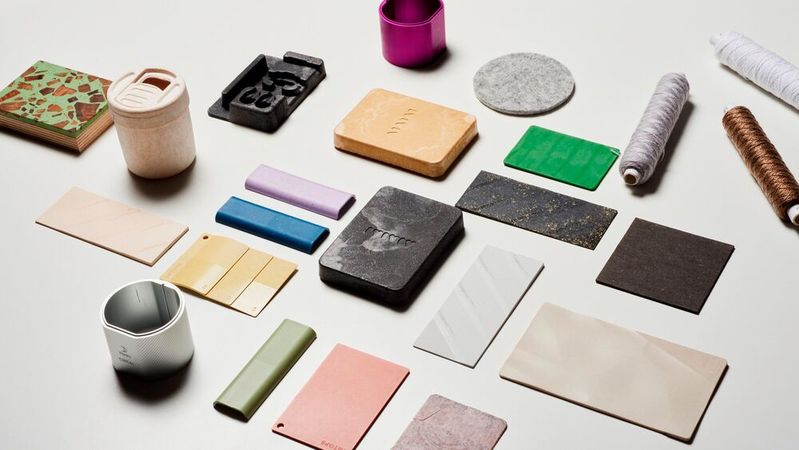
There’s a paradox at the heart of designing the aesthetics of products with sustainable materials. If you replace a less sustainable material with a more sustainable material but do the job so well that the newer, more responsible version is visually indistinguishable from the original, less responsible version, the question becomes: where does the sustainability story go and how do you communicate your wonderful achievement?
If the bio-based, recycled, low-carbon or whatever flavour of environmentally responsible material you’ve used looks like the original plastic, it’s difficult to communicate the sustainability of it, because the end result looks exactly the same. Visually, there’s no difference. The paradox at the core of what we as designers do is: in our quest to be sustainable, the sustainability story itself often vanishes. Or does it? It’s an important question to ask because so much importance is placed of the environmental angle and making it a feature of the product story - by product I mean anything from car interiors, appliances, sports goods, consumer electronics, etc.
Sign in or register and read on
Please log in or register and read this article. To be able to read this article in full, you must be registered. Free registration gives you access to exclusive specialist information.
Already registered? Log in here
:quality(80)/p7i.vogel.de/wcms/18/18/1818030c65df8d8b662de70f3ef40707/0129959962v1.jpeg "HIN Feinmechanik reduced scrap and accelerated series ramp-up with CAM preparation and simulation. (Source: Ency)")
:quality(80)/p7i.vogel.de/wcms/9e/bd/9ebd826ceed28c644a9205bdbf82beb4/0131007997v2.jpeg "The lead-free aluminium solutions that combine high performance with stable and reliable machining processes. (Source: Eural Gnutt)")