A recent technological partnership between Parker and Peter Wolters, a brand of Precision Surfacing Solutions (PSS), has resulted in the development of a next-generation fineblanking press
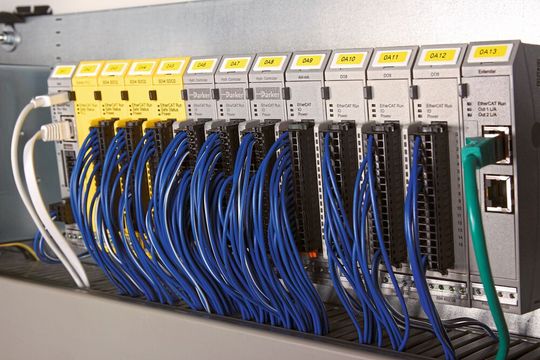
Six electro-hydraulic axes are controlled by Parker’s new axis-controller.
(Source: Parker)
Fineblanking is a special type of high precision metal stamping used for the mass production of ready-to-install flat metal parts that can achieve characteristics that are impossible to recreate using conventional metal cutting or stamping processes.
While compressing the metal, an upper punch and a lower counterpunch supports and extracts the blank without any fracturing of the edges, allowing for tight tolerances. As a result, secondary manufacturing operations such as polishing are reduced or no longer required. Common materials that can be fineblanked include carbon alloy steels, stainless steels, aluminium, brass, and copper. For most manufacturers, fineblanking becomes cost effective from annual production volumes of around 30,000 parts and above. Fineblanking’s greater cost efficiency, better production quality and higher productivity put it far ahead of other metal stamping processes. Highly complex shapes in a variety of sizes and thicknesses can be reliably produced with completely even surfaces and clean breakaway edges.
But for forward-thinking organisations, even the most innovative technology needs to be pushed further to retain its competitive advantage. One such company innovating in the fineblanking press field is Rendsburg-based Peter Wolters, a part of the Precision Surfacing Solutions (PSS) group.
This precision and flexibility become exceedingly necessary in the manufacture of parts for the automotive industry, where increasingly complex flat metal parts are needed in the rapidly evolving drivetrain. In the near future, while the number of different fineblanking components required will grow significantly, the actual volume of orders looks set to decrease. There is thus a need for increased manufacturing flexibility when it comes to changing tools and parameters.
A smart, efficient solution
As the technology partner for the development of the new Peter Wolters Fineblanking Press ML700, Parker developed and supplied the complete hydraulic system, including manifolds, valves, controllers, hydraulic power unit, motors, pumps and an IIoT solution.
The PAC120HC controller is not only used for the cushion cylinders, but also on all other closed-loop controlled axes, which can work in position and force control. In total, six electro-hydraulic axes are controlled by Parker’s new axis-controller, situated in the ram, the ram cushion, the table cushion, feeder leveling, feeder piloting and the scrap chopper. The new generation axis-controller utilised plays a key role within the ML700 safety-concept as the software allows a tool-safety-stop of all axes to take place in microseconds whenever a malfunction has been detected.
Also designed into the system is a hydraulic power unit including a variable speed drive, Parker’s Drive-Controlled Pump (DCP). The benefits of the DCP include higher energy efficiency, noise reduction, less or no cooling required, and an overall cost reduction due to the smaller pump and tank and fewer valves.
Greater control and flexibility
As a result of its superior components and design, the ML700 press offers OEMs increased flexibility, extensive machine control, integrated, high dynamic tool-safety, easy and simple operation, and service-friendly maintenance.
In addition to the automatic adjustment functions of the base machine, the ML700 offers decreased tool wear, patented leveling control and enlarges the tool design possibilities from simple tooling up to the most advanced and complex fineblanking tools. Due to the patented functions of the ML700, it is possible to use a compound die instead of a progressive die to obtain complex fineblanking parts, the machine also provides savings on tooling and maintenance costs. A closed-loop control allows the user to have position and force control on all axes, with the ability of changing parameters for force, speed and position on the fly, which makes it possible to achieve complex and precise parts as well as to use specific tooling kinematics. The table design, which is patented by Peter Wolters, allows for more efficient and flexible clamping and as a result, the option to use a wider range of tooling concepts.
The ML700 press can now continuously monitor environmental elements such as viscosity, particles, and water contents, which is a key factor for ensuring process stability and reliability. The system can also monitor the condition of the press by actively and continuously reporting the live status of its components. Through the use of advanced machine learning (ML) and artificial intelligence (AI), production can be optimised by analysing historical raw data and find various failure patterns, and predictive maintenance can also be practised thanks to system statements about the condition and maintenance of functional groups within the system as a whole.
Date: 08.12.2025
Naturally, we always handle your personal data responsibly. Any personal data we receive from you is processed in accordance with applicable data protection legislation. For detailed information please see our privacy policy.
Consent to the use of data for promotional purposes
I hereby consent to Vogel Communications Group GmbH & Co. KG, Max-Planck-Str. 7-9, 97082 Würzburg including any affiliated companies according to §§ 15 et seq. AktG (hereafter: Vogel Communications Group) using my e-mail address to send editorial newsletters. A list of all affiliated companies can be found here
Newsletter content may include all products and services of any companies mentioned above, including for example specialist journals and books, events and fairs as well as event-related products and services, print and digital media offers and services such as additional (editorial) newsletters, raffles, lead campaigns, market research both online and offline, specialist webportals and e-learning offers. In case my personal telephone number has also been collected, it may be used for offers of aforementioned products, for services of the companies mentioned above, and market research purposes.
Additionally, my consent also includes the processing of my email address and telephone number for data matching for marketing purposes with select advertising partners such as LinkedIn, Google, and Meta. For this, Vogel Communications Group may transmit said data in hashed form to the advertising partners who then use said data to determine whether I am also a member of the mentioned advertising partner portals. Vogel Communications Group uses this feature for the purposes of re-targeting (up-selling, cross-selling, and customer loyalty), generating so-called look-alike audiences for acquisition of new customers, and as basis for exclusion for on-going advertising campaigns. Further information can be found in section “data matching for marketing purposes”.
In case I access protected data on Internet portals of Vogel Communications Group including any affiliated companies according to §§ 15 et seq. AktG, I need to provide further data in order to register for the access to such content. In return for this free access to editorial content, my data may be used in accordance with this consent for the purposes stated here. This does not apply to data matching for marketing purposes.
Right of revocation
I understand that I can revoke my consent at will. My revocation does not change the lawfulness of data processing that was conducted based on my consent leading up to my revocation. One option to declare my revocation is to use the contact form found at https://contact.vogel.de. In case I no longer wish to receive certain newsletters, I have subscribed to, I can also click on the unsubscribe link included at the end of a newsletter. Further information regarding my right of revocation and the implementation of it as well as the consequences of my revocation can be found in the data protection declaration, section editorial newsletter.
New generation of fineblanking
With new developments already well underway in the automotive industry, new possibilities and opportunities are opening up for OEMs producing precision-cut and formed metal parts for example in terms of new drivetrain solutions and non-traditional seating patterns in self-driving vehicles.
The advancement in press technology has brought about a significant increase in the number of components which can be produced by the fineblanking manufacturing process. The development of Peter Wolters’ ML700 new generation fineblanking press with Parker as a trusted technology partner has brought quality and innovation together to deliver increased productivity well into the future.



:quality(80)/p7i.vogel.de/wcms/bb/74/bb74aefce7687b2ac87e62f6a52cf67e/0130170106v1.jpeg "Incoming orders for the German machine tool industry (Source: VDW)")
:quality(80)/p7i.vogel.de/wcms/73/8a/738a9f20229e20ae938c5e690b37a5df/0129780274v1.jpeg "With the acquisition of Knudsen Plast, MGS expands its European cleanroom injection moulding capacity and strengthens regional support for pharma, diagnostics and MedTech customers. (Source: MGS)")
:quality(80)/p7i.vogel.de/wcms/d2/63/d26376330f084c718f9ab83fc66eb39f/0129319680v1.jpeg "Situation in mechanical engineering: VDMA Chief Economist Dr. Johannes Gernandt looks back on the past year, with a particular focus on December: “Given the recent developments, we expect a slight increase in 2026. Sentiment is improving, but there is no reason for celebration.” (Source: VDMA / Sarah Kastner Fotografie)")
:quality(80)/p7i.vogel.de/wcms/4f/a9/4fa94db21a092a12fdb0822e3d5c8150/0129504798v1.jpeg "Riccardo Rosa, president of Ucimu, pointed out: “The overall outcome of the order collection regarding 2025 is in line with that of the last two years and thus disappointing once again”. (Source: Ucimu/ Ruggiero Scardigno)")
:quality(80)/p7i.vogel.de/wcms/95/86/9586c977cea778fd4714d8affe2ad482/0130104571v1.jpeg "Special area Automation + Turnkey at Arburg Technology Days 2026 (Source: Arburg)")
:quality(80)/p7i.vogel.de/wcms/0c/93/0c93aa797c04104b6f02174c1d2af45a/0130102454v1.jpeg "Mach 2026 will bring together technology, expertise and industry dialogue at the NEC Birmingham. (Source: MTA)")
:quality(80)/p7i.vogel.de/wcms/0c/70/0c70cb9e4dc176b7000cb09686ac3cbb/0130023477v1.jpeg "Plast & Printpack Alger 2026 will bring together more than 280 exhibitors from 22 countries in Algiers, highlighting the growing importance of Algeria as a market for plastics, print and packaging technologies in North Africa. (Source: Fairtrade/Alger)")
:quality(80)/p7i.vogel.de/wcms/60/df/60dfb18c5b8fd8bd081eea45208c11bf/0129959077v1.jpeg "More than 430 exhibitors — from start-ups to global giants — have confirmed their spots at Grindinghub. (Source: VDW)")
:quality(80)/p7i.vogel.de/wcms/1a/7c/1a7c4259282a4190e5068a9f4b05eb01/0130100449v1.jpeg "(Source: Hasco)")
:quality(80)/p7i.vogel.de/wcms/aa/21/aa2113aa2a9bb9c5937e2f930a5dd344/0129966928v1.jpeg "With the launch of the exclusive Push-Lok System Ø5 and an expanded Cooling System Ø5, Hasco broadens its range of components for precise and efficient mould cooling. (Source: Hasco)")
:quality(80)/p7i.vogel.de/wcms/63/53/6353c75a9072fc20846b40065c12f724/0129533055v1.jpeg "Industrial connectors operate at critical interfaces in automated production, where reliability under vibration, heat and contaminants directly affects uptime and maintenance effort. (Source: Mencom)")
:quality(80)/p7i.vogel.de/wcms/b7/e0/b7e0832ad0be13fb559a7028f2ef02c7/0129386806v2.jpeg "(Source: Husky)")
:quality(80)/p7i.vogel.de/wcms/d8/79/d879b046ea1475ff1172e9cb2563597e/0130247463v1.jpeg "The comparison between the SLA-printable plastics Accura Xtreme Grey (top) and the robust newcomer Accura Xtreme Black now used by Speedpart, which represents a cost-effective and deep-black alternative to mechanically machined plastic prototypes ... (Source: Speedpart)")
:quality(80)/p7i.vogel.de/wcms/37/2a/372a7d6fbc1aee547d87f91f925a5cc6/0130240729v2.jpeg "An SEM image of another nickel nano-architecture fabricated by the Greer lab (scale bar = 5 microns). This example is a spinodal-like nano-architecture. Box I shows a zoomed in view of the 2 micron x 2 micron dashed area in H. Box J features a CAD model based on the SEM image. (Source: Greer Lab/ Caltech)")
:quality(80)/p7i.vogel.de/wcms/40/0f/400f998c1d2d311ee8f468d8b8641b11/0130234739v1.jpeg "Rapid Fusion and Aivox join forces to bring large-format additive manufacturing to the Italian market. (Source: Aivox)")
:quality(80)/p7i.vogel.de/wcms/87/4c/874ca652c72c1f77ed527f997cbb67f0/0130187262v3.jpeg "Heat Exchanger for Blood Cooling — 3D Printed on the S150 in 1 hour, 18 min (Source: Boston Micro Fabrication)")
:quality(80)/p7i.vogel.de/wcms/db/58/db585f01f7d7c5503342feb6e2d17260/0130364195v1.jpeg "Automated Tool Production: Walter’s comprehensive solution for fully automated tool production. (Source: Walter Machines)")
:quality(80)/p7i.vogel.de/wcms/63/4e/634e7417e7849078dc12e6809cb48220/0130363483v1.jpeg "The new DMF 600|11 XXL travelling-column machining centre from DMG Mori. (Source: DMG Mori)")
:quality(80)/p7i.vogel.de/wcms/8e/bd/8ebd4cee7301e92908136aed3527bd35/0130093383v1.jpeg "Customized milling head of the FZ40c (Source: Zimmermann)")
:quality(80)/p7i.vogel.de/wcms/07/59/0759647a6e5c008648499947f03de4f0/0130086243v1.jpeg "Bruderer UK will premiere the BSTA 280-88-B3 with the new B3 control system at Mach 2026. (Source: Bruderer UK)")
:quality(80)/p7i.vogel.de/wcms/ac/ff/acffde689ec28e78eec957d4a0813dda/0130382745v1.jpeg "Visitors were able to see live cutting demonstrations on a Star SP23, showcasing how Solidcam drives high performance machining on advanced Sliding Head (Swiss-Type) technology. (Source: Solidcam)")
:quality(80)/p7i.vogel.de/wcms/90/46/9046974d34d72d06aa7966a3751d4a40/0130241270v1.jpeg "The Wittmann Group has optimized the “WiAssist” app to make it even easier for injection moulding practitioners to save time ... (Source: Wittmann Group)")
:quality(80)/p7i.vogel.de/wcms/22/eb/22ebb8826d0175c65e0ff4b96a3ee27a/0130186157v1.jpeg "Simcon’s new Cadmould AI Solver delivers injection molding simulation results in seconds. By removing lengthy computation times, the tool enables engineers to dynamically explore thousands of design and process variations in a single day. (Source: Business Wire/ Simcon)")
:quality(80)/p7i.vogel.de/wcms/b5/4f/b54fc77e69d8afd4ecfc90871ebf1ca9/0130174588v1.jpeg "Ency joined Factory of the Future as a solution provider that connects engineering data with real production. (Source: Ency)")
:quality(80)/p7i.vogel.de/wcms/d5/1d/d51def0b31e213e756bbfb9479fa9c7e/0129925621v2.jpeg "Automatic electrode feeding: Together with Sodick and Erowa, the Robot Compact 80 (ERC80) was integrated — including connection to the Zeiss measuring machine and chip-based job management. (Source: Sodick)")
:quality(80)/p7i.vogel.de/wcms/f9/ca/f9ca9cace88200a5ec0946f193264963/0129209504v1.jpeg "Neil Taylor, who has worked in the toolroom at Pre-Met for 20 years. (Source: Pre-Met)")
:quality(80)/p7i.vogel.de/wcms/2f/61/2f61dd20be68049fa2320a2e5aa860d7/0123789183v2.jpeg "from left to right: Sodick President Giuseppe Addelia and Vice President Salvatore Cocco (Source: Sodick)")
:quality(80)/p7i.vogel.de/wcms/c5/49/c54973f28495dada1c7605f913717341/0121533734v1.jpeg "The set-up of the complex parts on the new Sodick ALC600G (Source: Sodick)")
:quality(80)/p7i.vogel.de/wcms/53/c7/53c73ae0a157d4c103e1964e77c1f425/0130023300v1.jpeg "The LK Altera M 20.12.10 CMM at Action Plas Group in Pudsey supports the inspection of high-value machined and additively manufactured components. (Source: LK Metrology)")
:quality(80)/p7i.vogel.de/wcms/68/ab/68abf66929cb9f2dcb823a12e90d1d21/0129922525v1.jpeg "The blast nozzles, placed at the top and bottom of a vertical linear shuttle unit, can be moved up/down and individually turned on or off. (Source: Rösler Oberflchentechnik)")
:quality(80)/p7i.vogel.de/wcms/46/85/46854ab7a2679db67354f556f2bc1db9/0129539660v2.jpeg "Nikon Eclipse MA200 LED is an inverted microscope with reflected illumination that is ideal for inspecting industrial parts. (Source: Nikon)")
:quality(80)/p7i.vogel.de/wcms/3e/61/3e61ccb050c57809ce8f7cde582ef4c2/0129679889v1.jpeg "The Equator-X dual-method gauging system brings unique capability to the shop floor with its dual measurement functionality. (Source: Renishaw)")
:quality(80)/p7i.vogel.de/wcms/51/3e/513e2d937e96401a4d1ff8db1481cce7/0130242596v1.jpeg "With the GC1240 insert grade, Sandvik Coromant is bringing to the machining world a solution featuring a special coating that makes the tooling system significantly more wear-resistant and boosts productivity ... (Source: Sahdvik Coromant)")
:quality(80)/p7i.vogel.de/wcms/f8/8f/f88f47ba8e4ef50152497010c25dda11/0130168360v1.jpeg "At Grinding Hub, in Hall 7, Booth 7D80, Vomat will showcase high-performance microfiltration solutions for coolant, specifically designed for demanding metalworking applications such as tool grinding. (Source: Vomat)")
:quality(80)/p7i.vogel.de/wcms/3a/77/3a771c3954be7ad9129b7ec46114bd9c/0130022902v1.jpeg "Roemheld’s new B 1.8270 hydraulic workholding unit with patented kinematics. (Source: Roemheld)")
:quality(80)/p7i.vogel.de/wcms/fe/19/fe195d611d459acab868678ba6916958/0129831781v1.jpeg "The Emag UG Series at a glance: UG 400, UG 630, UG 1000 and UG 1500 cover grinding lengths from 400 to 1,500 mm. (Source: Emag)")
:quality(80)/p7i.vogel.de/wcms/66/52/6652eb3a653a0908d5b03fb638f16260/0129646074v2.jpeg "The powerful EVO42 turbine with throwing blades made from hardened tool steel is ideally suited for the harsh conditions in foundries (Source: Rösler Oberflächentechnik)")
:quality(80)/p7i.vogel.de/wcms/04/3d/043d3f95c300d98d7188d2c2f0673aa5/0129365083v1.jpeg "The extremely high demands placed on manufacturing precision in high-tech industries include the cleanliness of components. These sometimes extremely strict requirements call for appropriately designed cleaning processes and systems as well as a suitable manufacturing environment. (Source: Ecoclean)")
:quality(80)/p7i.vogel.de/wcms/57/9c/579c8e2bcff2e800a19fcb0926e574fa/0129056117v1.jpeg "Fortis mill grinding wheels from weiler abrasives are designed for hot and cold rolling mills, combining advanced ceramic grain technology with longer service life to reduce downtime and increase productivity. (Source: Weiler Abrasives)")
:quality(80)/p7i.vogel.de/wcms/4a/5f/4a5fd6bde5784db58812f15386c2126f/0126112832v2.jpeg "Boride Engineered Abrasives offers mould makers worldwide a complete toolkit for achieving top-quality surface finishes. (Source: Boride)")
:quality(80)/p7i.vogel.de/wcms/6b/9c/6b9cab1e262f77caed8179ed3dc29807/0129104421v1.jpeg "GMH Gruppe has consolidated Kind & Co., Schmiedewerke Gröditz and Buderus Edelstahl into a unified Open-Die Forging Group, supported by a 30 million euro investment programme to strengthen Europe-based tool steel and forging supply. (Source: Oliver Pracht/ GMH Gruppe)")
:quality(80)/p7i.vogel.de/wcms/49/58/4958084fe5c4ed0a7758f7cfb3051e92/0128854986v1.jpeg "Intelligent material procurement connects components, materials, and processes into one seamless flow. (Bild: FACTUREE - The Online Manufacturer)")
:quality(80)/p7i.vogel.de/wcms/39/a3/39a32d830d6bb6e4471c79e537c5ca52/chimei-ecologue-frosch-6000x3373v1v1.jpeg "The green frog represents the Ecologue portfolio at CHIMEI. It reflects the company's commitment to innovation, safety, and sustainability – aiming to drive progress in various industries while also contributing to addressing global environmental challenges. (Image:CHIMEI)")
:quality(80)/p7i.vogel.de/wcms/2b/29/2b297a2773f13d3017fc6d49424a57b1/0127570680v1.jpeg "Dr Aphrodite Tomou heads up the technical department of Goodfellow (Source: Goodfellow)")
:quality(80)/p7i.vogel.de/wcms/04/af/04af448dd1454719942d1d5e6e1ac94f/0130206408v1.jpeg "As the world’s largest injection moulding machine, the Engel duo 12000 US enables the production of large-format injection-moulded parts in previously unattained dimensions. (Source: Engel)")
:quality(80)/p7i.vogel.de/wcms/d2/f3/d2f3a50b66a1c494c1ba32bf0eae9348/0130240352v1.jpeg "Martin Cayre, Managing Director of Arburg S.A. (Source: Arburg)")
:quality(80)/p7i.vogel.de/wcms/49/7a/497ab170a01fbdf48753756f413d300e/0129922666v1.jpeg "(l-r) David Chapman, Rowan Crozier and Stuart Berry (all Brandauer) (Source: Brandauer)")
:fill(fff,0)/p7i.vogel.de/companies/66/0e/660e93698db24/hasco-logo-or-b50.jpeg "hasco-logo-or-b50 (HASCO)")
:fill(fff,0)/images.vogel.de/vogelonline/companyimg/118400/118496/65.jpg "Renishaw_EMBLEM_orange_RGB.jpg ()")
:quality(80)/p7i.vogel.de/wcms/85/05/850560fad507aeda9c15b9800bbb56e0/0101771255.jpeg "Bernhard Fuchsgruber, Application Engineer Fluid Power Industrial, Parker Hannifin(Source: Parker)")
:quality(80)/p7i.vogel.de/wcms/c0/18/c0182f371ca9f52728f66ec47b509d50/0101771253.jpeg "Christian Gummich, Applications Development Manager, Parker Hannifin(Source: Parker)")
:quality(80)/p7i.vogel.de/wcms/43/3c/433c88f4c77aece518e1a40fa4c4e3d3/0101771267.jpeg "The PAC120HC controller separates the position and pressure control into two valves, resulting in superimposed position and pressure control.(Source: Parker)")
:quality(80)/p7i.vogel.de/wcms/40/a6/40a691fa42b37391a9d38e4affadcc3b/90933432.jpeg "The benefits of the DCP include higher energy efficiency, noise reduction and less or no cooling required.(Source: Parker)")
:quality(80)/images.vogel.de/vogelonline/bdb/1731200/1731274/original.jpg "Climate change is having a huge impact on the world we live in and the calls to tackle it are growing louder every day. (Sebastian Unrau (Unsplash))")
:quality(80)/images.vogel.de/vogelonline/bdb/1731900/1731932/original.jpg "In-Comm Training has spent more than 7m pound on creating three state-of-the-art academies in Aldridge, Bridgnorth and Shrewsbury. (Sam Bagnall)")
:quality(80)/images.vogel.de/vogelonline/bdb/1734000/1734012/original.jpg "Excellent for aggressive finishing and tool mark removal, according to Boride. (Boride)")
:quality(80)/p7i.vogel.de/wcms/07/59/0759647a6e5c008648499947f03de4f0/0130086243v1.jpeg "Bruderer UK will premiere the BSTA 280-88-B3 with the new B3 control system at Mach 2026. (Source: Bruderer UK)")
:quality(80)/p7i.vogel.de/wcms/8f/b5/8fb540a3c5280029d8c06f9507f2fd71/0124649617v1.jpeg "The MSC 5 Duo from Emag is characterized by its compact design and an integrated stacker system that enables autonomous and unmanned production. (Source: Emag)")