Designed for use in compact high-speed machining centres, Ott-Jakob’s new Power-Check Micro measures the clamping force in small spindle interfaces like HSK E15 to E20. The lightweight, battery-powered device supports preventative maintenance and helps ensure precision, tool stability, and process reliability.
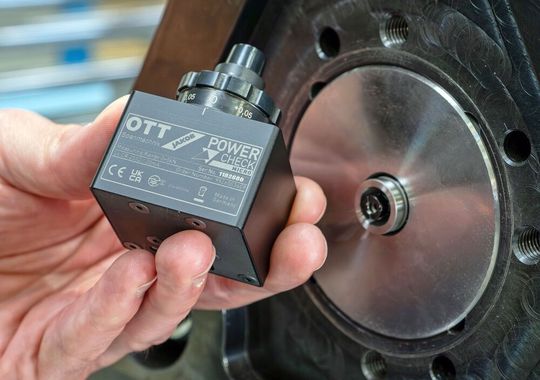
Ott-Jakob Spanntechnik’s Power-Check Micro tool pull-in force measuring device for HSK E15, E16 and E20 interfaces is ideal for use in confined spaces.
(Source: Ott-Jakob Spanntechnik)
Ott-Jakob Spanntechnik, a German manufacturer of tool clamping systems for lathes, milling machines and grinders, has launched a new spindle clamping force measuring device, the Power-Check Micro. A key component for preventative maintenance, it has been introduced alongside the established Power-Check 2 and Power Check Magazine, which determine the pull-in force with which a tool holder is held in a large diameter spindle taper, whether it is HSK (up to 160), BT (30, 40 or 50), SK, CAT or another type.
In contrast, the Power-Check Micro is designed to perform an equivalent job for more compact HSK E15, E16 and E20 spindle interfaces, which are mainly found on small, precise machine tools intended for high-speed cutting. Such machining platforms are typically utilised in the dentistry and jewellery sectors, as well as for production of small parts for electronic and medical products, precision components in aerospace and automotive engineering, and small tools and dies.
The latest drawbar force monitoring system is of compact design, measuring just 48.8 x 43 x 41.5 mm and weighing approximately 200 grams, making the unit well suited to use in constrained working areas. Mains-independent, it is powered by two replaceable lithium batteries capable of up to 1,000 hours of continuous operation.
The device is compatible with three interchangeable, screw-on adapters for the different HSK sizes and can be used with tool clamping systems from all manufacturers. In common with its larger counterparts, Power-Check Micro tests for how much axial force is exerted by a machine's drawbar to pull and hold the tool holder securely into the spindle taper. It is an important parameter to check in production environments, where precision and reliability are paramount. Even minor deviations in clamping force over time can lead to accelerated tool wear, machine downtime, poor surface quality due to vibration, or, in extreme cases, tool failure.
Based on proven technology, Power-Check Micro offers high standards of precision, robustness of construction and ease of use, but in a compact arrangement tailored to the specific requirements of small-format machines. Measuring of forces up to 5.0 kN is possible and the unit maintains consistent accuracy within ± 0.1 kN over the entire range. This performance is achieved within an operating temperature span of 10°C to 35°C and in relative humidity of up to 50 percent, ensuring reliable results in standard workshop conditions.
An innovative feature of the device is its adjustment ring with 0.05 mm graduations, which enables the user to simulate different tool holder tolerances. In traditional systems that assess pull-in force, measurements are referenced to nominal sizes. However, real-world components often fall within a tolerance band, rather than precise values. With the Power-Check Micro, users can simulate shorter or longer tool interface dimensions by turning the ring within a ± 0.2 mm range. It allows deviations in tool geometry to be accommodated, ensuring that results reflect actual clamping performance rather than theoretical values.
To ensure safety and prevent damage, the device is designed for manual insertion and, unlike the Power-Check Magazine, not for exchange during automatic tool change cycles. Neither model should be presented to the spindle while it is rotating, which could result in ejection and injury. During a force inspection cycle, the user simply switches on the unit, places it into the tool interface by hand and initiates the drawbar clamping action via the machine control.
Active status is indicated by a flashing green LED, whereupon the Power-Check Micro transmits one data point per second to a connected receiver. After the measurement is complete, the user releases the clamping mechanism, removes the device and powers it off. This simple yet effective procedure facilitates routine force checking, without the need for complex setups or additional equipment.
The system’s 2.4 GHz wireless transmission capabilities are supported by multiple Ott-Jakob receiver options, including a USB radio stick for PC-based data logging, software-based analysis and export, as well as modules such as Radio RS 485-A/D and Radio IO-Link that support integration into the machine tool control and modern digital manufacturing environments.
Date: 08.12.2025
Naturally, we always handle your personal data responsibly. Any personal data we receive from you is processed in accordance with applicable data protection legislation. For detailed information please see our privacy policy.
Consent to the use of data for promotional purposes
I hereby consent to Vogel Communications Group GmbH & Co. KG, Max-Planck-Str. 7-9, 97082 Würzburg including any affiliated companies according to §§ 15 et seq. AktG (hereafter: Vogel Communications Group) using my e-mail address to send editorial newsletters. A list of all affiliated companies can be found here
Newsletter content may include all products and services of any companies mentioned above, including for example specialist journals and books, events and fairs as well as event-related products and services, print and digital media offers and services such as additional (editorial) newsletters, raffles, lead campaigns, market research both online and offline, specialist webportals and e-learning offers. In case my personal telephone number has also been collected, it may be used for offers of aforementioned products, for services of the companies mentioned above, and market research purposes.
Additionally, my consent also includes the processing of my email address and telephone number for data matching for marketing purposes with select advertising partners such as LinkedIn, Google, and Meta. For this, Vogel Communications Group may transmit said data in hashed form to the advertising partners who then use said data to determine whether I am also a member of the mentioned advertising partner portals. Vogel Communications Group uses this feature for the purposes of re-targeting (up-selling, cross-selling, and customer loyalty), generating so-called look-alike audiences for acquisition of new customers, and as basis for exclusion for on-going advertising campaigns. Further information can be found in section “data matching for marketing purposes”.
In case I access protected data on Internet portals of Vogel Communications Group including any affiliated companies according to §§ 15 et seq. AktG, I need to provide further data in order to register for the access to such content. In return for this free access to editorial content, my data may be used in accordance with this consent for the purposes stated here. This does not apply to data matching for marketing purposes.
Right of revocation
I understand that I can revoke my consent at will. My revocation does not change the lawfulness of data processing that was conducted based on my consent leading up to my revocation. One option to declare my revocation is to use the contact form found at https://contact.vogel.de. In case I no longer wish to receive certain newsletters, I have subscribed to, I can also click on the unsubscribe link included at the end of a newsletter. Further information regarding my right of revocation and the implementation of it as well as the consequences of my revocation can be found in the data protection declaration, section editorial newsletter.
The Power-Check Micro is available as a stand-alone unit or as part of a complete measurement kit, which includes a rugged storage case, a USB radio receiver, batteries, operating instructions, and PC software including a driver on a USB stick. To ensure long-term accuracy and peak performance, Ott-Jakob recommends annual recalibration and regular visual inspection.



:quality(80)/p7i.vogel.de/wcms/bb/74/bb74aefce7687b2ac87e62f6a52cf67e/0130170106v1.jpeg "Incoming orders for the German machine tool industry (Source: VDW)")
:quality(80)/p7i.vogel.de/wcms/73/8a/738a9f20229e20ae938c5e690b37a5df/0129780274v1.jpeg "With the acquisition of Knudsen Plast, MGS expands its European cleanroom injection moulding capacity and strengthens regional support for pharma, diagnostics and MedTech customers. (Source: MGS)")
:quality(80)/p7i.vogel.de/wcms/d2/63/d26376330f084c718f9ab83fc66eb39f/0129319680v1.jpeg "Situation in mechanical engineering: VDMA Chief Economist Dr. Johannes Gernandt looks back on the past year, with a particular focus on December: “Given the recent developments, we expect a slight increase in 2026. Sentiment is improving, but there is no reason for celebration.” (Source: VDMA / Sarah Kastner Fotografie)")
:quality(80)/p7i.vogel.de/wcms/4f/a9/4fa94db21a092a12fdb0822e3d5c8150/0129504798v1.jpeg "Riccardo Rosa, president of Ucimu, pointed out: “The overall outcome of the order collection regarding 2025 is in line with that of the last two years and thus disappointing once again”. (Source: Ucimu/ Ruggiero Scardigno)")
:quality(80)/p7i.vogel.de/wcms/95/86/9586c977cea778fd4714d8affe2ad482/0130104571v1.jpeg "Special area Automation + Turnkey at Arburg Technology Days 2026 (Source: Arburg)")
:quality(80)/p7i.vogel.de/wcms/0c/93/0c93aa797c04104b6f02174c1d2af45a/0130102454v1.jpeg "Mach 2026 will bring together technology, expertise and industry dialogue at the NEC Birmingham. (Source: MTA)")
:quality(80)/p7i.vogel.de/wcms/0c/70/0c70cb9e4dc176b7000cb09686ac3cbb/0130023477v1.jpeg "Plast & Printpack Alger 2026 will bring together more than 280 exhibitors from 22 countries in Algiers, highlighting the growing importance of Algeria as a market for plastics, print and packaging technologies in North Africa. (Source: Fairtrade/Alger)")
:quality(80)/p7i.vogel.de/wcms/60/df/60dfb18c5b8fd8bd081eea45208c11bf/0129959077v1.jpeg "More than 430 exhibitors — from start-ups to global giants — have confirmed their spots at Grindinghub. (Source: VDW)")
:quality(80)/p7i.vogel.de/wcms/1a/7c/1a7c4259282a4190e5068a9f4b05eb01/0130100449v1.jpeg "(Source: Hasco)")
:quality(80)/p7i.vogel.de/wcms/aa/21/aa2113aa2a9bb9c5937e2f930a5dd344/0129966928v1.jpeg "With the launch of the exclusive Push-Lok System Ø5 and an expanded Cooling System Ø5, Hasco broadens its range of components for precise and efficient mould cooling. (Source: Hasco)")
:quality(80)/p7i.vogel.de/wcms/63/53/6353c75a9072fc20846b40065c12f724/0129533055v1.jpeg "Industrial connectors operate at critical interfaces in automated production, where reliability under vibration, heat and contaminants directly affects uptime and maintenance effort. (Source: Mencom)")
:quality(80)/p7i.vogel.de/wcms/b7/e0/b7e0832ad0be13fb559a7028f2ef02c7/0129386806v2.jpeg "(Source: Husky)")
:quality(80)/p7i.vogel.de/wcms/87/4c/874ca652c72c1f77ed527f997cbb67f0/0130187262v3.jpeg "Heat Exchanger for Blood Cooling — 3D Printed on the S150 in 1 hour, 18 min (Source: Boston Micro Fabrication)")
:quality(80)/p7i.vogel.de/wcms/40/8f/408f9253f6ef6399d15aa1f74995399b/0130090342v1.jpeg "Formnext 2026 is off to a strong start, with 527 exhibitors from 34 countries already registered by early March. (Source: Mesago)")
:quality(80)/p7i.vogel.de/wcms/5c/78/5c783a196388a46f0420c1906a76dcf8/0130090208v1.jpeg "Parrot toy and injection mould designed with Freeform and Haply lansdscape (Source: Hexagon)")
:quality(80)/p7i.vogel.de/wcms/1b/0e/1b0e941c5cd87abf76e420f13ef9adaf/0129842848v1.jpeg "Conceptual diagram showing AI-based analysis and prediction of how powder characteristics and process conditions affect defects and component performance in metal 3D printing processes.
(Source: Korea Institute of Materials Science (Kims))")
:quality(80)/p7i.vogel.de/wcms/8e/bd/8ebd4cee7301e92908136aed3527bd35/0130093383v1.jpeg "Customized milling head of the FZ40c (Source: Zimmermann)")
:quality(80)/p7i.vogel.de/wcms/07/59/0759647a6e5c008648499947f03de4f0/0130086243v1.jpeg "Bruderer UK will premiere the BSTA 280-88-B3 with the new B3 control system at Mach 2026. (Source: Bruderer UK)")
:quality(80)/p7i.vogel.de/wcms/21/65/21655b0b7713651611b022833eafff07/0130022526v1.jpeg "The K8 was designed for beginners and smaller companies looking for a cost-effective machine. (Source: Kellenberger)")
:quality(80)/p7i.vogel.de/wcms/09/40/094017bd2a6b8a953f37ce8d6cb2312a/0129958431v1.jpeg "North Axis directors Andy Battensby (left) and Dale Robson (right) with Jack Brown (centre), Hurco Europe’s Sales Engineer for the North East of England. They are pictured at Hurco’s open house last December with the 5-axis VM10Ui machining centre the subcontractor has purchased. (Source: Hurco)")
:quality(80)/p7i.vogel.de/wcms/22/eb/22ebb8826d0175c65e0ff4b96a3ee27a/0130186157v1.jpeg "Simcon’s new Cadmould AI Solver delivers injection molding simulation results in seconds. By removing lengthy computation times, the tool enables engineers to dynamically explore thousands of design and process variations in a single day. (Source: Business Wire/ Simcon)")
:quality(80)/p7i.vogel.de/wcms/b5/4f/b54fc77e69d8afd4ecfc90871ebf1ca9/0130174588v1.jpeg "Ency joined Factory of the Future as a solution provider that connects engineering data with real production. (Source: Ency)")
:quality(80)/p7i.vogel.de/wcms/18/18/1818030c65df8d8b662de70f3ef40707/0129959962v1.jpeg "HIN Feinmechanik reduced scrap and accelerated series ramp-up with CAM preparation and simulation. (Source: Ency)")
:quality(80)/p7i.vogel.de/wcms/c4/81/c4814011c9a46b27d9115fa5b0a196b3/0129961929v1.jpeg "Through the interface between Misulab and nCode DesignLife, Misutech and HBK are now able to jointly support their customers in increasing production competitiveness while reducing the risk of premature failures of critical parts. (Source: HBK)")
:quality(80)/p7i.vogel.de/wcms/d5/1d/d51def0b31e213e756bbfb9479fa9c7e/0129925621v2.jpeg "Automatic electrode feeding: Together with Sodick and Erowa, the Robot Compact 80 (ERC80) was integrated — including connection to the Zeiss measuring machine and chip-based job management. (Source: Sodick)")
:quality(80)/p7i.vogel.de/wcms/f9/ca/f9ca9cace88200a5ec0946f193264963/0129209504v1.jpeg "Neil Taylor, who has worked in the toolroom at Pre-Met for 20 years. (Source: Pre-Met)")
:quality(80)/p7i.vogel.de/wcms/2f/61/2f61dd20be68049fa2320a2e5aa860d7/0123789183v2.jpeg "from left to right: Sodick President Giuseppe Addelia and Vice President Salvatore Cocco (Source: Sodick)")
:quality(80)/p7i.vogel.de/wcms/c5/49/c54973f28495dada1c7605f913717341/0121533734v1.jpeg "The set-up of the complex parts on the new Sodick ALC600G (Source: Sodick)")
:quality(80)/p7i.vogel.de/wcms/53/c7/53c73ae0a157d4c103e1964e77c1f425/0130023300v1.jpeg "The LK Altera M 20.12.10 CMM at Action Plas Group in Pudsey supports the inspection of high-value machined and additively manufactured components. (Source: LK Metrology)")
:quality(80)/p7i.vogel.de/wcms/da/51/da511c7ee083a1ee3b0484a2851f6c28/0129922525v2.jpeg "The blast nozzles, placed at the top and bottom of a vertical linear shuttle unit, can be moved up/down and individually turned on or off. (Source: Rösler Oberflchentechnik)")
:quality(80)/p7i.vogel.de/wcms/46/85/46854ab7a2679db67354f556f2bc1db9/0129539660v2.jpeg "Nikon Eclipse MA200 LED is an inverted microscope with reflected illumination that is ideal for inspecting industrial parts. (Source: Nikon)")
:quality(80)/p7i.vogel.de/wcms/3e/61/3e61ccb050c57809ce8f7cde582ef4c2/0129679889v1.jpeg "The Equator-X dual-method gauging system brings unique capability to the shop floor with its dual measurement functionality. (Source: Renishaw)")
:quality(80)/p7i.vogel.de/wcms/f8/8f/f88f47ba8e4ef50152497010c25dda11/0130168360v1.jpeg "At Grinding Hub, in Hall 7, Booth 7D80, Vomat will showcase high-performance microfiltration solutions for coolant, specifically designed for demanding metalworking applications such as tool grinding. (Source: Vomat)")
:quality(80)/p7i.vogel.de/wcms/3a/77/3a771c3954be7ad9129b7ec46114bd9c/0130022902v1.jpeg "Roemheld’s new B 1.8270 hydraulic workholding unit with patented kinematics. (Source: Roemheld)")
:quality(80)/p7i.vogel.de/wcms/fe/19/fe195d611d459acab868678ba6916958/0129831781v1.jpeg "The Emag UG Series at a glance: UG 400, UG 630, UG 1000 and UG 1500 cover grinding lengths from 400 to 1,500 mm. (Source: Emag)")
:quality(80)/p7i.vogel.de/wcms/c0/37/c037359c39028ff19aeb84bb7f6d6b9f/0129665312v1.jpeg "The new Kemmler KSG600 conveniently houses inductive heating and air cooling in one highly controllable workstation. (Source: Kemmler)")
:quality(80)/p7i.vogel.de/wcms/66/52/6652eb3a653a0908d5b03fb638f16260/0129646074v2.jpeg "The powerful EVO42 turbine with throwing blades made from hardened tool steel is ideally suited for the harsh conditions in foundries (Source: Rösler Oberflächentechnik)")
:quality(80)/p7i.vogel.de/wcms/04/3d/043d3f95c300d98d7188d2c2f0673aa5/0129365083v1.jpeg "The extremely high demands placed on manufacturing precision in high-tech industries include the cleanliness of components. These sometimes extremely strict requirements call for appropriately designed cleaning processes and systems as well as a suitable manufacturing environment. (Source: Ecoclean)")
:quality(80)/p7i.vogel.de/wcms/57/9c/579c8e2bcff2e800a19fcb0926e574fa/0129056117v1.jpeg "Fortis mill grinding wheels from weiler abrasives are designed for hot and cold rolling mills, combining advanced ceramic grain technology with longer service life to reduce downtime and increase productivity. (Source: Weiler Abrasives)")
:quality(80)/p7i.vogel.de/wcms/4a/5f/4a5fd6bde5784db58812f15386c2126f/0126112832v2.jpeg "Boride Engineered Abrasives offers mould makers worldwide a complete toolkit for achieving top-quality surface finishes. (Source: Boride)")
:quality(80)/p7i.vogel.de/wcms/6b/9c/6b9cab1e262f77caed8179ed3dc29807/0129104421v1.jpeg "GMH Gruppe has consolidated Kind & Co., Schmiedewerke Gröditz and Buderus Edelstahl into a unified Open-Die Forging Group, supported by a 30 million euro investment programme to strengthen Europe-based tool steel and forging supply. (Source: Oliver Pracht/ GMH Gruppe)")
:quality(80)/p7i.vogel.de/wcms/49/58/4958084fe5c4ed0a7758f7cfb3051e92/0128854986v1.jpeg "Intelligent material procurement connects components, materials, and processes into one seamless flow. (Bild: FACTUREE - The Online Manufacturer)")
:quality(80)/p7i.vogel.de/wcms/39/a3/39a32d830d6bb6e4471c79e537c5ca52/chimei-ecologue-frosch-6000x3373v1v1.jpeg "The green frog represents the Ecologue portfolio at CHIMEI. It reflects the company's commitment to innovation, safety, and sustainability – aiming to drive progress in various industries while also contributing to addressing global environmental challenges. (Image:CHIMEI)")
:quality(80)/p7i.vogel.de/wcms/2b/29/2b297a2773f13d3017fc6d49424a57b1/0127570680v1.jpeg "Dr Aphrodite Tomou heads up the technical department of Goodfellow (Source: Goodfellow)")
:quality(80)/p7i.vogel.de/wcms/49/7a/497ab170a01fbdf48753756f413d300e/0129922666v1.jpeg "(l-r) David Chapman, Rowan Crozier and Stuart Berry (all Brandauer) (Source: Brandauer)")
:quality(80)/p7i.vogel.de/wcms/fa/8c/fa8c0ce301bfac6391894c4f91aa14ee/0129914578v1.jpeg "Allrounder injection moulding machine equipped with HB-Therm Thermo-6 temperature control units. (Source: HB-Therm)")
:quality(80)/p7i.vogel.de/wcms/b2/67/b2674535a8ddc265f0bda19b64f4bf5e/0129815079v2.jpeg "Effective April 1, 2026, Dirk Musser has taken over as Managing Director of Krauss Maffei Technologies. (Source: Krauss Maffei Technologies)")
:quality(80)/p7i.vogel.de/wcms/c8/08/c808e33876bb5b8b90300f4c26e8ef5f/0129796785v1.jpeg "Tactotek and Symbiose have entered a strategic partnership to expand industrial capacity for In-Mold Structural Electronics in automotive mass production. (Source: Tactotek)")
:fill(fff,0)/p7i.vogel.de/companies/66/0e/660e93698db24/hasco-logo-or-b50.jpeg "hasco-logo-or-b50 (HASCO)")
:fill(fff,0)/images.vogel.de/vogelonline/companyimg/118400/118496/65.jpg "Renishaw_EMBLEM_orange_RGB.jpg ()")
:quality(80)/p7i.vogel.de/wcms/d0/9b/d09b1b368c3a212f5c944a5215a4cad1/0128327967v1.jpeg "DMG Mori automation solutions such as the PH 10 increase the productivity of the company's new 5-axis machining centre, DMU 20 linear. (Source: DMG Mori )")
:quality(80)/p7i.vogel.de/wcms/5d/3c/5d3cd553a019b4033e441e61f98b23d6/0129229293v1.jpeg "Featured also will be the Roemheld Moduhub equipment range, designed to help operators handle heavy or awkward components safely and efficiently during manual assembly. It also has the facility to feed back production data. (Source: Roemheld)")