LK Metrology has unveiled the Surfacer SRP, a high-precision surface roughness probe that integrates seamlessly into any CMM cycle. Designed to eliminate the need for separate roughness checks, the plug-and-play sensor enables comprehensive, automated inspection in a single setup.
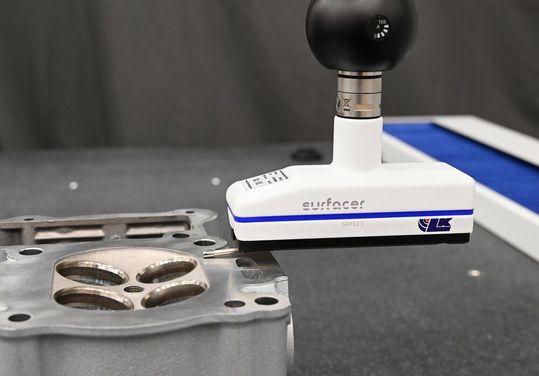
The Surfacer SRP from LK Metrology enables high-precision surface roughness measurement directly on the CMM.
(Source: LK Metrology)
Coordinate measuring machine (CMM) manufacturer LK Metrology, whose manufacturing facility is in Derbyshire, UK, has announced the introduction of the Surfacer SRP. It is a plug-and-play probe having a resolution of one micron for seamlessly analysing the roughness of the surface of a component as part of a CNC measuring cycle on any CMM, provided it has an industry-standard probe head.
The sensor eliminates the need for secondary surface roughness inspection, either manually using a hand-held instrument or automatically at a separate metrology station. Manufacturers are able to conduct comprehensive inspection on a component in a single setup in a CMM environment, resulting in significant savings in time and cost. Engineered for ease of use and versatility, the equipment comes with its own downloadable application software, facilitating integration and eliminating the need for third-party software.
Effortless swapping between touch probes, tactile scanning probes, non-contact laser scanners and the roughness probe gives users extended multi-sensor capability. The Surfacer SRP mounting is compatible with change racks, including the new versions introduced recently by LK, enabling automated sensor changing and enhanced operational efficiency.
At the heart of the roughness probe lies a special body that accommodates three interchangeable, skidded, stainless-steel probe modules. One evaluates flat, conical and cylindrical surfaces, another measures concave, convex and spherical surfaces, and a third is for inspecting grooves more than 3 mm wide by less than 10 mm deep, or steps of similar height.
The CMM positions a stylus so that it is in contact with the part, after which the machine axes remain stationary while the probe moves the stylus across the surface under investigation. Wireless communication with the CMM computer via a Bluetooth 4.0 adapter provides seamless data transfer for analysis, simplifying installation.
The skid plays a key role during measurement, acting as a straight-line datum that guides the stylus across a surface to ensure probe stability. The stylus travels independently of and slightly in front of the skid, with surface deviations recorded as the difference in the relative movements of the two elements in the Z-axis. The design ensures that even minute surface irregularities are captured with exceptional accuracy.
Further enhancing the precision of the Surfacer SRP is an integrated preload mechanism, which during stylus operation isolates it from the CMM kinematics, guaranteeing accurate and consistent results regardless of external vibration or machine movement. The force exerted by the stylus tip, which has a radius of 5 microns, is less than four thousandths of a Newton, avoiding surface deformation. Measurable roughness range is 0.5 to 6.5 Ra, which is the average roughness between the profile and the mean line.
Dave Robinson, LK’s marketing manager said: “By integrating surface roughness measurement directly onto the CMM, we are providing manufacturers with a powerful tool to streamline their inspection processes, reduce costs and enhance product quality. The ability to perform multiple metrology functions on a single platform eliminates the need for time-consuming transfers of components and ensures greater accuracy by maintaining part orientation between measurements.”
The importance of ascertaining surface roughness
Measuring the relative smoothness of the surface profile of a metal or plastic component is fundamental after turning, milling, grinding, spark erosion, broaching or reaming, as it directly correlates to how well the component will function in service. It is the small, fine-scale variations and imperfections in the surface including peaks and valleys that is assessed by LK’s Surfacer SRP, rather than larger-scale features like waviness or form.
The texture of a surface, even at a microscopic level, significantly influences its interactions with other parts and its environment. For instance, smoother surfaces minimise friction, which is vital for reducing wear of moving parts and improving efficiency, durability and performance. In applications involving seals, a precise surface finish prevents leaks. Furthermore, surface roughness can impact a component's susceptibility to fatigue; rougher surfaces create stress points that can lead to premature failure.
Beyond mechanical functionality, the degree of surface roughness plays a role in corrosion resistance, as smoother surfaces are less prone to trapping corrosive substances. A smooth surface improves electrical conductivity. Additionally, the ability of coatings or adhesives to bond effectively is heavily reliant on surface texture.
Date: 08.12.2025
Naturally, we always handle your personal data responsibly. Any personal data we receive from you is processed in accordance with applicable data protection legislation. For detailed information please see our privacy policy.
Consent to the use of data for promotional purposes
I hereby consent to Vogel Communications Group GmbH & Co. KG, Max-Planck-Str. 7-9, 97082 Würzburg including any affiliated companies according to §§ 15 et seq. AktG (hereafter: Vogel Communications Group) using my e-mail address to send editorial newsletters. A list of all affiliated companies can be found here
Newsletter content may include all products and services of any companies mentioned above, including for example specialist journals and books, events and fairs as well as event-related products and services, print and digital media offers and services such as additional (editorial) newsletters, raffles, lead campaigns, market research both online and offline, specialist webportals and e-learning offers. In case my personal telephone number has also been collected, it may be used for offers of aforementioned products, for services of the companies mentioned above, and market research purposes.
Additionally, my consent also includes the processing of my email address and telephone number for data matching for marketing purposes with select advertising partners such as LinkedIn, Google, and Meta. For this, Vogel Communications Group may transmit said data in hashed form to the advertising partners who then use said data to determine whether I am also a member of the mentioned advertising partner portals. Vogel Communications Group uses this feature for the purposes of re-targeting (up-selling, cross-selling, and customer loyalty), generating so-called look-alike audiences for acquisition of new customers, and as basis for exclusion for on-going advertising campaigns. Further information can be found in section “data matching for marketing purposes”.
In case I access protected data on Internet portals of Vogel Communications Group including any affiliated companies according to §§ 15 et seq. AktG, I need to provide further data in order to register for the access to such content. In return for this free access to editorial content, my data may be used in accordance with this consent for the purposes stated here. This does not apply to data matching for marketing purposes.
Right of revocation
I understand that I can revoke my consent at will. My revocation does not change the lawfulness of data processing that was conducted based on my consent leading up to my revocation. One option to declare my revocation is to use the contact form found at https://contact.vogel.de. In case I no longer wish to receive certain newsletters, I have subscribed to, I can also click on the unsubscribe link included at the end of a newsletter. Further information regarding my right of revocation and the implementation of it as well as the consequences of my revocation can be found in the data protection declaration, section editorial newsletter.



:quality(80)/p7i.vogel.de/wcms/b4/3d/b43d86eeaecc6d7ceb26c70af8944489/0131814374v1.jpeg "Valmet launches 3D Fiber technology, offering packaging producers a competitive end-to-end solution to meet the increasing demand for sustainable alternatives to plastic. (Source: Valmet)")
:quality(80)/p7i.vogel.de/wcms/42/24/42245f5bd6c8ec704e99c31d126f7425/0131772863v1.jpeg "The plastics and rubber machinery sector expects stable revenues in 2026, with modest growth possible from 2027 as demand in Asia and the Americas provides new momentum. (Source: free licensed)")
:quality(80)/p7i.vogel.de/wcms/53/65/5365ff4fc7e19552bb04afb221ead869/0131663399v1.jpeg "The Spanish plastics industry is going through a complex period marked by intense regulatory pressure. (Source: Fira Barcelona)")
:quality(80)/p7i.vogel.de/wcms/4f/65/4f652209fc2e425beeeb86a6553818d9/0131208808v1.jpeg "(Source: KB Components)")
:quality(80)/p7i.vogel.de/wcms/eb/be/ebbe79918bb7722ebb93963af44ffd67/0131807938v2.jpeg "The Boy 35 E with integrated igus handling formed the centrepiece of Boy’s exhibition booth at Elmia Polymer 2026 in Jönköping, Sweden. (Source: Dr. Boy)")
:quality(80)/p7i.vogel.de/wcms/7f/2a/7f2ac76fc168cc1b747036b0d72f0a6d/0131708068v2.jpeg "3DMC Host & Chairman Peter Kinnell (Source: Mark Pascal Sanders/ RWTH Aachen)")
:quality(80)/p7i.vogel.de/wcms/cd/e2/cde22fb39357274b5e06be017521226c/0131673566v1.jpeg "The next joint edition of Expoquimia and Equiplast will take place in May 2029. (Source: Fira Barcelona)")
:quality(80)/p7i.vogel.de/wcms/05/82/058293502fcdafec2491d22f9bff21db/0131551745v1.jpeg "With live-running machinery, international premieres and investment deals worth millions of euros, Plastpol 2026 marked its 30th anniversary as a key meeting point for the global plastics industry. (Source: Michał Stańczyk/ Plastpol)")
:quality(80)/p7i.vogel.de/wcms/5c/79/5c79339d56c1ae81c33ee29b238f23e4/0131768998v2.jpeg "Meusburger offers small, compact and space-saving locks for the precise alignment of mould inserts. (Source: Meusburger)")
:quality(80)/p7i.vogel.de/wcms/0d/6c/0d6c5ea88cb425ab9dd066457225e61b/0131066999v2.jpeg "Temperature-control connection plates in three versions (Source: Nonnenmann)")
:quality(80)/p7i.vogel.de/wcms/03/41/0341f13be7d88e59075184138a9bfc44/0131010620v2.jpeg "Meusburger offers high-quality coupling systems and delivers them immediately from stock. (Source: Meusburger)")
:quality(80)/p7i.vogel.de/wcms/16/fd/16fd246f520f6340c1d7fe77a26f817d/0130918842v2.jpeg "Progressive’s CVe Monitor RT and Profile provide 24/7 performance data streaming for instant visibility of your tool’s activity from anywhere in the world. (Source: Progressive Components)")
:quality(80)/p7i.vogel.de/wcms/0b/6b/0b6b5c7e8a7736f29e63fbd545c8a01b/0131918868v1.jpeg "Xometry marketplace accelerates solutions for complex manufacturing demands (Source: Noah Willman/ Xometry)")
:quality(80)/p7i.vogel.de/wcms/d6/85/d685f438a6430ad866e2fe56536e51c4/0131826173v1.jpeg "Schematic of photopolymerisation-extrusion coupled moulding: rheology, UV curing, precision-defect trade-off. 3 strategies (UV stepping, filler optimization, molecular engineering) yield isotropic, dense, crack‑free ceramics with strong, low-shrinkage. (Source: Linzhe Zhang/Yanshan University, et. al)")
:quality(80)/p7i.vogel.de/wcms/f8/29/f829f04d97c7217d7e915829bf641f34/0131750491v1.jpeg "Recently celebrated its world premiere: the S1 Basic from AM Solutions. It is the first compact blasting system for automated cleaning and surface finishing of 3D-printed polymer components in the industrial entry-level segment. (Source: Rösler Oberflächentechnik)")
:quality(80)/p7i.vogel.de/wcms/bc/0f/bc0f0901d17342a3f703d733669a4c41/0131713828v2.jpeg "3D-Werk’s Experience Center gives manufacturers a hands-on environment to evaluate additive manufacturing technologies such as X Jet’s NPJ solution (Source: 3D-Werk)")
:quality(80)/p7i.vogel.de/wcms/90/d0/90d09d46c2b891ed0b093dc38857107f/0131821344v1.jpeg "MPneo 480 multi-plate electric powder press.
(Source: Osterwalder Technology)")
:quality(80)/p7i.vogel.de/wcms/ba/33/ba33a9e3faa448e5a0e957d384ac7222/0131810824v1.jpeg "Güdel adds two additional degrees of freedom to heavy-duty robotic grinding applications through its Trackmotion Vertical (TMV) and Trackmotion Floor (TMF) systems. This allows a single robot to maintain consistent contact pressure and path speed across massive surfaces that would otherwise require multiple robots or complex part repositioning. (Source: Titan Robotics)")
:quality(80)/p7i.vogel.de/wcms/01/7f/017f9464b8a9e26ff005e276c1744f7d/0131807926v1.jpeg "The CV5-700 at Tigfusion’s facility in Hastings is the first to be purchased in the UK (Source: Andy Butler/ Mazak)")
:quality(80)/p7i.vogel.de/wcms/16/8d/168db1de2b7bfc98f2e2baa076b4fec8/0131663389v1.jpeg "“By exhibiting together at both IMTS in Chicago and AMB in Stuttgart, we clearly demonstrate the strength of our collaboration. With a shared vision and complementary machining expertise, Modig, Ibarmia, and Licon offer manufacturers a broad and highly capable solution portfolio that addresses a wide range of production requirements,” said David Modig, Chairman of Modig Machine Tool. (Source: Ibarmia)")
:quality(80)/p7i.vogel.de/wcms/57/27/5727c2da4281810abeb1fb99ecee48fc/0131920273v2.jpeg "Simatic AX Logic Control Engineering offers state-of-the-art IT tools for programming and maintaining Simatic PLCs. (Source: Siemens)")
:quality(80)/p7i.vogel.de/wcms/e2/1c/e21c5506c6f6b9c0b7b9530f29170229/0131766749v1.jpeg "All Ency Academy lessons are now translated into 14 languages. (Source: free licensed)")
:quality(80)/p7i.vogel.de/wcms/c2/7c/c27c9c2a9b7574935f297ade48543659/0131709938v2.jpeg "Left: A large area mold machined with a small radius tool at a low sample resolution. Centre: The same model visualised using GPU raytracing. Right: The camera has zoomed in further, and the scallops can be clearly seen. (Source: Machine Works)")
:quality(80)/p7i.vogel.de/wcms/8e/b4/8eb4d047b4316f528233a1ab3ae0ade2/0131554696v1.jpeg "Recent cutting trials in partnership with Kennametal and Autodesk reseller DSI compared Module Works SmartRoughing (left) versus Module Works Adaptive Roughing (right). (Source: Module Works )")
:quality(80)/p7i.vogel.de/wcms/d5/1d/d51def0b31e213e756bbfb9479fa9c7e/0129925621v2.jpeg "Automatic electrode feeding: Together with Sodick and Erowa, the Robot Compact 80 (ERC80) was integrated — including connection to the Zeiss measuring machine and chip-based job management. (Source: Sodick)")
:quality(80)/p7i.vogel.de/wcms/f9/ca/f9ca9cace88200a5ec0946f193264963/0129209504v1.jpeg "Neil Taylor, who has worked in the toolroom at Pre-Met for 20 years. (Source: Pre-Met)")
:quality(80)/p7i.vogel.de/wcms/2f/61/2f61dd20be68049fa2320a2e5aa860d7/0123789183v2.jpeg "from left to right: Sodick President Giuseppe Addelia and Vice President Salvatore Cocco (Source: Sodick)")
:quality(80)/p7i.vogel.de/wcms/c5/49/c54973f28495dada1c7605f913717341/0121533734v1.jpeg "The set-up of the complex parts on the new Sodick ALC600G (Source: Sodick)")
:quality(80)/p7i.vogel.de/wcms/85/07/850794d04a7c4bf9166662400efad3d1/0131663378v1.jpeg "New L100NX Blue Laser CMM Scanner (Source: LK Metrology)")
:quality(80)/p7i.vogel.de/wcms/ce/73/ce73b45969285c550f6c67c7d92b61e7/0131613641v2.jpeg "The robot handles the loading of the parts to be inspected into the storage area. Then it successively retrieves the stored pallets one by one and places them on the surface of the three-dimensional measuring machine, which is equipped with a clamping device, ensuring precise positioning and stability throughout the measurement process. (Source: Mitutoyo)")
:quality(80)/p7i.vogel.de/wcms/19/f5/19f518ed41305d96b25c296dcff9bb7a/0131585249v2.jpeg "AI-powered Grain Size Analysis automates the evaluation of metallic microstructures, delivering fast, consistent, and operator-independent results. Compliant with ASTM E112 and ISO 643, it ensures reliable, standards-based grain size measurements for quality control and research applications. (Source: Nikon Metrology)")
:quality(80)/p7i.vogel.de/wcms/4d/13/4d138122ae079c86b86249fe718d9090/0131478591v1.jpeg "Roemheld double-acting, hydraulically-actuated, swivelling clamping elements are set into the press table to secure the lower half of the trimming die. The clamp design results in interference-free insertion and removal of the heavy dies, assisted by the integration of Roemheld transport rails. (Source: Stephan Auch/ Roemheld)")
:quality(80)/p7i.vogel.de/wcms/f4/72/f47262615ea8814ddfb33e805a1babe8/0131478681v1.jpeg "Fabio Schoppet, an apprentice at K.H. Müller Präzisionswerkzeuge, in an interview with Tobias Witton. (Source: KS Komm)")
:quality(80)/p7i.vogel.de/wcms/60/45/6045cb15d71397154c6cee56d5d95ac7/0131063997v1.jpeg "Grinding from solid material using two CBN profile grinding wheels for roughing. (Source: Kapp)")
:quality(80)/p7i.vogel.de/wcms/4c/dd/4cdd1643347d5f6f72743402d36e93f4/0130628083v2.jpeg "The filter units of the AW oil mist filters are designed to take up minimal space and are characterised by easy maintenance, quiet operation and a high degree of system integration. (Source: Absolent)")
:quality(80)/p7i.vogel.de/wcms/b8/6f/b86f649863182a925480692939ac91f8/0131684985v1.jpeg "Extreme high-speed Laser Material Deposition (EHLA) enables the additive deposition of functional surfaces with high precision and speed. This allows components to be efficiently coated, repaired, or manufactured with close-to-final-contour precision. (Source: Fraunhofer ILT)")
:quality(80)/p7i.vogel.de/wcms/d5/05/d5057e4ec3f7c3acbed8a4241d0683c6/0131673703v2.jpeg "Copper gauze for cleaning and polishing exposed round or conical surfaces. (Source: Guill)")
:quality(80)/p7i.vogel.de/wcms/00/9a/009ae0e133b321f8f0dabfb3fe14d2a6/0130776695v1.jpeg "The expanded functions simplify digital manufacturing processes and support the automated procurement of precision components. (Source: Meviy)")
:quality(80)/p7i.vogel.de/wcms/20/80/2080366dbf8cca84fe9d00659b8de85c/0131056632v1.jpeg "ABB Robotics says it has once again listened to users. As a result, companies can now invest in a new robot cell that is also affordable for SMEs and can automatically handle time-consuming grinding and polishing tasks. (Source: ABB)")
:quality(80)/p7i.vogel.de/wcms/5a/e5/5ae5dfc67c07f0ca8347161642c36df3/0130721540v1.jpeg "Müller Präzisionswerkzeuge supports its customers with customised, application-specific tools. (Source: Müller)")
:quality(80)/p7i.vogel.de/wcms/2a/08/2a08f8bd2df95ca843d52cbce64bf355/0131212753v1.jpeg "It has taken time, but the full force of the government’s steel policy is beginning to have a devastating impact on the downstream manufacturing sector according to the President of the Confederation of British Metalforming (CBM). (Source: CBM)")
:quality(80)/p7i.vogel.de/wcms/9e/bd/9ebd826ceed28c644a9205bdbf82beb4/0131007997v2.jpeg "The lead-free aluminium solutions that combine high performance with stable and reliable machining processes. (Source: Eural Gnutt)")
:quality(80)/p7i.vogel.de/wcms/d5/e6/d5e68c74fabff18ef737ee767b7b359f/0130415707v1.jpeg "Efficiency in machining and a reduced carbon footprint will be at the centre of Swiss Steel Group’s presentation at Wire 2026 in Düsseldorf. (Source: Swiss Steel Group)")
:quality(80)/p7i.vogel.de/wcms/5e/7d/5e7dab38b2b3b429ee093b1506e54605/0131919638v1.jpeg "European machine tool builders continue operating in a difficult environment, marked by softer
demand, persistent global uncertainty and growing competitive pressure’’, commented François Duval, Cecimo President. (Source: Cecimo)")
:quality(80)/p7i.vogel.de/wcms/ac/6e/ac6e42ca596f07c340f731d940bf57ce/0131825755v2.jpeg "Matters Group is expanding its manufacturing footprint with the acquisition of Polish plastics and polyurethane specialist Letbek. (Source: Matters Group)")
:quality(80)/p7i.vogel.de/wcms/52/97/52978cbd7dfc421404314e34b8348a8a/0131353724v1.jpeg "From left to right: Gerhard Dimmler (CTO Engel Group), Piotr Orlikowski (Company founder and Managing Director of TMA Automation), Walter Aumayr (Vice President Automation Engel Group and Managing Director of TMA Automation), Marek Łangowski (Company founder and Managing Director of TMA Automation) and Stefan Engleder (CEO Engel Group) at the opening in Gdańsk
(Source: Engel)")
:quality(80)/p7i.vogel.de/wcms/4d/fa/4dfa0b367fb9c8da795c7fc29dc0815c/0131301905v1.jpeg "Artur Metzler will assume the post of Managing Director of the Arburg subsidiary in Poland on 1 June 2026. (Source: Arburg)")
:fill(fff,0)/p7i.vogel.de/companies/66/0e/660e93698db24/hasco-logo-or-b50.jpeg "hasco-logo-or-b50 (HASCO)")
:fill(fff,0)/images.vogel.de/vogelonline/companyimg/118400/118496/65.jpg "Renishaw_EMBLEM_orange_RGB.jpg ()")
:fill(fff,0)/images.vogel.de/vogelonline/companyimg/64200/64280/65.png "Diprofil_logo.png ()")
:quality(80)/p7i.vogel.de/wcms/76/59/76597db681e308f9feb14bc33b5e9888/0123905125v2.jpeg "Nikola Biresev, quality manager at Grindex, using the LK CMM to inspect a B-axis housing for an internal grinder at the company's factory in Kikinda, Serbia. (Source: LK Metrology)")
:quality(80)/p7i.vogel.de/wcms/e3/8a/e38ad3fc76805e30ec164f040be51323/0126220449v2.jpeg "Two photographs attached showing the new LK Surfacer SRP surface roughness probe in operation. (Source: LK Metrology)")
:quality(80)/p7i.vogel.de/wcms/63/b9/63b93a7420eba16e25feaacb80f8e82c/0128496384v2.jpeg "A model from LK Metrology's Maxima range of large-size, granite table-type CMMs. (Source: LK Metrology)")