Electric mobility put simply: What are its advantages and disadvantages, what are the laws the govern it and how do drive and energy storage systems work? All the basics at a glance!
Electromobility is one of the megatopics in the automotive industry. Some of the car manufacturers have now announced major product offensives.
(Source: Volkswagen-AG)
Electromobility is defined as the use of electric vehicles 1. Originally this referred to all types of vehicles (from bicycles to high-speed trains). This article only describes electromobility in the field of the automotive industry, but also includes the charging infrastructure.
History of Electromobility: Who Invented the Electric Car?
In the early days of automotive history, around 1900, there were more electric cars in the USA than with combustion engines. Only inventions such as the starter motor made the combustion engine ready for series production. In the decades that followed, the electric motor was only playing a niche role. In the 1970s, for example, milk floats were in great demand in Great Britain: Small vans that delivered the milk silently in the morning.
Gallery
“Modern" electromobility was launched in 1997 with the Toyota Prius. In the meantime Toyota manufactures the Prius in its fourth generation (also as a plug-in hybrid that can be charged on the power grid) and has produced a total of more than eleven million vehicles of this type.
Electromobility: What Types of Drives Are There?
Hybrid (HEV) — Combination of combustion engine and electric motor
Mild Hybrid — Hybrid with electric motor of limited power, which supports the internal combustion engine (similar to a turbocharger)
Plug-in Hybrid (PHEV) — Hybrid vehicle with charging ability via the power grid
Electric car with Range Extender (REX) - Additional combustion engine in an electric car that does not drive the vehicle but charges the battery via a generator
Battery (BEV) — "pure" electric vehicles without internal combustion engine. Power supply via battery, charging via charging station
Fuel cell — electric vehicles with fuel cell. By using electrolysis of hydrogen and oxygen, this technology provides electrical energy for the drive and the battery
The main disadvantage of BEVs is their limited range. A combination with a combustion engine (HEV, BEV + REX) increases the range, but also the complexity of the powertrain and the weight (and price) of the vehicle considerably.
Advantages and Disadvantages of Electric Mobility
One of the advantages is locally emission-free driving, although this fact already implies a disadvantage. The extent to which emissions are actually reduced in the overall balance depends on the energy mix. However, the energy required for vehicle production must also be taken into account. According to a study conducted by the Swedish Energy Agency, the life cycle assessment of an electric vehicle is more favorable after 30,000 km (small vehicle) to 100,000 km (large vehicle) than that of a "combustion engine" of the same size. An ecologically critical factor is also the demand for rare mineral resources (for example Lithium) for battery production.
If the electric cars were powered by regenerative electricity, the balance would be excellent. Currently, the generation of one kilowatt hour of electricity in the German electricity mix produces an average of 530 grams of CO2.
A clear disadvantage is (still) their limited range and the incomplete charging infrastructure, especially of fast charging stations on long-distance routes. The pleasant driving experience (low-noise, high torque right from the start) is regarded as an advantage.
From the point of view of vehicle development, it is positive that the lack of a combustion engine and mechanical drive train allows completely new freedom in construction and design. For the economy and the labor market, electromobility could result in job losses in the automotive industry (including suppliers) because an electric drive is much less complex and requires fewer components than a combustion engine. For example, Volkswagen reported that 7,000 jobs in the Hanover and Emden plants had become obsolete as a result of their electric offensive. However, the company apparently wants to offer alternatives to employees who do not leave voluntarily or due to their age.
Electromobility in Germany and Worldwide: Current Market Data
In the USA, the benchmark of one million electric vehicles was reached in December 2018. There, the share of new registrations is 1.8 % (based on the first three quarters of 2018) 2. Around 1.2 million electric cars are currently on the roads in China (3.5 % of new registrations), and more than three million worldwide. The highest proportion of new registrations of electric vehicles is in Norway (46.7 %), followed by the Netherlands with 4.7 %.
The best-selling electric vehicle on the German market in the period from January to July 2018 was the Renault Zoe, with 3,011 units, followed by VW Golf-E, Smart Fortwo EQ, Kia Soul and BMW 3i.
Keyword: market outlook: By the year 2030, it is to be expected that sales of passenger cars with combustion engines will decline sharply. In 2035, for the first time worldwide, more cars with electric drives than with combustion engines are likely to be sold 3. However, since total car sales will rise sharply by then (by 57 % to more than 116 million vehicles in 2030), a considerable number of cars with combustion engines will probably still be produced.
Date: 08.12.2025
Naturally, we always handle your personal data responsibly. Any personal data we receive from you is processed in accordance with applicable data protection legislation. For detailed information please see our privacy policy.
Consent to the use of data for promotional purposes
I hereby consent to Vogel Communications Group GmbH & Co. KG, Max-Planck-Str. 7-9, 97082 Würzburg including any affiliated companies according to §§ 15 et seq. AktG (hereafter: Vogel Communications Group) using my e-mail address to send editorial newsletters. A list of all affiliated companies can be found here
Newsletter content may include all products and services of any companies mentioned above, including for example specialist journals and books, events and fairs as well as event-related products and services, print and digital media offers and services such as additional (editorial) newsletters, raffles, lead campaigns, market research both online and offline, specialist webportals and e-learning offers. In case my personal telephone number has also been collected, it may be used for offers of aforementioned products, for services of the companies mentioned above, and market research purposes.
Additionally, my consent also includes the processing of my email address and telephone number for data matching for marketing purposes with select advertising partners such as LinkedIn, Google, and Meta. For this, Vogel Communications Group may transmit said data in hashed form to the advertising partners who then use said data to determine whether I am also a member of the mentioned advertising partner portals. Vogel Communications Group uses this feature for the purposes of re-targeting (up-selling, cross-selling, and customer loyalty), generating so-called look-alike audiences for acquisition of new customers, and as basis for exclusion for on-going advertising campaigns. Further information can be found in section “data matching for marketing purposes”.
In case I access protected data on Internet portals of Vogel Communications Group including any affiliated companies according to §§ 15 et seq. AktG, I need to provide further data in order to register for the access to such content. In return for this free access to editorial content, my data may be used in accordance with this consent for the purposes stated here. This does not apply to data matching for marketing purposes.
Right of revocation
I understand that I can revoke my consent at will. My revocation does not change the lawfulness of data processing that was conducted based on my consent leading up to my revocation. One option to declare my revocation is to use the contact form found at https://contact.vogel.de. In case I no longer wish to receive certain newsletters, I have subscribed to, I can also click on the unsubscribe link included at the end of a newsletter. Further information regarding my right of revocation and the implementation of it as well as the consequences of my revocation can be found in the data protection declaration, section editorial newsletter.
Political framework conditions are also a driver of e-mobility: This is another reason why car manufacturers have an interest in selling electric vehicles in order to keep fleet consumption low and to avoid fines (from 2021) that become due if specified values are exceeded. In addition, driving bans for vehicles with diesel engines are being considered in numerous metropolises - for example in London, Mexico City and Paris. Electric drives (including hybrid technology) in these cities can make it possible to travel the "last few miles" to their destination in the city. In addition electrically operated miniature vehicles like electric pedal scooter, Hoverboards or other micromobiles are an alternative, since the legislation now also creates the framework conditions for this future in Germany.
The Electric Mobility Act in a Nutshell
The Law on the Priority Use of Electrically Operated Vehicles, the Electric Mobility Act, or EmoG for short, has been in force since June 2015. Its objective: To enable measures to give priority to e-vehicles in road transport in order to promote environmentally friendly private transport.
Further information on the Electromobility Act is provided by the Federal Ministry of Justice and Consumer Protection.
E-Cars: State of the Art Drive and Energy Storage Technology
The traction motors used in electric vehicles are mainly three-phase synchronous motors. The gearboxes are much simpler and usually two-stage (plus reverse gear). Lithium-ion rechargeable batteries have established themselves as the state of the art in energy storage.
Future outlook — New battery technologies: For decades there was hardly any serious battery research (electrochemistry), at least in Europe. They're catching up now. A "hotspot" is located, for example, at the University of Münster: At the MEET Institute around 140 researchers are working on battery technologies of the future - with a focus on automotive applications 4. The main objectives of battery development are to reduce costs and increase range.
In addition to the enhancement of lithium-ion technology, battery researchers worldwide are also working on making new types of battery systems ready for series production. These include lithium iron phosphate (LiFePO4) technology and - to an even greater extent - solid state batteries, in which both electrodes and the electrolyte are made of solid materials. This enables a higher energy density. Several car manufacturers have announced that they will use solid state batteries in their electric cars from around 2025 onwards 5. Volkswagen invests $ 100 million, for example into a start-up company researching solid state batteries.
Battery production: Some car manufacturers have set up their own battery system production facilities in which cells are assembled into ready-to-install complete batteries. The battery cells as the heart of the energy storage system are supplied by a few, mostly Asian manufacturers.
Whether German or European car manufacturers (alone or in a group) need their own cell production is currently the subject of intense debate in industry and politics. The reason for this is that batteries account for a considerable part of the added value of an electric vehicle. The question of security of supply also plays a role in this discussion. There are also discussions as to which battery technology will be favored. Much speaks in favor of solid state batteries.
The Federal Ministry of Economics has made available a start-up budget of one billion euros in order to build up national battery production and, among other things, to compensate for the negative effects of electric mobility on the labor market.
What Charging Systems Are Available for Electric Cars?
Three or four connector systems are currently the standard on the market. In Europe, the "Type 2" plug and the CCS plug (Combined Charging System) with fast charging function dominate. The CHAdeMO connector is used in Japan. Tesla relies on its own connector system for its "superchargers".
Charging columns - from the wallbox for the garage to the high-power charging system - are offered by various manufacturers. Charging systems with an output of up to 320 or 350 kW (ADS-Tec and ABB) are currently technically feasible. They allow the "refueling" of energy for 200 kilometers within eight minutes.
Some electric vehicles, such as the BMW 530e with plug-in hybrid, offer the option of wireless inductive charging. In this case, however, the charging performance is limited. In the future, inductive charging systems are also conceivable (and are already being tested), which are integrated into the roadway and charge the batteries of electric cars while driving.
What About the Charging Infrastructure in Germany?
The acceptance of electromobility depends on the range of a battery charge and - especially for long-distance journeys - on the availability of charging stations and the speed of the charging process.
By 2020, around 15,000 charging stations should be available in Germany, around 5,000 of them with a charging capacity of more than 50 kilowatts. These rapid charging systems ("High Power Charging") are to be installed primarily along the highways. Ionity - a joint venture of Audi, BMW, Daimler, Ford, Porsche and VW - is working on such a network, for example. However, the general power grid is not designed for such charging capacities and grid-supported stationary battery storage will be required.
The infrastructure also includes information for drivers of electric cars about free charging points and a billing mode that is as simple as possible and includes all providers. In practice, there are still obstacles to overcome.
What Ranges Can Electric Vehicles Achieve?
For purely electric vehicles, the range per battery charge is the critical (and much-discussed) parameter and thus a decisive factor for the acceptance of the electric drive. A few years ago, 200 to 250 km were still common. The new models announced for 2019 by manufacturers such as Auto and Daimler state ranges of around 450 km. Vehicles with specific operational purposes such as the delivery vehicle Streetscooter get by with shorter ranges (approx. 120 km).
In the future, electric cars can also be used as part of smart grids. Their battery is then used as a storage system for decentralized networks and automatically charged when (regenerative) energy is available. If necessary, the batteries return the energy to the grid when the vehicle does not call it up. This technique is referred to as "sector coupling" and is currently the subject of much debate. This refers to the coupling of energy producers and consumers, which were previously separate from each other. Electric mobility will integrate the previously crude oil-based energy supply for transport into the centralized or decentralized power grid. This opens up additional synergy effects for all sectors involved.
E-Mobility: Status of the German Automotive Industry
The German automobile manufacturers only entered the electromobility market at a late point, but have now announced a vertabel model offensive. VW alone wants to present around 80 new electric models by 2025 and introduce its own brand ID for electric vehicles in 2020. In November 2018, the Group announced that by 2025 it would invest around 30 billion euros in electric mobility.
Audi has presented theall-electric SUV E-Tron, Mercedes the EQC and Porsche prepares the launch of the Taycan (based on the Mission E study) for 2019. BMW has been on the market with the i3 and i8 models since 2013. Opel has had various Ampera models in its range since 2012 - when it was still a General Motors subsidiary - and Ford plans to introduce several electric car models such as the crossover vehicle Mach E in 2020.
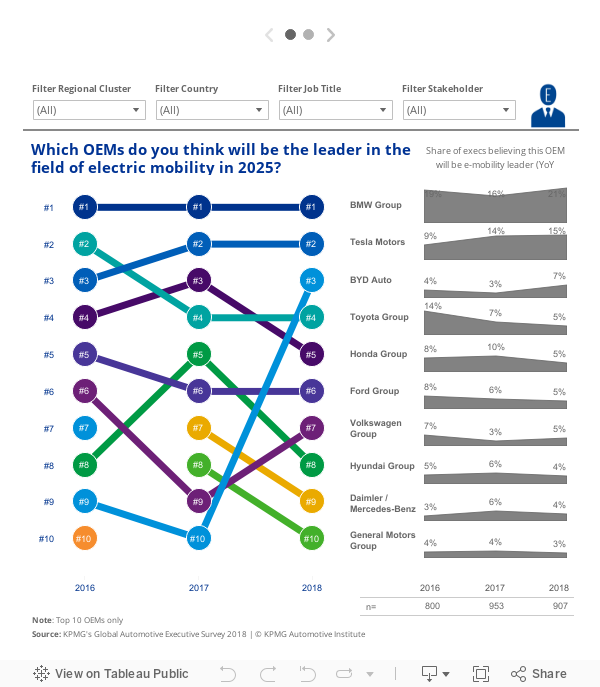
Interactive chart: Which OEMs will be the technology leaders in electric mobility in 2025?
What Effects Does Electromobility Have on Vehicle Architecture?
The elimination of the internal combustion engine has considerable effects on vehicle architecture, as does the integration of the bulky and heavy battery. In order to compensate for their weight, new technologies and materials are introduced to body construction.
All in all, electromobility offers opportunities for new concepts and for moving away from a tried and tested basic design that is decades old. Many companies see opportunities for the establishment of new technologies (e.g. for additive manufacturing processes and for automotive lightweight design) or for their market entry into the automotive industry (e.g. manufacturers of electric motors).
The effects of electromobility on the supply chain are just as severe. All components of the combustion engine (a four-digit number of components) become obsolete, as are auxiliary units such as the tank and exhaust system. The (usually two-stage) gearbox is much simpler in design or is completely omitted. Braking and steering systems as well as the wheel suspension are changing significantly, as are, for example, the heating/air conditioning. At the same time, additional electrical and electronic components are required.
Electric mobility will therefore result in significant changes in the supplier industry. According to Cedric Perlewitz, Head of Automotive & Transport at Commerzbank, automotive suppliers therefore need to accelerate their strategy change towards e-mobility: "New cross-sector competitors or OEMs specializing in pure e-cars compete with the established players." 6 For example, in 2017, Bosch, an automotive supplier, established a separate business unit for electromobility.
The economic effects should also not be underestimated. According to a study conducted by the Institute for Labour Market and Occupational Research in December 2018, almost 114,000 jobs will be lost in Germany due to the switch to electric drive systems for passenger cars. The main reason for this is the much simpler design of the drive train. 7
The Future of Electromobility — Just a Bridge Technology?
According to experts, it has not been determined whether electromobility is the ideal solution for the era after the use of fossil fuels. There are voices that see electric vehicles only as a bridge technology for other types of energy and drives. In particular, fuel cell vehicles powered by hydrogen could prevail in the medium term, as could alternative liquid fuels (so-called e-fuels).



:quality(80)/p7i.vogel.de/wcms/bb/74/bb74aefce7687b2ac87e62f6a52cf67e/0130170106v1.jpeg "Incoming orders for the German machine tool industry (Source: VDW)")
:quality(80)/p7i.vogel.de/wcms/73/8a/738a9f20229e20ae938c5e690b37a5df/0129780274v1.jpeg "With the acquisition of Knudsen Plast, MGS expands its European cleanroom injection moulding capacity and strengthens regional support for pharma, diagnostics and MedTech customers. (Source: MGS)")
:quality(80)/p7i.vogel.de/wcms/d2/63/d26376330f084c718f9ab83fc66eb39f/0129319680v1.jpeg "Situation in mechanical engineering: VDMA Chief Economist Dr. Johannes Gernandt looks back on the past year, with a particular focus on December: “Given the recent developments, we expect a slight increase in 2026. Sentiment is improving, but there is no reason for celebration.” (Source: VDMA / Sarah Kastner Fotografie)")
:quality(80)/p7i.vogel.de/wcms/4f/a9/4fa94db21a092a12fdb0822e3d5c8150/0129504798v1.jpeg "Riccardo Rosa, president of Ucimu, pointed out: “The overall outcome of the order collection regarding 2025 is in line with that of the last two years and thus disappointing once again”. (Source: Ucimu/ Ruggiero Scardigno)")
:quality(80)/p7i.vogel.de/wcms/79/53/795301ea6a776278189e2a019ba94390/0130415594v1.jpeg "To mark its 30th edition, Fakuma 2026 is launching the new Fakuma Innovation Award to honour technological excellence, innovation and teamwork across the plastics processing value chain. (Source: P.E. Schall)")
:quality(80)/p7i.vogel.de/wcms/95/86/9586c977cea778fd4714d8affe2ad482/0130104571v1.jpeg "Special area Automation + Turnkey at Arburg Technology Days 2026 (Source: Arburg)")
:quality(80)/p7i.vogel.de/wcms/0c/93/0c93aa797c04104b6f02174c1d2af45a/0130102454v1.jpeg "Mach 2026 will bring together technology, expertise and industry dialogue at the NEC Birmingham. (Source: MTA)")
:quality(80)/p7i.vogel.de/wcms/0c/70/0c70cb9e4dc176b7000cb09686ac3cbb/0130023477v1.jpeg "Plast & Printpack Alger 2026 will bring together more than 280 exhibitors from 22 countries in Algiers, highlighting the growing importance of Algeria as a market for plastics, print and packaging technologies in North Africa. (Source: Fairtrade/Alger)")
:quality(80)/p7i.vogel.de/wcms/09/0c/090ccfc5b48898dac74feabbbdf0aeae/0130423312v2.jpeg "Despite the challenging economic climate, Meusburger has strengthened its position as a reliable partner for making moulds, dies, jigs and fixtures. (Source: Meusburger)")
:quality(80)/p7i.vogel.de/wcms/1a/7c/1a7c4259282a4190e5068a9f4b05eb01/0130100449v1.jpeg "(Source: Hasco)")
:quality(80)/p7i.vogel.de/wcms/aa/21/aa2113aa2a9bb9c5937e2f930a5dd344/0129966928v1.jpeg "With the launch of the exclusive Push-Lok System Ø5 and an expanded Cooling System Ø5, Hasco broadens its range of components for precise and efficient mould cooling. (Source: Hasco)")
:quality(80)/p7i.vogel.de/wcms/63/53/6353c75a9072fc20846b40065c12f724/0129533055v1.jpeg "Industrial connectors operate at critical interfaces in automated production, where reliability under vibration, heat and contaminants directly affects uptime and maintenance effort. (Source: Mencom)")
:quality(80)/p7i.vogel.de/wcms/d8/79/d879b046ea1475ff1172e9cb2563597e/0130247463v1.jpeg "The comparison between the SLA-printable plastics Accura Xtreme Grey (top) and the robust newcomer Accura Xtreme Black now used by Speedpart, which represents a cost-effective and deep-black alternative to mechanically machined plastic prototypes ... (Source: Speedpart)")
:quality(80)/p7i.vogel.de/wcms/37/2a/372a7d6fbc1aee547d87f91f925a5cc6/0130240729v2.jpeg "An SEM image of another nickel nano-architecture fabricated by the Greer lab (scale bar = 5 microns). This example is a spinodal-like nano-architecture. Box I shows a zoomed in view of the 2 micron x 2 micron dashed area in H. Box J features a CAD model based on the SEM image. (Source: Greer Lab/ Caltech)")
:quality(80)/p7i.vogel.de/wcms/40/0f/400f998c1d2d311ee8f468d8b8641b11/0130234739v1.jpeg "Rapid Fusion and Aivox join forces to bring large-format additive manufacturing to the Italian market. (Source: Aivox)")
:quality(80)/p7i.vogel.de/wcms/87/4c/874ca652c72c1f77ed527f997cbb67f0/0130187262v3.jpeg "Heat Exchanger for Blood Cooling — 3D Printed on the S150 in 1 hour, 18 min (Source: Boston Micro Fabrication)")
:quality(80)/p7i.vogel.de/wcms/db/58/db585f01f7d7c5503342feb6e2d17260/0130364195v1.jpeg "Automated Tool Production: Walter’s comprehensive solution for fully automated tool production. (Source: Walter Machines)")
:quality(80)/p7i.vogel.de/wcms/63/4e/634e7417e7849078dc12e6809cb48220/0130363483v1.jpeg "The new DMF 600|11 XXL travelling-column machining centre from DMG Mori. (Source: DMG Mori)")
:quality(80)/p7i.vogel.de/wcms/8e/bd/8ebd4cee7301e92908136aed3527bd35/0130093383v1.jpeg "Customized milling head of the FZ40c (Source: Zimmermann)")
:quality(80)/p7i.vogel.de/wcms/07/59/0759647a6e5c008648499947f03de4f0/0130086243v1.jpeg "Bruderer UK will premiere the BSTA 280-88-B3 with the new B3 control system at Mach 2026. (Source: Bruderer UK)")
:quality(80)/p7i.vogel.de/wcms/62/0d/620d63746a132b3d59f37c3bc2d13d90/0130422909v1.jpeg "Ency supports DAMRC in linking robot programming with kinematic analysis and process preparation for robotic machining research. (Source: Ency)")
:quality(80)/p7i.vogel.de/wcms/ac/ff/acffde689ec28e78eec957d4a0813dda/0130382745v1.jpeg "Visitors were able to see live cutting demonstrations on a Star SP23, showcasing how Solidcam drives high performance machining on advanced Sliding Head (Swiss-Type) technology. (Source: Solidcam)")
:quality(80)/p7i.vogel.de/wcms/90/46/9046974d34d72d06aa7966a3751d4a40/0130241270v1.jpeg "The Wittmann Group has optimized the “WiAssist” app to make it even easier for injection moulding practitioners to save time ... (Source: Wittmann Group)")
:quality(80)/p7i.vogel.de/wcms/22/eb/22ebb8826d0175c65e0ff4b96a3ee27a/0130186157v1.jpeg "Simcon’s new Cadmould AI Solver delivers injection molding simulation results in seconds. By removing lengthy computation times, the tool enables engineers to dynamically explore thousands of design and process variations in a single day. (Source: Business Wire/ Simcon)")
:quality(80)/p7i.vogel.de/wcms/d5/1d/d51def0b31e213e756bbfb9479fa9c7e/0129925621v2.jpeg "Automatic electrode feeding: Together with Sodick and Erowa, the Robot Compact 80 (ERC80) was integrated — including connection to the Zeiss measuring machine and chip-based job management. (Source: Sodick)")
:quality(80)/p7i.vogel.de/wcms/f9/ca/f9ca9cace88200a5ec0946f193264963/0129209504v1.jpeg "Neil Taylor, who has worked in the toolroom at Pre-Met for 20 years. (Source: Pre-Met)")
:quality(80)/p7i.vogel.de/wcms/2f/61/2f61dd20be68049fa2320a2e5aa860d7/0123789183v2.jpeg "from left to right: Sodick President Giuseppe Addelia and Vice President Salvatore Cocco (Source: Sodick)")
:quality(80)/p7i.vogel.de/wcms/c5/49/c54973f28495dada1c7605f913717341/0121533734v1.jpeg "The set-up of the complex parts on the new Sodick ALC600G (Source: Sodick)")
:quality(80)/p7i.vogel.de/wcms/53/c7/53c73ae0a157d4c103e1964e77c1f425/0130023300v1.jpeg "The LK Altera M 20.12.10 CMM at Action Plas Group in Pudsey supports the inspection of high-value machined and additively manufactured components. (Source: LK Metrology)")
:quality(80)/p7i.vogel.de/wcms/68/ab/68abf66929cb9f2dcb823a12e90d1d21/0129922525v1.jpeg "The blast nozzles, placed at the top and bottom of a vertical linear shuttle unit, can be moved up/down and individually turned on or off. (Source: Rösler Oberflchentechnik)")
:quality(80)/p7i.vogel.de/wcms/46/85/46854ab7a2679db67354f556f2bc1db9/0129539660v2.jpeg "Nikon Eclipse MA200 LED is an inverted microscope with reflected illumination that is ideal for inspecting industrial parts. (Source: Nikon)")
:quality(80)/p7i.vogel.de/wcms/3e/61/3e61ccb050c57809ce8f7cde582ef4c2/0129679889v1.jpeg "The Equator-X dual-method gauging system brings unique capability to the shop floor with its dual measurement functionality. (Source: Renishaw)")
:quality(80)/p7i.vogel.de/wcms/51/3e/513e2d937e96401a4d1ff8db1481cce7/0130242596v1.jpeg "With the GC1240 insert grade, Sandvik Coromant is bringing to the machining world a solution featuring a special coating that makes the tooling system significantly more wear-resistant and boosts productivity ... (Source: Sahdvik Coromant)")
:quality(80)/p7i.vogel.de/wcms/f8/8f/f88f47ba8e4ef50152497010c25dda11/0130168360v1.jpeg "At Grinding Hub, in Hall 7, Booth 7D80, Vomat will showcase high-performance microfiltration solutions for coolant, specifically designed for demanding metalworking applications such as tool grinding. (Source: Vomat)")
:quality(80)/p7i.vogel.de/wcms/3a/77/3a771c3954be7ad9129b7ec46114bd9c/0130022902v1.jpeg "Roemheld’s new B 1.8270 hydraulic workholding unit with patented kinematics. (Source: Roemheld)")
:quality(80)/p7i.vogel.de/wcms/fe/19/fe195d611d459acab868678ba6916958/0129831781v1.jpeg "The Emag UG Series at a glance: UG 400, UG 630, UG 1000 and UG 1500 cover grinding lengths from 400 to 1,500 mm. (Source: Emag)")
:quality(80)/p7i.vogel.de/wcms/66/52/6652eb3a653a0908d5b03fb638f16260/0129646074v2.jpeg "The powerful EVO42 turbine with throwing blades made from hardened tool steel is ideally suited for the harsh conditions in foundries (Source: Rösler Oberflächentechnik)")
:quality(80)/p7i.vogel.de/wcms/04/3d/043d3f95c300d98d7188d2c2f0673aa5/0129365083v1.jpeg "The extremely high demands placed on manufacturing precision in high-tech industries include the cleanliness of components. These sometimes extremely strict requirements call for appropriately designed cleaning processes and systems as well as a suitable manufacturing environment. (Source: Ecoclean)")
:quality(80)/p7i.vogel.de/wcms/57/9c/579c8e2bcff2e800a19fcb0926e574fa/0129056117v1.jpeg "Fortis mill grinding wheels from weiler abrasives are designed for hot and cold rolling mills, combining advanced ceramic grain technology with longer service life to reduce downtime and increase productivity. (Source: Weiler Abrasives)")
:quality(80)/p7i.vogel.de/wcms/4a/5f/4a5fd6bde5784db58812f15386c2126f/0126112832v2.jpeg "Boride Engineered Abrasives offers mould makers worldwide a complete toolkit for achieving top-quality surface finishes. (Source: Boride)")
:quality(80)/p7i.vogel.de/wcms/d5/e6/d5e68c74fabff18ef737ee767b7b359f/0130415707v1.jpeg "Efficiency in machining and a reduced carbon footprint will be at the centre of Swiss Steel Group’s presentation at Wire 2026 in Düsseldorf. (Source: Swiss Steel Group)")
:quality(80)/p7i.vogel.de/wcms/6b/9c/6b9cab1e262f77caed8179ed3dc29807/0129104421v1.jpeg "GMH Gruppe has consolidated Kind & Co., Schmiedewerke Gröditz and Buderus Edelstahl into a unified Open-Die Forging Group, supported by a 30 million euro investment programme to strengthen Europe-based tool steel and forging supply. (Source: Oliver Pracht/ GMH Gruppe)")
:quality(80)/p7i.vogel.de/wcms/49/58/4958084fe5c4ed0a7758f7cfb3051e92/0128854986v1.jpeg "Intelligent material procurement connects components, materials, and processes into one seamless flow. (Bild: FACTUREE - The Online Manufacturer)")
:quality(80)/p7i.vogel.de/wcms/39/a3/39a32d830d6bb6e4471c79e537c5ca52/chimei-ecologue-frosch-6000x3373v1v1.jpeg "The green frog represents the Ecologue portfolio at CHIMEI. It reflects the company's commitment to innovation, safety, and sustainability – aiming to drive progress in various industries while also contributing to addressing global environmental challenges. (Image:CHIMEI)")
:quality(80)/p7i.vogel.de/wcms/23/c2/23c213848bec7ea6ffaa4cec36d550d5/0130424512v1.jpeg "Tactotek and Acad group have partnered to accelerate the development and prototyping of IMSE-based smart surfaces. (Source: Tactotek)")
:quality(80)/p7i.vogel.de/wcms/17/82/17821b5308c069aba2f9cbba9df405ec/0130415575v1.jpeg "John Fini will assume the role of President of Krauss Maffei Corporation on June 1, 2026, succeeding Brett Greenhalgh as part of an internal leadership transition. (Source: Krauss Maffei )")
:quality(80)/p7i.vogel.de/wcms/04/af/04af448dd1454719942d1d5e6e1ac94f/0130206408v1.jpeg "As the world’s largest injection moulding machine, the Engel duo 12000 US enables the production of large-format injection-moulded parts in previously unattained dimensions. (Source: Engel)")
:fill(fff,0)/p7i.vogel.de/companies/66/0e/660e93698db24/hasco-logo-or-b50.jpeg "hasco-logo-or-b50 (HASCO)")
:fill(fff,0)/images.vogel.de/vogelonline/companyimg/84400/84424/65.jpg "logo.jpg ()")
:fill(fff,0)/images.vogel.de/vogelonline/companyimg/118400/118496/65.jpg "Renishaw_EMBLEM_orange_RGB.jpg ()")

:quality(80)/p7i.vogel.de/wcms/60/d6/60d6689a8126bb5fd9eb4fd325206c97/0106584109.jpeg "In the 1970s, there were various manufacturers of electrically operated \"milk floats\" in Great Britain who delivered milk silently in the early morning. (Source: Wikipedia)")
:quality(80)/p7i.vogel.de/wcms/5e/23/5e23dd68a0c1e30d985d730f89c80d71/0106584120.jpeg "The Renault Zoe is the best-selling electric car in Germany. (Source: Renault)")
:quality(80)/p7i.vogel.de/wcms/48/cc/48ccc6a2ffbec135f6cc8572abeb6767/0106584276.jpeg "Several connector systems are currently in use. (Source: Innogy)")
:quality(80)/p7i.vogel.de/wcms/19/1f/191f9fa933deb1774a6a3e117188d6af/0106584123.jpeg "Around 1900, electric mobility dominated the automotive industry. The picture shows the \"Semper Vivus\" with electric wheel hub drive developed by Ferdinand Porsche.(Source: Porsche)")
:quality(80)/p7i.vogel.de/wcms/67/b4/67b414d16ab69e041ec684165e7eedf9/0125168485v2.jpeg "At K 2025, the dynamic ASEAN region takes centre stage as a key driver of innovation, sustainability, and resilience in global plastics supply chains. (Source: free licensed)")
:quality(80)/p7i.vogel.de/wcms/04/af/04af448dd1454719942d1d5e6e1ac94f/0130206408v1.jpeg "As the world’s largest injection moulding machine, the Engel duo 12000 US enables the production of large-format injection-moulded parts in previously unattained dimensions. (Source: Engel)")