Toward cheaper, tougher tool parts3D printing tungsten carbide-cobalt with less waste
Source:
Hiroshima University
3 min Reading Time
Hiroshima University researchers are working on 3D printing tungsten carbide–cobalt (WC–Co), a super-hard material used in cutting and construction tools. Their hot-wire laser approach uses less of the expensive raw material and still delivers very high hardness, pointing to a more efficient way to make wear-resistant parts.
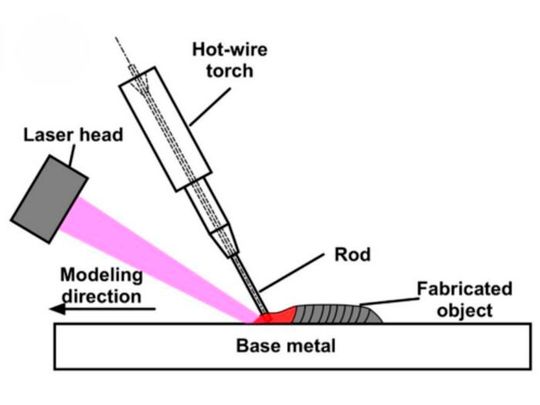
Illustration of the laser‑leading method.
(Source: Keita Marumoto/ Hiroshima University)
Tungsten carbide–cobalt (WC–Co) is valued for its exceptional hardness, but that same strength also makes it notoriously difficult to shape. Conventional production methods are costly and material-intensive relative to the usable output, and researchers at Hiroshima University argue that a more economical route to manufacturing is overdue.
WC–Co cemented carbides are widely used wherever high wear resistance and hardness are critical, including cutting and construction tools. Today, they are typically produced via powder metallurgy: WC and Co powders are consolidated under high pressure and then sintered to form the final material. While this approach delivers highly durable, high-hardness components, it consumes substantial amounts of expensive feedstock and often results in suboptimal yield.
The study explores an alternative pathway based on additive manufacturing using a hot-wire laser irradiation method. The goal is to produce WC–Co cemented carbides without compromising hardness or durability, while reducing both material waste and overall manufacturing cost.
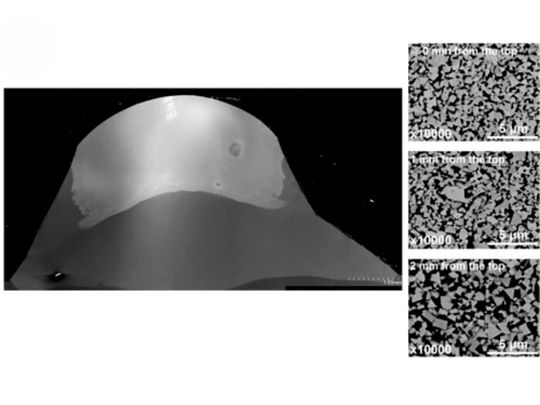
Scanning electron microscope image of a cemented carbide mold at the final stage of formation, produced using a laser-leading method with a Nickel-based alloy inserted in the middle layer.
(Source: Keita Marumoto/ Hiroshima University)
The study focuses on the use of AM, specifically hot-wire laser irradiation, along with two fabrication methods for their experiment. Firstly, hot-wire laser irradiation (also called laser hot-wire welding) is a technique in which a laser beam and a preheated filler wire are combined to increase the deposition rate (how much of the filler metal is added) and efficiency of the process.
One fabrication method used in this study involves direct irradiation on top of the cemented carbide rod, with the rod leading the direction of fabrication. The other method is led by the laser and is irradiated by the laser between the bottom of the cemented carbide rod and the base material (iron). In both methods, the metals are softened instead of completely melted to form the cemented carbide.
“Cemented carbides are extremely hard materials used for cutting tool edges and similar applications, but they are made from very expensive raw materials such as tungsten and cobalt, making reduction of material usage highly desirable. By using additive manufacturing, cemented carbide can be deposited only where it is needed, thereby reducing material consumption,” said corresponding author Keita Marumoto, assistant professor at Hiroshima University’s Graduate School of Advanced Science and Engineering.
Defect-free, industrial-grade carbides achieved
The results showed that the method can preserve the hardness and mechanical integrity of conventionally manufactured WC-Co cemented carbides, producing a base material with a hardness above 1400 HV (a measure of resistance to indentation) without defects or decomposition. At this hardness level, the material ranks among the toughest used in industry, surpassed only by superhard substances such as sapphire and diamond. Overall, defect-free fabrication of cemented carbide molds appears achievable — the central aim of the study — although performance was not fully consistent across all trials.
Some approaches revealed clear limitations. The rod-leading method, for instance, appears to promote WC decomposition in the upper region of the build, which then translates into defects in the final part. The laser-leading method also struggled to retain the hardness required for reliable outcomes. The researchers addressed these issues by introducing a nickel alloy-based intermediate layer and by tightly controlling process temperatures — keeping them above cobalt’s melting point while remaining below the threshold that would trigger grain growth. With these measures, they demonstrated additively manufactured cemented carbide that maintained the targeted hardness.
These findings provide a strong basis for further refinement. Next steps include mitigating cracking and expanding the process window to enable more complex geometries.
“The approach of forming metal materials by softening them rather than fully melting them is novel, and it has the potential to be applied not only to cemented carbides, which were the focus of this study, but also to other materials,” said Marumoto.
Date: 08.12.2025
Naturally, we always handle your personal data responsibly. Any personal data we receive from you is processed in accordance with applicable data protection legislation. For detailed information please see our privacy policy.
Consent to the use of data for promotional purposes
I hereby consent to Vogel Communications Group GmbH & Co. KG, Max-Planck-Str. 7-9, 97082 Würzburg including any affiliated companies according to §§ 15 et seq. AktG (hereafter: Vogel Communications Group) using my e-mail address to send editorial newsletters. A list of all affiliated companies can be found here
Newsletter content may include all products and services of any companies mentioned above, including for example specialist journals and books, events and fairs as well as event-related products and services, print and digital media offers and services such as additional (editorial) newsletters, raffles, lead campaigns, market research both online and offline, specialist webportals and e-learning offers. In case my personal telephone number has also been collected, it may be used for offers of aforementioned products, for services of the companies mentioned above, and market research purposes.
Additionally, my consent also includes the processing of my email address and telephone number for data matching for marketing purposes with select advertising partners such as LinkedIn, Google, and Meta. For this, Vogel Communications Group may transmit said data in hashed form to the advertising partners who then use said data to determine whether I am also a member of the mentioned advertising partner portals. Vogel Communications Group uses this feature for the purposes of re-targeting (up-selling, cross-selling, and customer loyalty), generating so-called look-alike audiences for acquisition of new customers, and as basis for exclusion for on-going advertising campaigns. Further information can be found in section “data matching for marketing purposes”.
In case I access protected data on Internet portals of Vogel Communications Group including any affiliated companies according to §§ 15 et seq. AktG, I need to provide further data in order to register for the access to such content. In return for this free access to editorial content, my data may be used in accordance with this consent for the purposes stated here. This does not apply to data matching for marketing purposes.
Right of revocation
I understand that I can revoke my consent at will. My revocation does not change the lawfulness of data processing that was conducted based on my consent leading up to my revocation. One option to declare my revocation is to use the contact form found at https://contact.vogel.de. In case I no longer wish to receive certain newsletters, I have subscribed to, I can also click on the unsubscribe link included at the end of a newsletter. Further information regarding my right of revocation and the implementation of it as well as the consequences of my revocation can be found in the data protection declaration, section editorial newsletter.
Looking ahead, the team’s priorities include fabricating cutting tools, testing additional material systems, and systematically improving durability.
Original Article: Effect of the hot-wire laser irradiation method and a Ni-based alloy middle layer on mechanical properties and microstructure in additive manufacturing of WC–Co cemented carbide; International Journal of Refractory Metals and Hard Materials; DOI:10.1016/j.ijrmhm.2025.107624



:quality(80)/p7i.vogel.de/wcms/73/8a/738a9f20229e20ae938c5e690b37a5df/0129780274v1.jpeg "With the acquisition of Knudsen Plast, MGS expands its European cleanroom injection moulding capacity and strengthens regional support for pharma, diagnostics and MedTech customers. (Source: MGS)")
:quality(80)/p7i.vogel.de/wcms/d2/63/d26376330f084c718f9ab83fc66eb39f/0129319680v1.jpeg "Situation in mechanical engineering: VDMA Chief Economist Dr. Johannes Gernandt looks back on the past year, with a particular focus on December: “Given the recent developments, we expect a slight increase in 2026. Sentiment is improving, but there is no reason for celebration.” (Source: VDMA / Sarah Kastner Fotografie)")
:quality(80)/p7i.vogel.de/wcms/4f/a9/4fa94db21a092a12fdb0822e3d5c8150/0129504798v1.jpeg "Riccardo Rosa, president of Ucimu, pointed out: “The overall outcome of the order collection regarding 2025 is in line with that of the last two years and thus disappointing once again”. (Source: Ucimu/ Ruggiero Scardigno)")
:quality(80)/p7i.vogel.de/wcms/8d/b7/8db71c3fe25cd48399bfd8faaa5e90f7/0129228188v1.jpeg "The Contract Manufacturing Index shows the value of the market for contract and subcontract manufacturing services for machining, fabrication, and other processes. (Source: Qimtek)")
:quality(80)/p7i.vogel.de/wcms/d5/95/d5954dbd50e0262743b46bdc6d6734f8/0129685950v2.jpeg "Industry players praise the special user benefits as well as the unique spirit of this practical trade fair with its lively atmosphere. (Source: P.E. Schall)")
:quality(80)/p7i.vogel.de/wcms/af/56/af56bd4ae5b0e079ca69c244525b2cd1/0129646105v2.jpeg "This year’s expo cluster not only reflects the strong position of the Metal trade fair but also marks the debut of the Nonferra and the premiere of the Filvent Expo. (Source: Targi Kiecle)")
:quality(80)/p7i.vogel.de/wcms/ba/ea/baea897f2d161c46f0872c77cd26fb6b/0129039787v1.jpeg "The momentum of smart manufacturing is accelerating – TMTS 2026 showcases Taiwan's industrial strength. (Source: TMTS)")
:quality(80)/p7i.vogel.de/wcms/a6/06/a606d5e06236baca21d7f53019dedf42/0129504701v1.jpeg "Vomat filters clean in full flow and separate dirty and clean oil 100 percent. (Source: Vomat)")
:quality(80)/p7i.vogel.de/wcms/63/53/6353c75a9072fc20846b40065c12f724/0129533055v1.jpeg "Industrial connectors operate at critical interfaces in automated production, where reliability under vibration, heat and contaminants directly affects uptime and maintenance effort. (Source: Mencom)")
:quality(80)/p7i.vogel.de/wcms/b7/e0/b7e0832ad0be13fb559a7028f2ef02c7/0129386806v2.jpeg "(Source: Husky)")
:quality(80)/p7i.vogel.de/wcms/5d/3c/5d3cd553a019b4033e441e61f98b23d6/0129229293v1.jpeg "Featured also will be the Roemheld Moduhub equipment range, designed to help operators handle heavy or awkward components safely and efficiently during manual assembly. It also has the facility to feed back production data. (Source: Roemheld)")
:quality(80)/p7i.vogel.de/wcms/82/e7/82e72d20cefdef73713b584312be57d0/0129209599v2.jpeg "Asim Spahović, Hasco (third from left), in discussion with BSI customers Erwin Bekto, Redžo Bekto and Mehmed Šehić (from left to right). (Source: Hasco)")
:quality(80)/p7i.vogel.de/wcms/12/e6/12e60f69147f2d777c8fea551f7211a7/0129831745v1.jpeg "Illustration of the laser‑leading method. (Source: Keita Marumoto/ Hiroshima University)")
:quality(80)/p7i.vogel.de/wcms/4f/28/4f282db53ba4d229cbced88209c8dd20/0129831716v1.jpeg "3D printing can be sustainable - if recyclable ink is used. Photo: Hereon/Steffen Niemann (Source: Hereon/ Steffen Niemann)")
:quality(80)/p7i.vogel.de/wcms/85/70/8570373dd63e66be4f68b2ca4a91e867/0129831343v1.jpeg "Biochar–polymer composites for 3D printing: a review
(Source: Rachel Day)")
:quality(80)/p7i.vogel.de/wcms/9e/fb/9efb9e849306cbd56d7a57a35684ee8f/0129796773v1.jpeg "Closing the loop: the Unimelt system converts Siemens Energy’s spent nickel alloy powder into high performance additive manufacturing powders (Source: 6K Additive)")
:quality(80)/p7i.vogel.de/wcms/76/cb/76cb34489d92452e54fcd6157586be12/0129796759v2.jpeg "In addition to reliable chip-breaking, LFV lowers cutting resistance, prevents stringy swarf from damaging the component, inhibits the formation of built-up edge to prolong tool life, and extends the period between successive chip disposals, as the swarf volume is smaller. (Source: Citizen Machinery )")
:quality(80)/p7i.vogel.de/wcms/21/1b/211b0274a9a8ee51eb7d39767a632837/0129639547v1.jpeg "DMG Mori’s deep hole drilling technology cycle deskills a machining process that previously required an experienced operator. (Source: DMG Mori)")
:quality(80)/p7i.vogel.de/wcms/69/59/6959edab3090fb6cf478998605b90f26/0129542165v1.jpeg "Hurco’s stand was busy throughout the three days at Southern Manufacturing & Electronics 2026. (Source: Hurco)")
:quality(80)/p7i.vogel.de/wcms/c8/43/c843d8084b4db01b20506a3773a8e56d/0129505472v2.jpeg "Viking Precision Engineers has invested in four Yamazaki Mazak Quick Turn 250 lathes. (Source: Keith Mindham/ Mazak)")
:quality(80)/p7i.vogel.de/wcms/6e/48/6e487ebc4e8332824f45a9174a171a4c/0129666289v1.jpeg "“For CNC processes you’re talking millions of points — you can’t teach a robot that; you need CAM,” recalls managing director Lander Debruyne. (Source: Ency)")
:quality(80)/p7i.vogel.de/wcms/96/16/9616c2fc580d720e8b3f91bbffcc5a01/0129504787v1.jpeg "Hummingbird MES offers real time insight into machine performance. (Source: Open Mind)")
:quality(80)/p7i.vogel.de/wcms/9b/5d/9b5db33353f3e5a256e2f634ddc349c7/0129333056v1.jpeg "Browser-based simulation results showing improved cooling times after accepting SimForm's automated channel recommendations. (Source: Machine Works)")
:quality(80)/p7i.vogel.de/wcms/0a/e1/0ae1b7a9cc45bf10ebcbce27be707eda/0129230371v1.jpeg "Vericut Optimizer is a standalone optimisation solution that works directly from NC code. (Source: Vericut)")
:quality(80)/p7i.vogel.de/wcms/f9/ca/f9ca9cace88200a5ec0946f193264963/0129209504v1.jpeg "Neil Taylor, who has worked in the toolroom at Pre-Met for 20 years. (Source: Pre-Met)")
:quality(80)/p7i.vogel.de/wcms/2f/61/2f61dd20be68049fa2320a2e5aa860d7/0123789183v2.jpeg "from left to right: Sodick President Giuseppe Addelia and Vice President Salvatore Cocco (Source: Sodick)")
:quality(80)/p7i.vogel.de/wcms/c5/49/c54973f28495dada1c7605f913717341/0121533734v1.jpeg "The set-up of the complex parts on the new Sodick ALC600G (Source: Sodick)")
:quality(80)/p7i.vogel.de/wcms/94/8f/948f81f46645691d1d90152ef605a0ae/0120806008v2.jpeg "Some of the billets clamped and ready for lights out machining at Bellcliffe. (Source: ETG)")
:quality(80)/p7i.vogel.de/wcms/46/85/46854ab7a2679db67354f556f2bc1db9/0129539660v2.jpeg "Nikon Eclipse MA200 LED is an inverted microscope with reflected illumination that is ideal for inspecting industrial parts. (Source: Nikon)")
:quality(80)/p7i.vogel.de/wcms/3e/61/3e61ccb050c57809ce8f7cde582ef4c2/0129679889v1.jpeg "The Equator-X dual-method gauging system brings unique capability to the shop floor with its dual measurement functionality. (Source: Renishaw)")
:quality(80)/p7i.vogel.de/wcms/88/a2/88a2be18834640f6e34db6bcaa98da06/0129504771v1.jpeg "The new Ready Corex 250 industrial X-ray CT system from LK Metrology is designed for inspection and measurement on the shop floor. (Source: LK Metrology)")
:quality(80)/p7i.vogel.de/wcms/04/3d/043d3f95c300d98d7188d2c2f0673aa5/0129365083v1.jpeg "The extremely high demands placed on manufacturing precision in high-tech industries include the cleanliness of components. These sometimes extremely strict requirements call for appropriately designed cleaning processes and systems as well as a suitable manufacturing environment. (Source: Ecoclean)")
:quality(80)/p7i.vogel.de/wcms/c0/37/c037359c39028ff19aeb84bb7f6d6b9f/0129665312v1.jpeg "The new Kemmler KSG600 conveniently houses inductive heating and air cooling in one highly controllable workstation. (Source: Kemmler)")
:quality(80)/p7i.vogel.de/wcms/8b/54/8b54feb68d4c545e53445acd0f4ad451/0129553957v1.jpeg "Data-based monitoring of cooling lubricants links process chemistry and machine data to stabilise grinding quality, reduce energy consumption and enable more efficient, sustainable production. (Source: free licensed)")
:quality(80)/p7i.vogel.de/wcms/4a/3e/4a3ee5cd13d05629db9d3e88aa22ff01/0129103256v1.jpeg "Full-flow microfiltration to 3 to 5 µm, demand-based backwashing, precise temperature control, and modular system architecture make the cooling lubricant peripherals a real performance factor for the entire production chain. (Source: Vomat)")
:quality(80)/p7i.vogel.de/wcms/6b/b4/6bb456c148f06af9d65155da63665c22/0129102929v1.jpeg "Thanks to a dual spindle, hybrid machines can grind PCD tools (top) and erode them (bottom) in a single set-up, increasing efficiency in terms of both time and quality. (Source: Vollmer Werke Maschinenfabrik)")
:quality(80)/p7i.vogel.de/wcms/66/52/6652eb3a653a0908d5b03fb638f16260/0129646074v2.jpeg "The powerful EVO42 turbine with throwing blades made from hardened tool steel is ideally suited for the harsh conditions in foundries (Source: Rösler Oberflächentechnik)")
:quality(80)/p7i.vogel.de/wcms/57/9c/579c8e2bcff2e800a19fcb0926e574fa/0129056117v1.jpeg "Fortis mill grinding wheels from weiler abrasives are designed for hot and cold rolling mills, combining advanced ceramic grain technology with longer service life to reduce downtime and increase productivity. (Source: Weiler Abrasives)")
:quality(80)/p7i.vogel.de/wcms/4a/5f/4a5fd6bde5784db58812f15386c2126f/0126112832v2.jpeg "Boride Engineered Abrasives offers mould makers worldwide a complete toolkit for achieving top-quality surface finishes. (Source: Boride)")
:quality(80)/p7i.vogel.de/wcms/6b/9c/6b9cab1e262f77caed8179ed3dc29807/0129104421v1.jpeg "GMH Gruppe has consolidated Kind & Co., Schmiedewerke Gröditz and Buderus Edelstahl into a unified Open-Die Forging Group, supported by a 30 million euro investment programme to strengthen Europe-based tool steel and forging supply. (Source: Oliver Pracht/ GMH Gruppe)")
:quality(80)/p7i.vogel.de/wcms/49/58/4958084fe5c4ed0a7758f7cfb3051e92/0128854986v1.jpeg "Intelligent material procurement connects components, materials, and processes into one seamless flow. (Bild: FACTUREE - The Online Manufacturer)")
:quality(80)/p7i.vogel.de/wcms/39/a3/39a32d830d6bb6e4471c79e537c5ca52/chimei-ecologue-frosch-6000x3373v1v1.jpeg "The green frog represents the Ecologue portfolio at CHIMEI. It reflects the company's commitment to innovation, safety, and sustainability – aiming to drive progress in various industries while also contributing to addressing global environmental challenges. (Image:CHIMEI)")
:quality(80)/p7i.vogel.de/wcms/2b/29/2b297a2773f13d3017fc6d49424a57b1/0127570680v1.jpeg "Dr Aphrodite Tomou heads up the technical department of Goodfellow (Source: Goodfellow)")
:quality(80)/p7i.vogel.de/wcms/b2/67/b2674535a8ddc265f0bda19b64f4bf5e/0129815079v2.jpeg "Effective April 1, 2026, Dirk Musser has taken over as Managing Director of Krauss Maffei Technologies. (Source: Krauss Maffei Technologies)")
:quality(80)/p7i.vogel.de/wcms/c8/08/c808e33876bb5b8b90300f4c26e8ef5f/0129796785v1.jpeg "Tactotek and Symbiose have entered a strategic partnership to expand industrial capacity for In-Mold Structural Electronics in automotive mass production. (Source: Tactotek)")
:quality(80)/p7i.vogel.de/wcms/8b/8d/8b8db0a97eb1239cbbb61059ec5ab72f/0129661137v1.jpeg "Ben Mechelmans, Managing Director of Arburg N.V. in Belgium since 1 January 2026. (Source: Arburg)")
:quality(80)/p7i.vogel.de/wcms/0a/5c/0a5c9d0ec1ed36e089efc5720b03652c/0129646071v1.jpeg "Steve Thomson has been Managing Director of Arburg Ltd. in Warwick since 1 December 2025. (Source: Arburg)")